
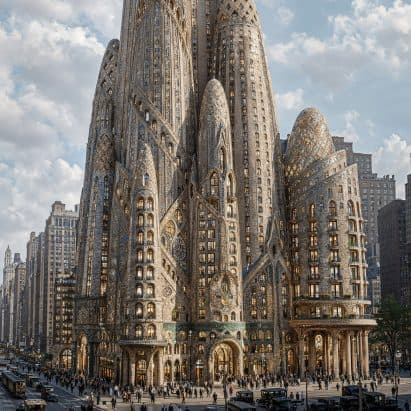
What If Gaudí Had Built in New York? AI Artist Thierry Lechanteur Has the Answer
New York City's skyline is one of the most recognisable in the world, shaped by decades of bold architectural ambition. But what if that skyline had looked radically different — twisted, organic, and alive with the unmistakable spirit of Antoni Gaudí? That question sits at the heart of a stunning new AI visualisation project by Belgian artist Thierry Lechanteur, who has brought Gaudí's long-forgotten Hotel Attraction design back from the pages of history and planted it firmly in the heart of Manhattan.
The project has captivated architecture enthusiasts and design lovers alike, offering a haunting glimpse into an alternative architectural reality — one where the father of Catalan Modernisme left his mark not just on Barcelona, but on the New York City skyline itself.
The Story Behind Gaudí's Hotel Attraction
Antoni Gaudí is best known for masterworks like the Sagrada Família, Park Güell, and Casa Batlló — all located in Barcelona and all bearing his signature approach to organic form, intricate ornamentation, and deeply symbolic design. However, far fewer people know that Gaudí once conceived an extraordinary skyscraper intended for New York City.
In 1908, two American businessmen — who had previously visited Gaudí in Barcelona — commissioned the architect to design a grand hotel for Manhattan. The resulting concept, known as Hotel Attraction, was breathtaking in its ambition. Standing at roughly 360 metres tall, it would have dwarfed most of the buildings of its era and introduced a form of architecture entirely unlike anything New York had ever seen.
The design featured a soaring central tower flanked by smaller auxiliary towers, all clad in Gaudí's characteristic undulating surfaces and biomorphic details. The structure leaned into parabolic arches, natural geometries, and a verticality that was simultaneously spiritual and futuristic. Critics and historians have since described it as a "ghost of an alternative New York" — a vision of the city that never was.
The project never moved beyond preliminary sketches. Financial and logistical barriers prevented its realisation, and New York's skyline was ultimately defined by the steel-and-glass modernism of architects like Ludwig Mies van der Rohe and the streamlined Art Deco grandeur of buildings like the Empire State Building and the Chrysler Building. Gaudí's organic dream remained confined to dusty drawings — until now.
How Thierry Lechanteur Visualised the Unbuilt Masterpiece
Thierry Lechanteur is a Brussels-based AI artist who has built a significant following for his ability to use artificial intelligence tools to reconstruct and reimagine architectural history. His work sits at a compelling intersection of art, architecture, and technology, and the Hotel Attraction project represents one of his most ambitious undertakings to date.
Drawing on Gaudí's original sketches and his deep understanding of the architect's visual language, Lechanteur used advanced AI image generation tools to produce a series of detailed renders showing Hotel Attraction as it might have appeared standing in Manhattan. The results are nothing short of spectacular — a tower that seems to grow organically from the city grid, its form contrasting dramatically with the surrounding steel and glass towers of the modern skyline.
The renders place the hotel within recognisable New York contexts, making the juxtaposition of Gaudí's flowing, nature-inspired forms against the hard geometry of the Manhattan skyline all the more striking. Warm stone-like surfaces, intricate facade detailing, and tapering spires give the building an almost cathedral-like presence, evoking the spiritual grandeur that defines so much of Gaudí's built work in Barcelona.
Lechanteur has spoken about the challenge of remaining faithful to Gaudí's original intent while extrapolating details that the architect himself never fully resolved. The original sketches were relatively sparse, meaning that significant creative interpretation was required — a process that AI tools made both more fluid and more precise than traditional digital rendering techniques would have allowed.
Why Unbuilt Architecture Matters
Projects like Lechanteur's Hotel Attraction visualisation highlight the growing cultural interest in unbuilt and lost architecture — designs that were conceived but never constructed, whether due to financial constraints, political upheaval, or simple changes in circumstance. These ghost buildings represent alternative histories of the built environment, and they carry enormous imaginative and intellectual value.
Architectural historians have long studied unbuilt projects as a way of understanding the full scope of a designer's vision, the cultural climate of a given era, and the forces that shape the cities we actually live in. From Le Corbusier's Plan Voisin for Paris to Frank Lloyd Wright's Mile-High Illinois skyscraper concept, the history of architecture is littered with extraordinary ideas that never made it off the drawing board.
- Unbuilt designs reveal the breadth of an architect's creative thinking beyond their completed works.
- They challenge us to reconsider how cities might have developed under different conditions.
- They serve as important records of design intent and historical context.
- AI visualisation tools are now making these lost visions more accessible and vivid than ever before.
Gaudí's Hotel Attraction is particularly compelling because of the sheer scale of the what-if it represents. New York in the early twentieth century was a city defining the future of architecture for the entire world. Had the Hotel Attraction been built, it would have introduced an entirely different aesthetic vocabulary into that conversation — one rooted in nature, spirituality, and handcrafted detail rather than industrial efficiency and abstract geometry.
AI as a Tool for Architectural Heritage
One of the most thought-provoking dimensions of Lechanteur's project is what it suggests about the future role of artificial intelligence in architectural heritage and historical reconstruction. AI image generation tools have matured rapidly in recent years, developing the ability to synthesise complex visual information and produce outputs that are both technically detailed and aesthetically coherent.
For projects involving historical reconstruction, this capability is transformative. Where traditional digital rendering requires an architect or visualiser to manually model every surface and detail, AI tools can extrapolate from reference imagery and stylistic cues to fill in gaps that historical records leave open. This makes it possible to engage with incomplete or fragmentary designs in ways that were previously impractical.
At the same time, projects like this raise important questions about authenticity and authorship. When an AI artist interprets a historical design, how much of the result belongs to the original architect, how much to the AI, and how much to the human artist directing the process? Lechanteur's work invites these questions without necessarily resolving them, which is part of what makes it such fertile ground for discussion within architecture and design communities.
A New York That Could Have Been
Ultimately, Thierry Lechanteur's AI visualisation of Gaudí's Hotel Attraction is more than a technical exercise — it is an act of architectural imagination and historical empathy. By giving form to a building that existed only in sketches and in the minds of its creators, Lechanteur invites us to see New York differently, and to appreciate just how contingent and provisional the cities we inhabit actually are.
The skyline we know was not inevitable. It is the result of countless decisions, accidents, and missed opportunities. Gaudí's "ghost of an alternative New York" is a reminder that architecture, like history itself, is full of roads not taken — and that those roads are sometimes the most beautiful ones of all.
As AI tools continue to evolve and as interest in architectural history deepens, we can expect to see more projects like this one: imaginative, rigorous, and deeply invested in the question of what our built environment could have been. For now, Lechanteur's renderings stand as one of the most compelling visions of the city that never was — and a fitting tribute to one of architecture's greatest dreamers.