
From Failed Real Estate Venture to Iconic Landmark: The Unlikely Story of Park Güell
Every great city has a landmark that defines it — a place so visually arresting and historically layered that it seems impossible to imagine the city without it. For Barcelona, that place is Park Güell. With its mosaic-covered terraces, serpentine benches, and fantastical gingerbread gatehouses, the park draws millions of visitors each year and stands as one of the most photographed sites in all of Europe. Yet few of those visitors know the surprising truth: Park Güell was never meant to be a park at all. It began as a failed private housing estate, a commercial venture that never found its market — and its failure is precisely what gave the world one of its most beloved public spaces.
Antoni Gaudí and the Vision Behind Park Güell
At the turn of the twentieth century, Antoni Gaudí was already one of Barcelona's most celebrated architects, known for his deeply personal, nature-inspired style that blended Gothic influences with Art Nouveau sensibility. His patron, the wealthy Catalan industrialist Eusebi Güell, shared his ambition and vision. In 1900, Güell commissioned Gaudí to design a high-end residential development on a rugged hillside in the Gràcia district — a large, sloping terrain known as the Muntanya Pelada, or Bare Mountain.
The concept was inspired by the English garden city movement, which Güell had encountered during his travels to Britain. The idea was to build an exclusive community of sixty single-family homes, all set within a landscaped garden environment with communal amenities, winding roads, and spectacular views over Barcelona and the Mediterranean. It would be a private paradise for the city's elite, combining Gaudí's architectural genius with the tranquility of nature.
Why the Housing Development Failed
Gaudí worked on the project from 1900 to 1914, constructing the infrastructure of the estate — its elaborate entrance pavilions, a massive viaduct system, the famous hypostyle hall intended to serve as a market, and the central esplanade with its celebrated undulating bench. However, only two of the planned sixty plots ever sold. One was purchased by a business associate of Güell, and the other was bought by Gaudí himself, who moved into the show home on the site.
The reasons for the project's commercial failure were numerous. The hillside location was considered too remote from the city center by Barcelona's wealthy classes, who preferred the fashionable boulevards of the Eixample district. The steep terrain made access difficult, and the avant-garde architectural language Gaudí employed — while breathtaking — may have felt too unconventional for conservative buyers looking for a safe investment. The project quietly stalled, and when Eusebi Güell died in 1918, his heirs sold the land to the Barcelona city council.
A Public Park Is Born
In 1926, the city of Barcelona officially opened the grounds to the public as a municipal park. What had been an unfulfilled luxury estate became a gift to the people of the city — and, in time, to the world. The transformation was remarkable not because anything fundamental changed about the space, but because the change in ownership and access changed everything about how it could be experienced and valued.
Over the following decades, Park Güell grew steadily in reputation. By the mid-twentieth century, it was recognized as one of the finest examples of Gaudí's mature work. In 1984, it was designated a UNESCO World Heritage Site as part of the broader recognition of Gaudí's architectural works across Barcelona — a group that also includes the Sagrada Família, the Casa Batlló, and the Casa Milà.
What Makes Park Güell Architecturally Significant
Park Güell is remarkable for the way it integrates architecture with landscape, treating the natural environment not as a backdrop but as a collaborator. Gaudí's design philosophy, rooted in close observation of organic forms, is evident throughout the park.
- The Monumental Zone: The central area of the park, now ticketed to manage visitor numbers, contains the most architecturally significant elements — the dragon staircase, the hypostyle hall with its 86 Doric columns, and the main terrace with its iconic serpentine bench covered in colorful trencadís mosaic.
- The Viaducts: Gaudí designed a series of stone viaducts that wind through the hillside, supporting the carriageway above while blending organically into the rocky landscape below. Their leaning, almost geological forms make them appear to have grown from the earth rather than been built upon it.
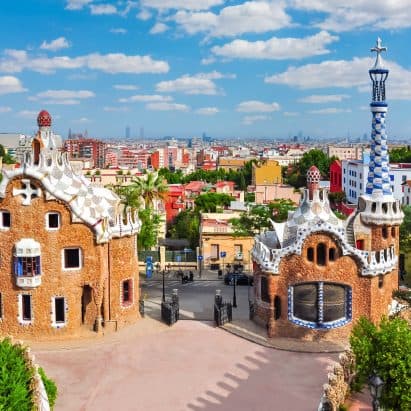
- The Gatehouses: The two entrance pavilions, with their mushroom-like roofs and gingerbread textures, are among Gaudí's most playful creations, suggesting the threshold of a fairy tale rather than a residential suburb.
- The Trencadís Technique: Throughout the park, Gaudí and his collaborator Josep Maria Jujol used broken ceramic tiles to create shimmering mosaic surfaces. This technique — economical, colorful, and endlessly expressive — became one of the defining visual signatures of Gaudí's later career.
Park Güell Today: Managing Success
Today, Park Güell attracts roughly four to five million visitors annually, making it one of the busiest tourist attractions in Spain. That level of popularity has brought real challenges. To protect the site's integrity, Barcelona introduced a ticketing system for the Monumental Zone in 2013, limiting the number of visitors allowed into the most architecturally sensitive areas at any one time. The broader park remains free and open to the public, offering locals and visitors alike a green escape from the city below.
The park also holds deep personal significance in Gaudí's biography. The house he lived in on the grounds — known as the Casa del Guarda or the Gaudí House Museum — has been preserved and is open to visitors, offering a rare glimpse into the architect's private life during the years he was simultaneously working on the Sagrada Família.
The Legacy of a Beautiful Failure
The story of Park Güell is, at its heart, a story about how failure can be redeemed by time and by public ownership. What Eusebi Güell and Antoni Gaudí could not sell as a private luxury community, the city of Barcelona freely gave to the world — and the world has repaid that generosity with admiration. As the centenary of Gaudí's death in 2026 invites a global reexamination of his life and work, Park Güell stands as one of his most complex and resonant achievements: a monument to ambition, imagination, and the happy accidents of history.
Whether you visit for the architecture, the views, the mosaics, or simply the experience of walking through a landscape shaped by one of the twentieth century's most original minds, Park Güell rewards every kind of attention. It is proof that some of the greatest public spaces in the world were never planned to be public at all — and that is precisely what makes them extraordinary.