
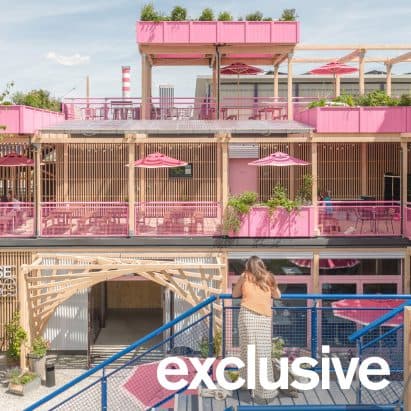
How Hello Wood Turned a Forgotten Railway Site into Zurich's Most Talked-About Cultural Destination
There is something quietly radical about taking a place the city has stopped noticing — a rusted siding, an overgrown depot yard, the ghost of an industrial past — and breathing vivid new life into it. That is precisely what architecture studio Hello Wood has done with Remise Rosa, a colourful dining and events complex now standing on an abandoned railway site in Zurich, Switzerland. Built almost entirely from cross-laminated timber (CLT), the project is being celebrated not only as a bold act of adaptive reuse but as a template for what urban cultural infrastructure can look and feel like when architects are willing to think beyond the conventional.
What Is Remise Rosa?
Remise Rosa is a mixed-use indoor-outdoor complex designed to serve as a community gathering point, a venue for cultural events, and a destination for dining and social life. Its name is a nod to the site's railway heritage — a "remise" is the French and German word for a depot or engine shed — while the rosy hue of its timber-clad exterior signals its transformation into something warm, welcoming, and distinctly contemporary.
Hello Wood, the Budapest-based studio known for its experimental use of wood and its commitment to craftsmanship and community engagement, conceived the project as a place where the boundary between inside and outside dissolves. Rather than imposing a sealed, climate-controlled box onto the historic site, the studio designed a fluid sequence of covered and open spaces that respond to Zurich's seasonal rhythms and invite spontaneous use throughout the year.
The Architecture: CLT as a Design Philosophy
At the heart of the project is an ambitious structural choice: cross-laminated timber. CLT panels form the primary structural system, the wall surfaces, and much of the interior fit-out, giving Remise Rosa a material honesty that is rare in contemporary hospitality design. Rather than concealing the engineered wood behind cladding or plasterboard, Hello Wood left it largely exposed, allowing the warmth and grain of the material to define the atmosphere of every room and corridor.
This approach is more than aesthetic. CLT is a low-carbon building material that stores the carbon absorbed by the trees during their growth, making it a compelling choice for a project that wants to take its environmental responsibilities seriously. In an era when the construction industry accounts for a significant share of global carbon emissions, choosing structural timber over concrete or steel is a meaningful act — and in a city like Zurich, where sustainability is deeply embedded in civic culture, it resonates strongly with the intended audience.
The structural system also allowed Hello Wood to work quickly and with relatively minimal site disruption, an important consideration when building on a historically sensitive railway corridor. The precision manufacturing of CLT components off-site meant that assembly on location was efficient and comparatively quiet — a respectful approach to a neighbourhood that was already watching the site's transformation with curiosity.
Indoor-Outdoor Living at the Core
Perhaps the most distinctive quality of Remise Rosa is its deliberate blurring of inside and outside. Hello Wood designed the complex around a series of transitional spaces — covered terraces, sheltered courtyards, retractable walls, and generous overhanging rooflines — that allow visitors to experience the open air even when the weather is less than cooperative. In the warmer months, the entire venue effectively opens up to become a semi-outdoor space, with dining areas spilling into landscaped zones and event stages visible from the surrounding public realm.
This indoor-outdoor design philosophy reflects a broader movement in contemporary architecture toward spaces that promote wellbeing by maintaining a connection to daylight, fresh air, and nature. Research consistently shows that access to natural light and ventilation improves mood, cognitive performance, and social engagement — all qualities that are particularly valuable in a cultural venue that wants visitors to linger, explore, and connect.
Adaptive Reuse and the Value of Industrial Heritage
Remise Rosa is also a powerful case study in adaptive reuse, the practice of repurposing existing structures and sites rather than demolishing and starting from scratch. The abandoned railway site brought with it a set of constraints — irregular plot boundaries, existing infrastructure, protected landscape elements — but Hello Wood treated these not as obstacles but as design opportunities. The layout of the new complex was shaped by the traces of the old rail lines, and certain industrial elements were retained and integrated into the new scheme as deliberate memory markers.
This sensitivity to place and history is increasingly recognised as a hallmark of responsible urbanism. Cities across Europe are grappling with the challenge of what to do with the vast industrial landscapes left behind by the retreat of heavy industry — former factory sites, disused docks, abandoned depots. Projects like Remise Rosa demonstrate that these places need not be erased; they can instead become the raw material for a new generation of cultural infrastructure that is richer and more layered for carrying the weight of its past.
Zurich's Evolving Cultural Landscape
Zurich has long been a city that takes culture seriously, from its world-class museums and music institutions to its vibrant independent arts scene. In recent years, however, the city has increasingly turned its attention to the kinds of informal, flexible, community-oriented spaces that Remise Rosa represents. The success of projects in Zurich West — the city's post-industrial creative district — demonstrated an appetite for venues that combine food, events, art, and public life in ways that resist easy categorisation.
Remise Rosa steps confidently into this tradition while adding something new: a material warmth and ecological ambition that sets it apart from the raw concrete aesthetic that has defined much post-industrial adaptive reuse. Its colourful CLT surfaces, its generous landscaping, and its invitation to gather and linger in the open air give it a character that feels genuinely distinctive within Zurich's cultural geography.
Hello Wood's Vision for Community-Centred Design
Founded in Hungary, Hello Wood has built an international reputation through projects that combine architectural rigour with a deep commitment to craft and community participation. The studio is perhaps best known for its annual summer school and festival, where architects, designers, and students collaborate to build experimental timber structures in a forest setting. That spirit of collaboration and hands-on making is evident in Remise Rosa, which feels less like a corporate hospitality venue and more like a place made by people who genuinely love wood and believe in the power of good design to bring communities together.
The studio's decision to work with CLT on this scale represents a maturation of their longstanding exploration of timber construction. Where earlier Hello Wood projects often worked with simpler, more rustic forms of woodwork, Remise Rosa demonstrates mastery of engineered timber at an urban scale — proof that a studio rooted in craft can also deliver sophisticated, city-level architectural thinking.
Why Remise Rosa Matters Beyond Zurich
At a moment when cities worldwide are rethinking how they use land, how they build, and what kinds of spaces their communities actually need, Remise Rosa offers a compelling set of answers. It shows that abandoned infrastructure sites can become vibrant public assets without requiring either demolition or the kind of glass-and-steel redevelopment that erases a place's memory entirely. It demonstrates that sustainable materials like CLT can produce spaces of real warmth and beauty, not just ecological virtue. And it proves that the line between indoors and outdoors, between cultural venue and public space, between dining destination and community gathering point, is one that the best architects are increasingly willing to erase.
For anyone interested in the future of urban design, adaptive reuse, sustainable construction, or simply the question of what makes a city feel alive, Remise Rosa by Hello Wood is a project worth watching — and, if you find yourself in Zurich, well worth visiting.