
Home Sales Are Bouncing Back — But Only Where Supply Has Recovered
After years of frustration, gridlock, and near-impossible competition, a meaningful shift is quietly reshaping the American housing market in 2025. Home sales are rebounding — not everywhere, but in the places where something fundamental has changed: inventory is finally back. According to new data from Zillow, the spring housing market is warming up fastest in cities where buyers actually have options to choose from, and the trend is offering a compelling explanation for why the broader national market has been so slow to fully recover.
The relationship between supply and sales activity turns out to be straightforward. When buyers have more homes to choose from, they buy more homes. That may sound obvious, but for years the American housing market operated under such severe supply constraints that even motivated, financially qualified buyers simply couldn't find a home to purchase. Now, in a growing number of markets — concentrated in the South and West — those constraints are easing. And where they ease, sales follow.
Austin Leads the Nation in Both Inventory and Sales Growth
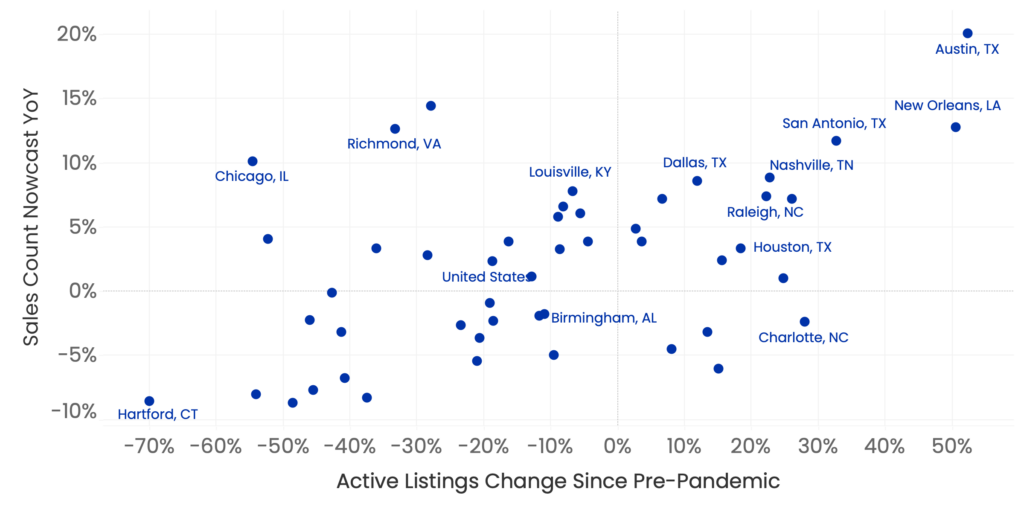
No city illustrates this dynamic more clearly than Austin, Texas. According to Zillow's latest data, Austin leads all major U.S. metros in year-over-year sales growth, up an impressive 20% compared to last year. It also leads the nation in inventory recovery, with available homes sitting 52% above pre-pandemic averages — the highest surplus of any major market in the country.
The connection is not a coincidence. Austin experienced a massive construction boom during the pandemic years, as remote work, population migration, and speculative investment all converged on the Texas capital. That surge in building activity initially created a period of market adjustment, with prices correcting and activity slowing. But now, the same supply glut that once looked like a liability is functioning as a catalyst. With incomes more in line with local prices and a wide range of listings available, Austin buyers are re-entering the market with confidence.
Among the top 10 U.S. markets for year-over-year sales growth, six have more inventory today than they did before the pandemic. That statistic alone underscores just how tightly linked housing supply and transaction volume have become in the current environment.
The Sun Belt Construction Boom Is Paying Off
Austin is not an isolated case. Across the Sun Belt — the broad arc of warmer-weather states stretching from Florida through Texas and into the Southwest — homebuilders ramped up construction aggressively during and after the pandemic years. Cities like Phoenix, Tampa, Nashville, San Antonio, and Raleigh all saw significant additions to their housing stock as developers responded to surging demand and population growth.
In total, inventory has fully recovered to pre-pandemic levels in 19 major metros across the country, the vast majority of which are located in the South and West. These are precisely the markets now showing the strongest sales growth — a clear and consistent pattern that validates the straightforward logic: more supply enables more transactions.
This is particularly meaningful given the broader national context. Nationwide, home sales are only up 2.3% compared to April of last year — a modest gain that reflects the uneven nature of the recovery. The national headline number is dragged down by markets where inventory remains severely constrained, particularly across much of the Northeast and Midwest, where new construction has been limited and existing homeowners continue to hold onto properties financed at ultra-low pandemic-era mortgage rates.
Homes Are Selling at Pre-Pandemic Speeds
One of the most telling data points in Zillow's spring market report is the average time a home spends on the market before going under contract. As of the latest figures, homes are typically selling after just 17 days — roughly in line with pre-pandemic norms. This suggests that while the total volume of sales may still lag historical averages, the quality and pace of individual transactions has normalized considerably.
In practical terms, this means that in well-supplied markets, buyers are not waiting months for new listings and sellers are not sitting on stagnant inventory. Homes priced correctly and presented well are moving efficiently. The market is functioning again — a phrase that may sound mundane but represents a significant departure from the chaotic, offer-war-driven conditions of 2021 and 2022.
Affordability Is Improving, But Broader Cost Pressures Remain
Another tailwind supporting the housing recovery in these high-inventory markets is a modest improvement in affordability at the national level. According to the data, a typical monthly mortgage payment is 3.4% lower in April 2025 than it was in April of last year. That reduction, while not dramatic, is enough to meaningfully shift the calculus for buyers who have been sitting on the sidelines waiting for conditions to improve.
Lower mortgage costs, combined with more available listings and recovering wage growth in many Sun Belt metros, are creating the conditions for a genuine market thaw in select cities. Incomes have gradually caught up with local price levels in many of these markets, making the math of homeownership more feasible than it was at the peak of the post-pandemic frenzy.
That said, the broader economic backdrop introduces real uncertainty. The rising costs of everyday goods and services continue to squeeze household budgets, and many prospective buyers remain cautious about taking on large financial commitments in a volatile environment. Affordability at the mortgage level has improved slightly, but total household financial pressure has not disappeared.
What This Means for Buyers in 2025
For anyone considering a home purchase this year, the strategic takeaway from this data is significant. If you have flexibility on geography — particularly if you're open to Sun Belt metros like Austin, San Antonio, Phoenix, or Tampa — you are entering a market with far more favorable conditions than most other regions of the country. Inventory is up, competition has cooled from its peak, and affordability metrics are moving in the right direction.
In these markets, buyers have something they lacked for years: negotiating power. The ability to compare multiple listings, request concessions, and take a measured approach to one of life's largest financial decisions has returned. That's not a small thing.
The Broader Lesson: Supply Is the Foundation of a Healthy Housing Market
The spring 2025 housing data offers a clear and important lesson for policymakers, developers, and market observers alike. Housing market health is not primarily about interest rates, buyer sentiment, or economic conditions in isolation. It is, at its core, about supply. Markets that built more homes are now transacting more effectively, providing more options to buyers, and generating more economic activity around real estate. Markets that did not build enough are still struggling with the same structural imbalances that have defined the housing shortage for over a decade.
As the data from Zillow confirms, when you stock the shelves, shoppers come. The housing market rebound of 2025 is, in many ways, a story about what becomes possible when supply finally catches up to demand — and a reminder of what the rest of the country is still missing.