
The $1 Million Home: America's Housing Future by 2050
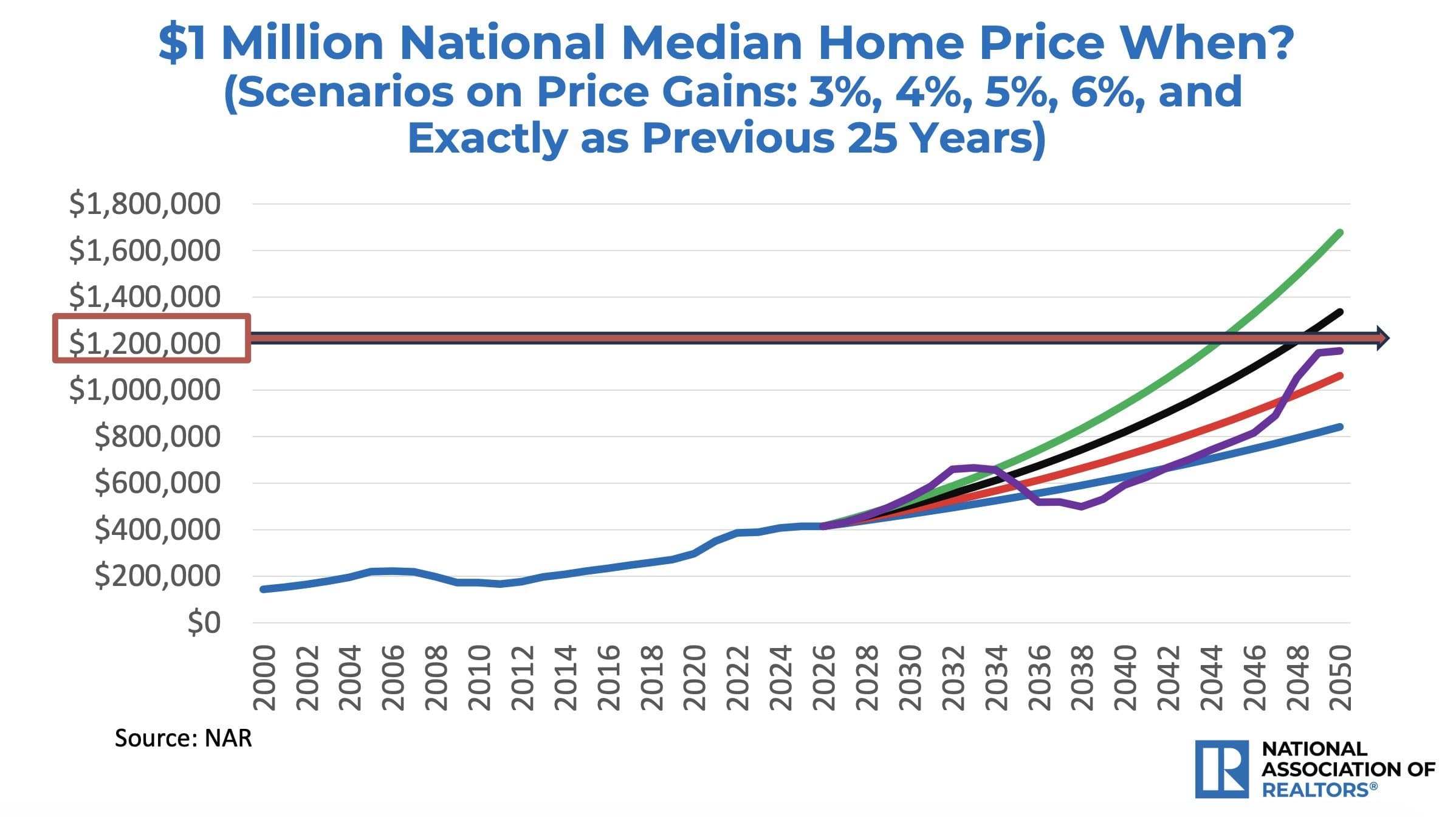
If owning a home feels out of reach today, brace yourself for what economists are forecasting for the next quarter century. According to Lawrence Yun, chief economist at the National Association of Realtors® (NAR), the median U.S. home price is on track to hit $1 million by around the year 2050 — right as the millennial generation approaches traditional retirement age. It's a headline-grabbing prediction, but when you look at the historical trajectory of home prices in America, it's one that's difficult to argue with.
What Lawrence Yun Said — and Why It Matters
Speaking at NAR's annual Legislative Meetings conference in Washington, DC, Yun laid out a stark but data-grounded vision of America's housing market future. "Essentially, in about 25 years the national median home price will be a million dollars," he told attendees. "It may be hard to envision that, but back in 1990, the national median price was $90,000."
To put that in further perspective, Yun pointed out that even San Francisco — long considered one of the most expensive real estate markets in the country — had a median home price of just $250,000 in 1990. Today, that figure seems almost quaint. The same kind of shift, Yun argues, is now playing out on a national scale.
As of last month, the national median sales price for existing homes stood at nearly $430,000. Yun ran multiple economic scenarios to project where prices are headed, and remarkably, each one converged on roughly the same conclusion: the $1 million median is approximately 25 years away.
A Look Back to See Where We're Headed
Understanding how we got here is essential to grasping where the housing market is going. In 1990, a median-priced American home cost $90,000. Over the following three decades, prices climbed steadily, accelerated by low interest rates, population growth, zoning restrictions, and limited housing supply. The COVID-19 pandemic then poured fuel on an already hot market, triggering an unprecedented surge in home values across the country.
From $90,000 in 1990 to roughly $430,000 today, median home prices have increased nearly fivefold in about 35 years. Yun's projection to $1 million by 2050 represents a more than doubling from current levels over 25 years — a rate of appreciation that, while significant, is actually more moderate than what the market has delivered in recent decades.
What This Means for Millennials
Millennials — broadly defined as those born between 1981 and 1996 — are already navigating one of the most challenging housing markets in modern American history. Many entered their prime home-buying years during or after the 2008 financial crisis, only to face skyrocketing prices, record-low inventory, and surging mortgage rates in the years that followed.
By 2050, the oldest millennials will be in their late 60s and approaching or entering retirement. If Yun's forecast holds, those who managed to purchase a home will have accumulated enormous wealth through home equity. Those who did not — or could not — may find themselves in a far more precarious financial position.
This generational dynamic was front and center in Yun's message to NAR members. "Homeowners will continue to build wealth, while renters are simply spinning their wheels," he said plainly. It's a sobering statement, but one rooted in decades of economic evidence showing that homeownership remains one of the most reliable vehicles for long-term wealth creation in the United States.
The Widening Gap Between Owners and Renters
As home prices continue their long-term climb, the financial divide between homeowners and renters is expected to grow even wider. Homeowners benefit from appreciating asset values, building equity with each mortgage payment, and gaining access to financial tools like home equity loans. Renters, by contrast, see their monthly payments go entirely to their landlord, with no ownership stake and no equity accumulation.
If the median home reaches $1 million by 2050, those who purchased a home in 2025 at today's median price of approximately $430,000 could see their asset more than double in value. That's the kind of generational wealth transfer that shapes family financial trajectories for decades.
Is $1 Million the New Normal? What Buyers Should Do Now
For prospective homebuyers sitting on the fence, Yun's forecast carries an implicit message: waiting may cost you. While no one can predict the market with certainty, the long-term trend in U.S. home prices has historically been upward. Here are several considerations for those looking to act strategically in today's market:
- Buy what you can afford today. Even a modest starter home purchased now can become a significant financial asset over 20 to 30 years if historical appreciation trends continue.
- Think long-term over short-term. Short-term market dips and interest rate fluctuations matter less to buyers who plan to stay in a home for a decade or more.
- Explore all available programs. First-time homebuyer assistance programs, down payment grants, and FHA loans can help make homeownership more accessible even in today's pricier market.
- Build credit and savings now. Stronger financial profiles lead to better mortgage rates, which can save tens of thousands of dollars over the life of a loan.
Supply Constraints and the Road to $1 Million
One of the primary drivers behind long-term home price appreciation is a persistent and structural shortage of housing supply in the United States. Decades of restrictive zoning laws, slow permitting processes, rising construction costs, and a shortage of skilled construction labor have made it extraordinarily difficult to build enough homes to meet growing demand. Until these structural issues are addressed at the local, state, and federal level, upward pressure on home prices is likely to remain a defining feature of the American housing landscape.
Demographic trends add further fuel to the fire. Despite economic headwinds, millennials continue to represent the largest segment of homebuyers in the U.S. As Gen Z ages into its prime homebuying years, demand for housing is unlikely to ease anytime soon.
The Bottom Line
Lawrence Yun's prediction of a $1 million national median home price by 2050 is not a fringe forecast — it is a well-reasoned projection grounded in historical price trends and current market dynamics. For millennials and younger generations, the message is clear: homeownership is not just a lifestyle choice, it is an increasingly critical component of long-term financial security. The gap between those who own and those who rent is only expected to grow, making the decision to enter the housing market — whenever and however possible — one of the most consequential financial moves a person can make in the decades ahead.