
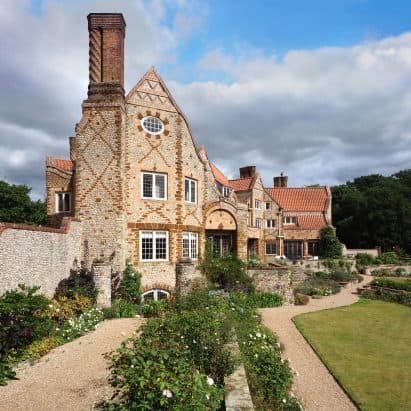
The Arts and Crafts Movement: A Return to Honest Craftsmanship
In an age dominated by machine-made uniformity and industrial mass production, the Arts and Crafts movement emerged in the late nineteenth century as a powerful act of resistance. Rooted in the reformist ideals of John Ruskin and the passionate advocacy of William Morris, the movement sought to restore dignity to the skilled artisan, celebrate the beauty of natural materials, and reconnect architecture with the human hand. Nowhere is this philosophy more powerfully expressed than in the houses the movement produced — structures that feel as though they were grown from the earth rather than simply built upon it.
A new book by architectural historian David Cole shines a fresh spotlight on this enduring legacy, gathering ten of the most iconic Arts and Crafts houses and framing them through the compelling lens of what he calls "the humanisation of the handmade." Together, these buildings form a portrait of an architectural revolution that continues to inspire designers, architects, and homeowners more than a century later.
What Made Arts and Crafts Architecture So Revolutionary?
To understand why these houses matter, it helps to understand what they were reacting against. The Industrial Revolution had transformed the built environment with alarming speed, replacing local craft traditions with factory-produced components and stripping buildings of regional character. Arts and Crafts architects pushed back decisively, insisting that beauty, utility, and craftsmanship were inseparable values.
Their houses were designed as total works of art. Furniture, textiles, metalwork, tilework, and garden layouts were conceived as part of a unified whole rather than afterthoughts. Local stone, brick, timber, and tile were preferred over imported or industrial materials. The visible joint, the hand-carved detail, and the slightly irregular surface were not flaws to be hidden but features to be celebrated. As Cole argues, this approach represented nothing less than the humanisation of the built environment — architecture that bore the marks of individual makers and spoke to the people who would live within it.
Ten Houses That Define the Movement
1. Red House, Bexleyheath (1859)
Designed by Philip Webb for William Morris himself, Red House is widely regarded as the birthplace of the Arts and Crafts movement in architecture. Its warm red brick, steeply pitched roofs, and irregular, asymmetrical plan broke sharply from the classical conventions of its day. Every detail — from the painted tiles to the hand-embroidered wall hangings — was made by Morris and his circle of artist friends, making it a true manifesto in built form.
2. Standen, West Sussex (1894)
Designed by George Jack and supervised by Philip Webb, Standen is now cared for by the National Trust and remains one of the best-preserved examples of Arts and Crafts domestic architecture in England. Its interiors are filled with Morris and Co. textiles and wallpapers, demonstrating how the movement envisioned the house as a complete decorative environment.
3. Blackwell, Cumbria (1900)
Built by M. H. Baillie Scott as a holiday retreat overlooking Lake Windermere, Blackwell is celebrated for its extraordinary interior spaces. The main hall, with its carved friezes of berries and foliage, and the white drawing room, with its Art Nouveau-influenced plasterwork, rank among the finest interiors of the entire movement.
4. Wightwick Manor, Wolverhampton (1887)
An outstanding example of the movement's influence on the wealthy middle classes, Wightwick Manor combines half-timbered vernacular architecture with interiors stuffed with pre-Raphaelite art and Morris textiles. It is a vivid demonstration of how Arts and Crafts ideals penetrated commercial patronage as well as artistic circles.
5. The Gamble House, Pasadena (1908)
Across the Atlantic, the American Arts and Crafts movement produced its own masterpieces. Designed by brothers Charles and Henry Greene, The Gamble House in California is a testament to the movement's global reach. Its sweeping timber eaves, sleeping porches, and intricate joinery translate the philosophy of honest craftsmanship into the Californian climate with breathtaking results.
6. Melsetter House, Orkney (1898)
Designed by W. R. Lethaby, Melsetter House on the remote island of Hoy in Orkney stands as one of the movement's most atmospheric achievements. Lethaby transformed an existing farmhouse using local stone and vernacular details, producing a building that feels as though it has always belonged to the landscape around it.
7. Deanery Garden, Berkshire (1901)
Edwin Lutyens and Gertrude Jekyll collaborated on many of the most celebrated Arts and Crafts properties, and Deanery Garden is among their finest joint achievements. Lutyens's architecture and Jekyll's garden design are so seamlessly integrated here that the boundary between built and natural environments virtually disappears.
8. Hill House, Helensburgh (1902)
Charles Rennie Mackintosh brought a distinctly Scottish sensibility and a more geometric, proto-modernist edge to the Arts and Crafts tradition. Hill House, designed for publisher Walter Blackie, remains his greatest domestic work — a building of quiet drama and exceptional spatial intelligence.
9. Tigbourne Court, Surrey (1901)
Another Lutyens masterpiece, Tigbourne Court demonstrates the architect's mastery of local Surrey stone and his ability to produce buildings that appear to have evolved naturally from their surroundings. Its warm, irregular stonework and deep window reveals embody the movement's reverence for regional building traditions.
10. Sunningdale Park, Berkshire (c. 1900)
A lesser-known gem, Sunningdale Park illustrates how widely Arts and Crafts principles spread beyond the movement's inner circle. Its careful brickwork, generous proportions, and attention to craft detail reflect how thoroughly the movement had transformed expectations of what a well-designed house should look and feel like.
Why Arts and Crafts Houses Still Matter Today
The relevance of these buildings extends far beyond architectural history. In an era of prefabricated construction, algorithmically optimised floor plans, and anonymous global aesthetics, the Arts and Crafts houses collected in David Cole's book feel more urgent than ever. They remind us that architecture can be deeply personal, rooted in place, and made with genuine care for the people who will inhabit it.
The movement's emphasis on natural materials, skilled craftsmanship, and the integration of interior and exterior space anticipates many of the values that drive contemporary sustainable architecture and biophilic design. Its insistence that beauty is not a luxury but a human necessity remains a provocation worth taking seriously.
Whether you are an architecture enthusiast, a design historian, or simply someone who loves beautiful homes, these ten iconic Arts and Crafts houses offer an endlessly rewarding study in what buildings can be when they are made with humility, skill, and genuine love for the craft.