
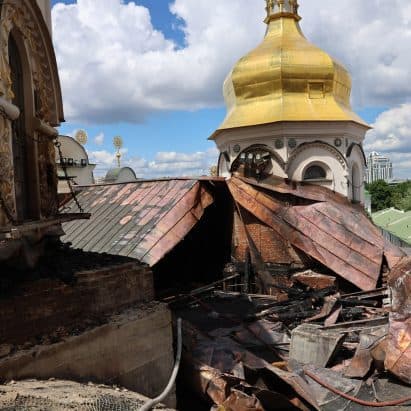
Kyiv's Iconic Dormition Cathedral Damaged in Russian Strike
In one of the most devastating cultural losses since Russia's full-scale invasion of Ukraine began, Kyiv's UNESCO-listed Dormition Cathedral has been set alight following a Russian military attack on the Ukrainian capital. The fire, which broke out as a direct result of the assault, has drawn widespread international condemnation and reignited urgent calls to protect Ukraine's irreplaceable architectural and spiritual heritage from the ongoing conflict.
The Dormition Cathedral, also known as the Uspensky Sobor, is among the most significant religious monuments in the post-Soviet world and sits at the heart of the Kyiv-Pechersk Lavra — the famous Monastery of the Caves complex that has stood for nearly a millennium. Its destruction or severe damage would represent not just a loss for Ukraine, but for all of humanity.
What Is the Dormition Cathedral and Why Does It Matter?
The Dormition Cathedral has roots stretching back to the eleventh century, when it was first constructed under the orders of Yaroslav the Wise as a centerpiece of the Kyiv-Pechersk Lavra monastic complex. Over the centuries, the cathedral has been rebuilt, expanded, and restored multiple times, each iteration absorbing the artistic and architectural sensibilities of its era. The version that stood before this latest attack was a magnificent example of Ukrainian Baroque architecture, characterized by its gleaming white facades, ornate gilt domes, and elaborate interior frescoes.
The Kyiv-Pechersk Lavra, of which the cathedral forms the spiritual and visual core, was inscribed on the UNESCO World Heritage List in 1990, recognizing the site's outstanding universal value as a place of profound religious, historical, and architectural significance. For Eastern Orthodox Christians, the complex is among the holiest pilgrimage destinations in the world, revered for centuries as a seat of monastic learning, spiritual life, and Christian culture in the region.
Beyond its religious importance, the cathedral and its surrounding monastery represent an irreplaceable archive of Eastern European art, architecture, and history. The site contains ancient cave systems with the remains of saints, museum collections of priceless artifacts, and architectural features that have influenced ecclesiastical design across Russia, Ukraine, and beyond.
The Attack: What We Know So Far
The fire at the Dormition Cathedral was the direct result of a Russian military strike on Kyiv. While full details of the attack are still emerging, reports confirm that the blaze took hold following the assault, with images and footage circulating on social media showing smoke rising from the historic complex. Ukrainian emergency services responded rapidly, working to contain the fire and prevent further structural collapse.
The attack is part of an escalating pattern of Russian strikes on Ukrainian cities that have increasingly targeted civilian infrastructure, cultural institutions, and heritage sites. Since the full-scale invasion began in February 2022, numerous UNESCO-recognized locations, museums, theaters, and churches across Ukraine have been damaged or destroyed, prompting UNESCO and international heritage organizations to issue repeated warnings about what they describe as a systematic assault on Ukrainian cultural identity.
International Condemnation and the Battle to Protect Cultural Heritage
News of the cathedral fire sparked immediate international outrage. Cultural institutions, governments, and heritage organizations around the world condemned the attack, with many pointing to the destruction as a potential war crime under international humanitarian law, which explicitly prohibits attacks on cultural property of great importance to humanity.
UNESCO's 1954 Hague Convention for the Protection of Cultural Property in the Event of Armed Conflict — a landmark international treaty — specifically designates sites of major cultural significance as protected zones that must not be targeted in warfare. Ukraine has previously submitted documentation to international bodies cataloguing hundreds of damaged or destroyed heritage sites since the start of the war, building a legal and historical record of what Ukrainian officials and many international observers characterize as deliberate cultural erasure.
- The Kyiv-Pechersk Lavra has been a UNESCO World Heritage Site since 1990, recognized for its outstanding universal cultural and religious value.
- The Dormition Cathedral has been rebuilt multiple times throughout history, including after its destruction during World War II, when Nazi forces were blamed for the original explosion that leveled the structure in 1941.
- Ukraine has documented hundreds of cultural heritage sites damaged or destroyed since Russia's full-scale invasion began in February 2022.
- Attacks on protected cultural sites may constitute war crimes under international humanitarian law, including the 1954 Hague Convention.
A History of Destruction and Resilience
This is not the first time the Dormition Cathedral has been caught in the crossfire of war. In September 1941, the cathedral was destroyed in a massive explosion during the Nazi German occupation of Kyiv. Soviet authorities initially blamed German forces for the deliberate destruction, though historical debate has persisted over the exact cause. The cathedral was painstakingly reconstructed after Ukrainian independence and was reconsecrated in 2000, standing once again as a symbol of Ukrainian resilience and spiritual continuity.
That the cathedral now faces destruction again, barely two decades after its careful restoration, carries a particular historical weight. For many Ukrainians, the sight of their most sacred national monument in flames represents something far beyond physical damage — it is an attack on cultural memory, religious identity, and the very idea of Ukraine as a distinct civilization with deep historical roots.
The Broader Impact on Ukraine's Architectural Heritage
The damage to the Dormition Cathedral must be understood within the broader context of what heritage experts are calling an unprecedented assault on built cultural heritage in the twenty-first century. Ukraine is home to an extraordinary concentration of historical architecture, from medieval fortresses and Byzantine churches to Art Nouveau streetscapes and Soviet-era monuments. The war has placed all of it at risk.
International bodies including UNESCO, ICOMOS, and the Blue Shield network have mobilized resources to document, photograph, and digitally archive Ukrainian heritage sites as quickly as possible, creating records that could one day guide reconstruction efforts. However, experts acknowledge that no digital archive can fully replace the physical reality of a thousand-year-old building, its stones, its frescoes, its accumulated layers of history.
What Happens Next: Restoration, Documentation, and Accountability
As emergency responders work to assess and contain the damage, attention is already turning to questions of documentation and eventual restoration. Ukrainian authorities have consistently vowed to rebuild what has been destroyed, pointing to the post-WWII reconstruction of the cathedral itself as proof that such efforts are possible. International partners have pledged financial and technical support for heritage restoration once hostilities end.
Meanwhile, human rights and legal organizations are continuing to build cases for accountability at international tribunals. The targeting of UNESCO-listed sites provides some of the clearest potential evidence of deliberate cultural destruction, and legal scholars believe that prosecutions related to attacks on cultural heritage could form a significant part of any eventual international reckoning with the conduct of the war.
For now, the world watches with grief as smoke rises over one of Eastern Christianity's holiest sites. The fire at the Dormition Cathedral is more than a news story about architecture — it is a reminder that culture, history, and identity are among the first casualties of war, and that protecting them is inseparable from the broader struggle for justice and human dignity.