
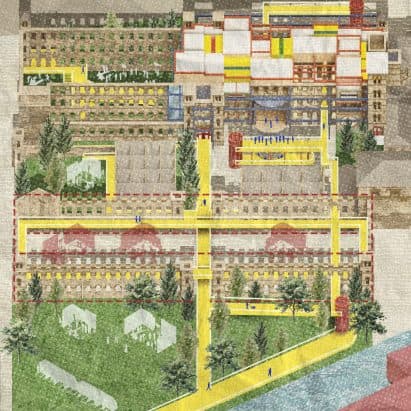
University of Sheffield Students Envision a Zero-Waste Future Inside a Historic Mill
Architecture and design students at the University of Sheffield have unveiled a series of ambitious, forward-thinking proposals aimed at reshaping how we think about industrial spaces, sustainability, and the built environment. Among the most striking of these concepts is a plan for a fully zero-waste factory housed within a former textile mill — a building that has endured years of neglect and repeated cycles of decline. The proposal is part of the university's School Shows, a celebrated platform that brings emerging design talent to wider public attention, and it signals a growing urgency among the next generation of designers to tackle the climate crisis head-on through architecture.
Reimagining Industrial Heritage Through Sustainable Design
The textile mills of northern England are among the most evocative relics of the Industrial Revolution. Once the beating heart of a global manufacturing economy, many of these structures now sit empty, deteriorating quietly in post-industrial towns and cities across Yorkshire and beyond. Rather than demolishing these buildings or leaving them to ruin, the University of Sheffield proposal argues for something far more compelling: adaptive reuse as a vehicle for environmental transformation.
By retrofitting an existing mill rather than constructing an entirely new building, the student team immediately sidesteps a significant portion of the carbon emissions typically associated with new construction. Embodied carbon — the CO₂ released during the manufacturing and transportation of building materials — is one of the construction industry's most overlooked contributors to climate change. Reusing an existing structure is one of the most effective tools designers have at their disposal to address it.
The retrofit concept aligns with a broader movement in contemporary architecture that prioritises stewardship of existing buildings over demolition and rebuild. From the perspective of both cultural preservation and carbon reduction, it is a strategy with few downsides — and the Sheffield proposal demonstrates just how far the idea can be pushed when paired with serious environmental ambition.
What Does a Zero-Waste Factory Actually Look Like?
The term "zero-waste factory" might sound like an aspirational slogan, but the University of Sheffield students have worked to ground it in tangible design decisions. The proposal draws on principles of the circular economy, a model in which materials are kept in use for as long as possible, waste is designed out of systems from the start, and natural cycles are regenerated rather than depleted.
In practical terms, this means rethinking every stage of a product's lifecycle within the factory environment. Materials that would otherwise become waste are captured and redirected — either back into the production process, into on-site energy generation, or into other productive uses. The building itself is conceived as an active participant in this cycle, with its fabric, systems, and spatial organisation all calibrated to minimise what leaves the site as landfill or pollution.
The historic mill structure provides an unexpectedly strong foundation for this vision. Its robust masonry walls, generous floor plates, and large windows — originally designed to flood workspaces with daylight for textile workers — translate naturally into a contemporary industrial context. With careful adaptation, these features can support passive ventilation, natural lighting, and flexible manufacturing layouts, all of which contribute to lower operational energy demands.
The Role of Architecture Schools in Shaping Sustainable Futures
It is no accident that proposals like this are emerging from university design programmes rather than established commercial practices. Architecture schools occupy a unique position in the design ecosystem: they are spaces where ideas can be tested without the constraints of client budgets or planning timelines, where students are actively encouraged to challenge orthodoxies and imagine alternatives to the status quo.
The University of Sheffield's School of Architecture has a long reputation for socially and environmentally engaged design education. Its School Shows platform amplifies this work by connecting student projects with a broader public audience, sparking conversations that extend well beyond the studio. In this sense, the zero-waste factory proposal is not just an academic exercise — it is a contribution to a live cultural debate about how Britain's post-industrial built environment can and should be transformed.
Similar propositions are gaining traction across Europe and beyond, as governments, developers, and communities grapple with the twin pressures of housing demand and climate targets. The question of what to do with the vast stock of underused or derelict industrial buildings is increasingly urgent, and student-led concepts like this one offer a reservoir of creative answers that the wider profession would do well to take seriously.
Why Zero-Waste Manufacturing Matters Now
The timing of this proposal is significant. Global manufacturing accounts for roughly a fifth of total greenhouse gas emissions, and waste generated by industrial processes represents one of the sector's most stubborn environmental challenges. As governments introduce stricter environmental legislation and consumers increasingly demand transparency about how products are made, manufacturers face growing pressure to find cleaner, more efficient ways of operating.
A zero-waste factory model — particularly one embedded within a repurposed heritage building — offers a compelling response to these pressures. It demonstrates that sustainability and productivity need not be in tension, and that the physical environments in which we manufacture goods can themselves embody the values of a lower-carbon economy.
A Blueprint Worth Building On
- Adaptive reuse of existing industrial buildings dramatically reduces embodied carbon compared to new construction.
- Circular economy principles applied at the factory scale can eliminate or dramatically reduce industrial waste streams.
- Historic textile mills possess spatial qualities that translate well into contemporary sustainable manufacturing contexts.
- Student-led design research provides a vital source of innovation for the wider architecture and construction industry.
- Zero-waste manufacturing aligns with tightening environmental regulations and shifting consumer expectations globally.
The University of Sheffield's zero-waste factory proposal will not be built tomorrow. But as a piece of speculative design thinking, it does something equally valuable: it makes a future that can feel abstract and distant feel tangible, achievable, and worth striving for. In an era defined by ecological urgency, that kind of imaginative ambition is precisely what the built environment profession needs more of.