
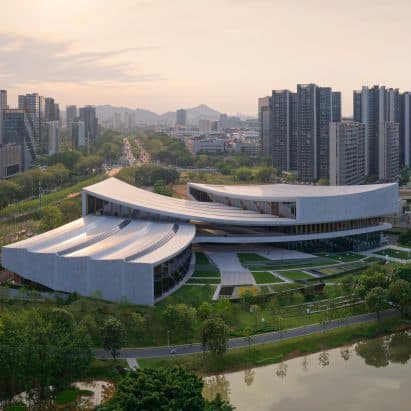
Zaha Hadid Architects Unveils Visionary Waterfront Performance Venue at Songshan Lake
Zaha Hadid Architects (ZHA) has revealed designs for a breathtaking new cultural landmark on the shores of Songshan Lake in China. The Songshan Lake Exhibition and Performance Centre is conceived as an architectural expression of music itself — a building that appears to rise, swell, and release in a dramatic visual crescendo. With sweeping curves, a dynamic waterfront presence, and a design philosophy deeply rooted in performance and culture, this project is poised to become one of the most striking examples of contemporary architecture in China and across the world.
A Building Born from the Language of Music
The concept behind the Songshan Lake Exhibition and Performance Centre is anything but conventional. ZHA has described the design as one that seeks to "crescendo and flare," borrowing directly from the vocabulary of musical composition to inform the building's physical form. Just as a musical piece builds in intensity before releasing into an expansive climax, the venue's architecture rises gradually from the waterfront landscape before opening outward in a bold, dramatic flourish.
This approach is characteristic of ZHA's broader design philosophy, which has long explored the intersection of architecture, nature, and human experience. Founded by the late Dame Zaha Hadid and now led by Patrik Schumacher, the practice has consistently pushed the boundaries of what buildings can look and feel like. The Songshan Lake centre is the latest manifestation of that ambition, translating an invisible, temporal art form — music — into permanent, tangible architecture.
The result is a structure that feels alive. Its undulating rooflines and fluid façades suggest movement, as though the building itself is mid-performance. This kind of parametric design, in which complex geometries are generated through computational tools, has become something of a ZHA signature, and the Songshan Lake project demonstrates the firm's continued mastery of the technique.
Setting and Context: Songshan Lake, Dongguan
The venue is situated in Dongguan, a major city in Guangdong Province in southern China, on the banks of Songshan Lake — a large artificial reservoir and ecological zone that has become a hub for high-tech industry, tourism, and urban development in recent years. The lake and its surrounding parklands offer a serene, natural backdrop that makes the proposed performance centre all the more striking by contrast.
Waterfront architecture carries a particular set of design challenges and opportunities. Buildings at the water's edge must respond not just to their immediate surroundings but to the reflective, shifting nature of the water itself. ZHA has clearly embraced this dialogue, designing a structure whose curves and forms are intended to engage with the lake's surface, creating a visual relationship between the built environment and the natural landscape that changes with the light throughout the day.
The location also carries strategic significance. Dongguan has positioned itself as an emerging cultural and economic powerhouse in the Greater Bay Area, the ambitious urban cluster anchored by Guangzhou, Shenzhen, and Hong Kong. A landmark cultural venue of this scale and ambition reinforces the city's aspirations to attract talent, tourism, and international attention.
Programme and Function: Exhibition and Performance Under One Roof
As its name suggests, the Songshan Lake Exhibition and Performance Centre is designed to serve a dual purpose: hosting large-scale performances and providing flexible exhibition space. This combination of functions is increasingly common in contemporary cultural architecture, reflecting a desire to create venues that can serve diverse communities and programming needs year-round.
The performance facilities are expected to accommodate a range of artistic disciplines, from orchestral concerts and opera to contemporary dance and theatrical productions. Designing acoustically excellent performance spaces within dramatically shaped buildings is one of the most demanding challenges in architecture, requiring close collaboration between architects, acoustic engineers, and theatre designers. ZHA's track record in this area — including projects such as the Guangzhou Opera House — suggests the firm is well-equipped to meet that challenge.
Exhibition spaces, meanwhile, offer the flexibility to host art shows, trade fairs, corporate events, and public programming. The integration of these two functions within a single, cohesive architectural envelope reinforces the centre's role as a true civic asset — a place where culture, commerce, and community can intersect.
ZHA's Legacy in China and Beyond
China has long been one of the most important markets for ZHA, and the practice has delivered some of its most celebrated work there. The Guangzhou Opera House, completed in 2010, remains a touchstone of contemporary performance architecture globally. The CCTV Headquarters in Beijing, while designed by OMA, reflects the broader appetite for architectural ambition that has defined Chinese urban development in the twenty-first century — and ZHA has consistently been at the forefront of meeting that appetite with genuinely innovative work.
The Songshan Lake Exhibition and Performance Centre represents a continuation of this legacy, bringing ZHA's fluid, parametric design language to a new city and a new waterfront context. For Dongguan and the wider Guangdong region, it represents an investment not just in infrastructure but in cultural identity.
Why This Project Matters for Architecture and Culture
At a time when many cities around the world are rethinking the role of cultural institutions — asking how they can be more inclusive, more sustainable, and more deeply embedded in their communities — the Songshan Lake Exhibition and Performance Centre offers a compelling vision. It is a building that dares to be beautiful, that treats architecture as a form of artistic expression in its own right, and that aspires to elevate the experience of everyone who passes through it.
ZHA's decision to frame the design around the concept of musical crescendo is more than a marketing metaphor. It signals an intent to create a building that resonates emotionally, that builds anticipation, and that delivers — architecturally speaking — a moment of release and wonder. Whether through its dramatic silhouette on the Songshan Lake waterfront, its innovative interior spaces, or its role as a new centre of cultural life in Dongguan, this project has every hallmark of a future landmark.
As construction details and timelines are confirmed, the architecture world will be watching closely. The Songshan Lake Exhibition and Performance Centre may well prove to be one of ZHA's finest hours — a building that crescendos, flares, and endures.