
Florida Tops the Nation in Foreclosures as U.S. Filings Climb 14% Year-Over-Year
The American housing market is sending mixed signals in 2026. While home values in many regions remain elevated and inventory slowly improves, a concerning trend is emerging beneath the surface: foreclosure activity is climbing. According to the May 2026 U.S. Foreclosure Market Report released by leading property data provider ATTOM, foreclosure filings across the country have surged 14% compared to the same period a year ago. At the center of this trend sits Florida, which now holds the unenviable distinction of leading the nation in foreclosure rates.
For homeowners, buyers, investors, and real estate professionals, understanding what these numbers mean — and what's driving them — is essential for navigating the market in the months ahead.
What the Numbers Actually Say
ATTOM's May 2026 report paints a nuanced picture of where the U.S. housing market stands. On a month-over-month basis, foreclosure filings actually declined 5% from April to May, which could be interpreted as a modest positive sign. However, zooming out to a 12-month comparison tells a different story: year-over-year, filings are up a significant 14%, signaling that distress in portions of the housing market has been building steadily throughout the past year.
The report covers all foreclosure filings, which includes default notices, scheduled auctions, and bank repossessions. Both foreclosure starts — the initial stage of the foreclosure process — and completed foreclosures increased compared to last year, suggesting the pipeline of distressed properties is not just growing at the front end but moving through to resolution as well.
Florida: The Foreclosure Epicenter of 2026
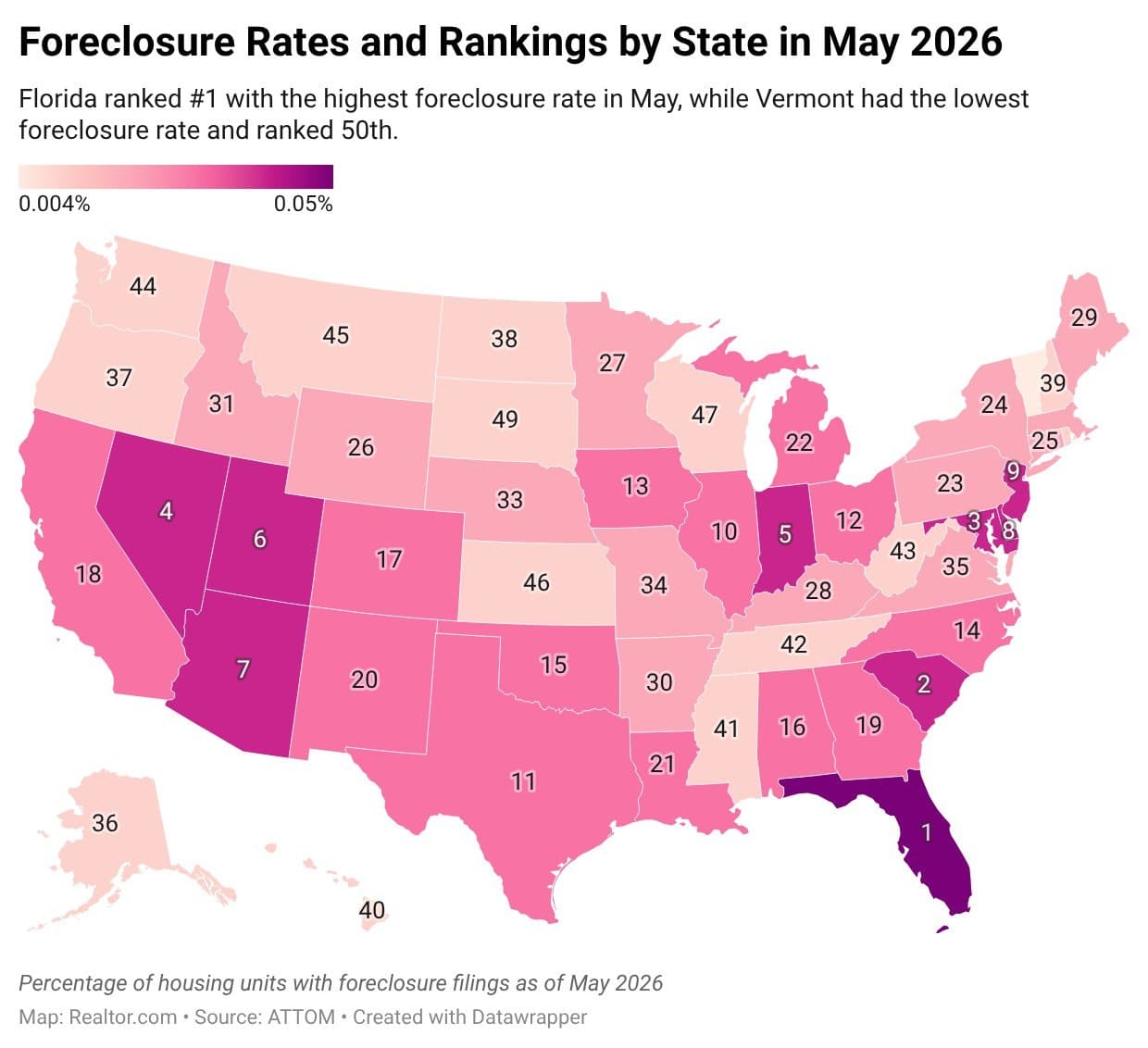
Of all 50 states, Florida stands out most dramatically. The Sunshine State recorded a foreclosure rate of 1 in every 2,110 housing units carrying a foreclosure filing in May 2026. To put that in context, the national average sits at 1 in every 3,562 housing units — meaning Florida's foreclosure rate is roughly 69% worse than the national norm.
This is not entirely surprising to those who have been watching the Florida real estate market closely. The state has experienced a unique combination of pressures: explosive population growth driving up home prices, insurance costs that have skyrocketed in the aftermath of recent hurricane seasons, elevated property taxes in many counties, and a mortgage rate environment that has left many homeowners financially stretched. When multiple cost pressures converge on homeowners simultaneously, foreclosure becomes an increasingly likely outcome for those who cannot absorb the financial shock.
Florida was followed in foreclosure rankings by South Carolina and Maryland, two states with their own distinct economic pressures. On the other end of the spectrum, Vermont and South Dakota recorded the lowest foreclosure rates in the nation, reflecting more stable and affordable local housing conditions.
Expert Insight: Resilience Amid Rising Pressure
ATTOM CEO Rob Barber offered important context alongside the report's data, striking a tone that is cautious but not alarmist. "Foreclosure starts and completed foreclosures both increased compared to last year, reflecting ongoing pressure on some homeowners as elevated mortgage rates, rising ownership costs, and affordability constraints persist," Barber stated. "At the same time, foreclosure volumes remain well below historical norms, indicating that the housing market continues to show resilience despite these challenges."
This framing is critical for understanding the true scope of the situation. While a 14% year-over-year increase sounds alarming, it is important to remember that foreclosure activity during and after the COVID-19 pandemic was artificially suppressed by moratoriums and forbearance programs. As those protections have long since expired and the market has normalized, some uptick in foreclosure activity was statistically inevitable. The current levels, while rising, remain substantially below the crisis-era peaks seen during the 2008 to 2012 housing collapse.
What's Driving the Nationwide Foreclosure Uptick?
Several interconnected factors are contributing to the broader national rise in foreclosure filings heading into mid-2026.
- Elevated mortgage rates: Mortgage rates have remained stubbornly high compared to the historic lows of 2020 and 2021. Homeowners who purchased or refinanced at those low rates are generally protected, but those who bought more recently or have adjustable-rate mortgages face considerably higher monthly obligations.
- Rising ownership costs: Beyond the mortgage payment itself, homeowners are grappling with sharply higher property insurance premiums, increased property tax assessments, and elevated costs for maintenance and utilities. In states like Florida, insurance costs alone have become a crisis-level issue for many households.
- Affordability constraints: Home prices in many markets remain near record highs despite cooling from their peaks. This has reduced equity buffers for buyers who purchased at the top of the market, limiting their ability to sell out of a difficult situation without facing losses.
- End of pandemic-era protections: Forbearance programs and foreclosure moratoriums that were established during the pandemic are now fully expired, allowing the foreclosure process to proceed for borrowers who have been in long-term default.
What This Means for Buyers, Sellers, and Investors
For prospective homebuyers, rising foreclosure activity can present opportunities in the form of distressed properties entering the market at potentially below-market prices. However, purchasing foreclosed homes comes with its own risks, including deferred maintenance, title complications, and as-is sale conditions that require careful due diligence.
For current homeowners in states with elevated foreclosure rates — particularly Florida — the data underscores the importance of proactively communicating with mortgage servicers if financial strain is developing. Loss mitigation options, including loan modifications and repayment plans, are often available before the foreclosure process is formally initiated.
For real estate investors, markets with rising foreclosure activity like Florida, South Carolina, and Maryland may warrant closer monitoring for acquisition opportunities, though local market conditions, insurance landscapes, and carrying costs must be factored carefully into any investment thesis.
Looking Ahead: Will Foreclosures Continue to Rise?
The trajectory of foreclosure activity for the remainder of 2026 will depend heavily on the direction of mortgage rates, the health of the broader labor market, and whether insurance and ownership costs stabilize in high-rate states like Florida. If rates begin to ease and economic conditions remain stable, the foreclosure uptick may plateau. If financial pressures intensify, further increases are likely.
What the May 2026 ATTOM report makes clear is that while the housing market is not in crisis, it is not without stress. Florida, in particular, faces a convergence of challenges that have pushed it to the top of the foreclosure rankings for the nation. Stakeholders at every level of the real estate market would be wise to watch these numbers closely as the year progresses.