
Antoni Gaudí: The Designer the World Forgot to Celebrate
When most people hear the name Antoni Gaudí, their minds immediately conjure images of the soaring, still-unfinished spires of the Sagrada Família in Barcelona, or the mosaic-tiled terraces of Park Güell winding above the city skyline. Gaudí's architecture is among the most photographed and recognisable in the world, drawing millions of visitors to Catalonia every year. Yet for all his global fame as an architect, a fascinating and deeply personal dimension of his creative genius remains largely overlooked: his furniture.
Gaudí was not simply an architect who occasionally sketched a chair to fill a room. He was a total designer, a man who believed that a building and its interior furnishings should speak the same visual language. Every curve, joint, and material choice in his furniture was an extension of the same philosophy that drove his buildings — a philosophy rooted in the observation of nature, the traditions of Catalan craftsmanship, and a restless rejection of straight lines wherever they could be avoided. To understand Gaudí's furniture is to understand the mind behind the architecture in a far more intimate way.
As part of a broader renewed interest in Gaudí's legacy during his centenary year, five key furniture pieces have come into focus that together tell the story of a designer working at the very edge of what wood, iron, and upholstery could do.
1. The Calvet Bench: Ergonomics Carved from Nature
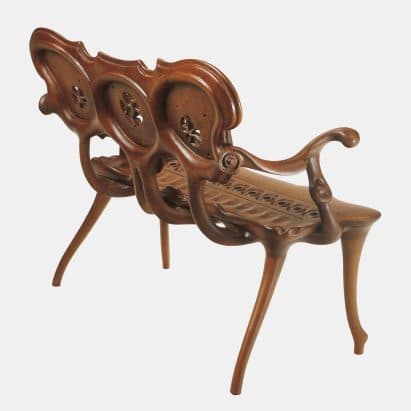
Perhaps the most reproduced of all Gaudí's furniture designs, the Calvet bench was created around 1902 for the entrance hall of Casa Calvet in Barcelona — a building Gaudí designed for the Calvet family textile business. What makes this bench so extraordinary is the way Gaudí approached the human body as a design brief in itself. The seat and backrest are shaped to follow the contours of the sitter's spine and hips with an almost anatomical precision that would not look out of place in a modern ergonomics lab.
The bench is crafted from oak and features armrests shaped into organic, bone-like forms. Its legs taper in a way that echoes the branching of trees, and the whole piece conveys a sense of growth rather than manufacture. Long before the concept of ergonomic design entered the mainstream vocabulary, Gaudí was already solving the problem of human comfort through the language of nature. The Calvet bench remains in production today, a testament to the enduring relevance of his thinking.
2. The Calvet Chair: A Masterclass in Organic Form
Designed alongside the bench as part of the same commission, the Calvet chair shares the same commitment to ergonomic and naturalistic principles. The backrest features an ornamental cross shape that references Gaudí's deep Catholic faith, while the overall silhouette curves and swells in ways that feel more sculptural than functional — until you sit in one and realise the two are inseparable in Gaudí's hands.
The chair has become a design classic and is widely studied in schools of design and architecture as an early example of form following not just function, but the body itself. Its combination of religious symbolism, natural form, and practical comfort makes it one of the most conceptually layered pieces of furniture produced in the early twentieth century.
3. The Casa Batlló Furniture: A Room as a Living Organism
Gaudí's transformation of Casa Batlló between 1904 and 1906 is celebrated for its undulating ceramic façade and its skeletal, cave-like interior. Less discussed is the bespoke furniture he designed to inhabit those spaces. The sofas and chairs created for the main salon are upholstered in rich fabrics and shaped to echo the building's own rippling walls and ceilings. Sitting in them, one has the uncanny sense of being inside a living organism, the furniture and architecture breathing together.
These pieces demonstrate something essential about Gaudí's method: he never designed a building and then filled it with furniture. He designed an environment, and the furniture was as integral to that environment as the walls themselves.
4. The Güell Palace Furniture: Gothic Ambition in Wood and Iron
Built in the late 1880s for his great patron Eusebi Güell, the Palau Güell gave Gaudí his first major opportunity to design at scale. The furniture he created for the palace reflects his early immersion in Gothic forms, with tall, lancet-arched chair backs and heavy, richly worked timber construction. Yet even here, the characteristic Gaudí tension between historical reference and personal invention is visible. These are not Gothic revival pieces in any straightforward sense — they are Gaudí in conversation with the Gothic, pushing and distorting its conventions toward something entirely his own.
5. The Teresianes College Furniture: Simplicity in Service of Faith
Designed for a convent school in the early 1890s, the furniture Gaudí produced for the Teresianes College is notably more restrained than his work for wealthy patrons. Here, the organic exuberance is quieted in favour of simple, sturdy forms appropriate to an institution dedicated to discipline and devotion. And yet the pieces are unmistakably his — the proportions are careful, the joinery considered, and even in simplicity there is a sense of someone who cannot help but make beautiful things.
Why Gaudí's Furniture Still Matters
Taken together, these five pieces reveal a designer who was decades ahead of his time. Gaudí was thinking about ergonomics, about total design environments, about the relationship between the human body and its surroundings long before those ideas had names. His furniture is not a footnote to his architecture; it is the clearest possible expression of the values that drove all of his work.
As the centenary of his death invites a fresh look at his legacy, these objects deserve their place at the centre of that conversation. They remind us that Gaudí was not merely a builder of extraordinary buildings, but one of the most complete and visionary designers of the modern era — and that his genius was perhaps most purely expressed not in stone and tile, but in a single well-carved chair.