
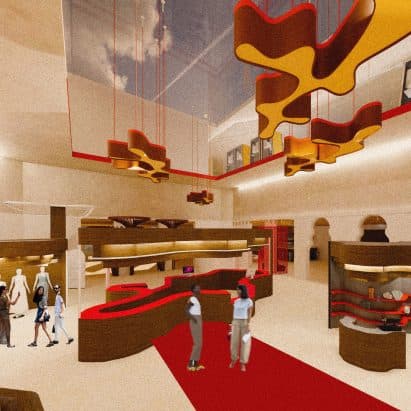
Birmingham City University Students Design a Learning and Enterprise Space for Refugees
Architecture has always been about more than buildings. At its best, it is a tool for social transformation — a means of giving communities shelter, dignity, purpose, and opportunity. A compelling new example of this philosophy in action comes from Birmingham City University (BCU), where students have been developing a series of forward-thinking design projects aimed at addressing some of today's most urgent social challenges. Among the most striking of these is a proposed learning and enterprise platform specifically designed to support migrants and refugees.
Showcased as part of the Dezeen School Shows — an annual series that highlights outstanding student work from architecture and design schools around the world — BCU's graduate projects demonstrate a clear commitment to community-centred design thinking. The refugee support centre concept, in particular, has captured attention for its thoughtful blend of functionality, inclusivity, and architectural ambition.
What Is the Refugee Learning and Enterprise Platform?
The project envisions a dedicated facility that goes well beyond simple accommodation or basic services. Rather than treating refugees as passive recipients of charity, the design positions them as active participants in their own futures. The proposed centre combines learning spaces, enterprise incubation areas, and community facilities under one roof — creating an environment where individuals can develop skills, launch small businesses, engage with education, and rebuild a sense of normalcy after displacement.
This integrated approach reflects a growing understanding among architects, urban planners, and policy makers that sustainable refugee support must address long-term economic and social integration, not just immediate humanitarian needs. A well-designed space can become a catalyst for self-sufficiency, helping people to not only survive in a new country but to actively contribute to it.
Key Design Principles Behind the Project
- Inclusivity and accessibility: The design prioritises barrier-free access and flexible spaces that can adapt to users with a wide range of needs, backgrounds, and abilities.
- Community ownership: Rather than imposing a top-down architectural vision, the concept incorporates participatory design elements, ensuring that the eventual users have a voice in how the space functions.
- Mixed-use flexibility: Spaces are designed to serve multiple purposes — a classroom by day might become a community meeting room by evening, maximising the utility of every square metre.
- Economic empowerment: Enterprise zones within the building provide affordable workspace for small businesses and start-ups, helping refugees to gain financial independence.
- Cultural sensitivity: The architecture acknowledges the diverse cultural backgrounds of its users, avoiding one-size-fits-all solutions in favour of adaptable, respectful spaces.
Architecture as a Vehicle for Social Justice
What makes BCU's student projects particularly significant is the seriousness with which they engage with real-world social issues. It would be easy for architecture students to focus purely on aesthetics or technical innovation, and there is certainly a place for that kind of exploration. But the decision to centre a major project around the lived experiences of refugees speaks to a generation of designers who understand that their skills carry a responsibility as well as a creative opportunity.
The global refugee crisis remains one of the defining humanitarian challenges of our time. According to the United Nations High Commissioner for Refugees (UNHCR), there are currently more displaced people around the world than at any point in recorded history. While governments and NGOs work to address immediate needs, the role of thoughtful, human-centred architecture in building longer-term solutions is increasingly recognised by practitioners and academics alike.
BCU's emphasis on this kind of socially engaged design is not accidental. The university has built a reputation for encouraging students to look outward — to engage with communities, understand complex social dynamics, and produce work that has the potential to make a genuine difference. The refugee learning and enterprise platform is a vivid expression of that ethos.
The Broader Context: BCU's Commitment to Innovative Student Projects
The refugee support centre is one of several ambitious projects emerging from Birmingham City University's architecture and design programmes. Collectively, these projects reflect a curriculum that pushes students to think critically about the built environment and its relationship to society, politics, and culture. BCU's inclusion in Dezeen School Shows is a testament to the quality and relevance of this work on an international stage.
Birmingham itself provides a rich backdrop for this kind of thinking. As one of the UK's most diverse cities, with a long history of migration, industry, and reinvention, Birmingham offers architecture students a living laboratory in which questions of community, identity, and urban space play out in real time. Designing for refugees and migrants in this context is not an abstract exercise — it is a response to genuine local and national need.
Why Student-Led Design Projects Matter
It is worth pausing to consider why student projects like this deserve wider attention. In many ways, student work occupies a uniquely valuable space in the design world. Free from the constraints of commercial briefs and client demands, students are able to ask radical questions, take creative risks, and propose solutions that established practices might never consider. The best student projects do not just showcase individual talent — they point toward futures that the profession as a whole can learn from.
The BCU refugee learning and enterprise platform does exactly this. It challenges the architecture community to think more expansively about what buildings can do for the most vulnerable members of society, and it demonstrates that thoughtful design can be a genuinely powerful force for good.
Looking Ahead: The Future of Refugee-Focused Architecture
As climate change, geopolitical instability, and economic inequality continue to drive displacement across the globe, the need for innovative, humane approaches to refugee support will only grow. Architecture schools like Birmingham City University are helping to train the next generation of designers to meet that challenge — not with generic solutions, but with carefully considered, community-driven responses that respect the dignity and potential of every person they serve.
The learning and enterprise platform envisioned by BCU students may be a conceptual project today, but the ideas it embodies are urgently relevant. It is a reminder that architecture, at its most meaningful, is not about making impressive images — it is about making better lives. Birmingham City University's contribution to this conversation, as highlighted through Dezeen School Shows, is a welcome and inspiring example of design education at its most purposeful.