
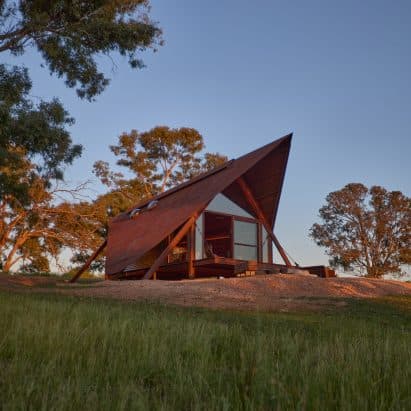
Casey Brown Architecture Pitches Corten Steel "Tents" in the Australian Landscape
Australian studio Casey Brown Architecture has unveiled its latest rural retreat project, Permanent Camping 3, a series of tent-shaped cabins clad in weathering Corten steel and set within the rolling pastoral landscape of Orange, New South Wales. The project continues the firm's long-running exploration of what it means to live permanently in the bush — buildings that feel temporary by nature but are built to endure the test of time and climate.
Permanent Camping 3 is the third iteration in Casey Brown Architecture's celebrated series of rural structures, each one pushing the boundaries of how contemporary architecture can respond to the rugged Australian countryside. With this latest project, the Sydney-based practice has refined its signature approach: creating shelters that are visually poetic, structurally resolute, and deeply connected to the land on which they sit.
The Concept: Permanent Impermanence
The central idea behind the Permanent Camping series is a deliberate tension between the temporary and the enduring. A tent is, by definition, a transient structure — lightweight, portable, and provisional. Casey Brown Architecture takes that archetype and rebuilds it in Corten steel, a material synonymous with durability, industrial character, and, most importantly, its ability to age gracefully in the open air.
Corten steel, also known as weathering steel, develops a stable, rust-like patina when exposed to the elements. Rather than corroding and weakening over time, the oxidised surface layer acts as a protective coating, meaning the material actually becomes more resilient as it ages. In the context of the Australian bush — subject to intense sun, periodic drought, and dramatic seasonal shifts — this choice of material is as pragmatic as it is aesthetic.
The result is a series of structures that seem to emerge organically from the ochre and rust tones of the surrounding landscape. The buildings do not seek to contrast with their environment but to belong to it, taking on the warm, earthy colours of the New South Wales soil and scrubland as the steel weathers and settles into place over years.
Design and Form: Tent Shapes Reimagined in Steel
The defining visual feature of Permanent Camping 3 is the tent-like roofline — a pitched, angular profile that immediately evokes the form of a canvas camp shelter. Casey Brown Architecture has translated this familiar silhouette into a precise architectural language, with crisp folded steel planes that capture light and shadow in ways that shift dramatically across the day and across the seasons.
The structures are deliberately low-slung and modest in scale, respecting the horizontal sweep of the Australian pastoral landscape rather than imposing upon it. Each cabin is oriented to maximise its relationship with the surrounding terrain, with openings and glazed sections carefully positioned to frame views of the countryside, draw in natural ventilation, and manage solar gain in a climate that demands thermal sensitivity.
Interior spaces are compact but considered, prioritising quality of experience over quantity of floor area. The palette inside echoes the rawness of the exterior — exposed materials, natural textures, and an absence of ornamentation that keeps the focus firmly on the landscape visible through every window. This is architecture that frames nature rather than competing with it.
Site and Setting: Orange, New South Wales
Orange, located in the central tablelands of New South Wales, provides a compelling backdrop for this kind of project. The region is known for its distinct seasons, its rolling agricultural land, its vineyards, and its wide open skies — a landscape that rewards careful, site-specific architectural thinking. Casey Brown Architecture has worked with the topography of the site rather than against it, situating the cabins to take advantage of natural shelter, existing vegetation, and the subtle drama of the land's contours.
The location also connects the project to a broader conversation about rural living in Australia. As more people seek alternatives to urban density — whether as primary residences, weekend retreats, or creative escapes — the demand for thoughtfully designed rural architecture has grown significantly. Projects like Permanent Camping 3 offer a compelling model: buildings that are genuinely sustainable in their use of long-lasting materials, sensitive in their engagement with landscape, and honest in their architectural ambition.
Casey Brown Architecture's Legacy in Rural Design
Casey Brown Architecture has built a distinctive reputation in Australia for its rural and regional work. The practice, led by Casey Brown, has consistently demonstrated that remote and regional sites are not constraints to be overcome but opportunities to be embraced. The Permanent Camping series in particular has become something of a benchmark in Australian residential design, celebrated for the clarity of its concept and the rigour of its execution.
- Permanent Camping 1 established the tent-as-architecture concept and introduced Corten steel as the practice's material of choice for rural projects.
- Permanent Camping 2 developed the typology further, refining interior spatial quality and expanding the relationship between built form and landscape.
- Permanent Camping 3 represents the most resolved iteration yet, bringing together lessons learned from both predecessors into a cohesive and confident architectural statement.
Each project in the series builds on the last, demonstrating how a strong conceptual framework can sustain and reward sustained investigation over time.
Why Corten Steel Makes Sense for Australian Architecture
The choice of Corten steel for rural Australian architecture goes beyond aesthetics. In remote locations where maintenance access is limited and the climate can be unforgiving, selecting materials that require minimal upkeep is a genuinely responsible decision. Corten steel does not need painting, sealing, or regular treatment — it asks very little of its occupants while giving a great deal in return, developing a richness of surface texture and colour that no manufactured finish could replicate.
The material also has strong thermal mass properties when used in combination with appropriate insulation, helping to moderate internal temperatures without excessive reliance on mechanical heating and cooling systems. In a country where energy costs and environmental impact are live concerns for any building project, this passive performance matters.
A Vision for the Future of Rural Living
Permanent Camping 3 is more than a striking series of cabins in the New South Wales countryside. It is a carefully argued proposition about how Australians might choose to inhabit their extraordinary landscape — with intelligence, restraint, and a deep respect for the character of place. Casey Brown Architecture has once again demonstrated that the most powerful architectural ideas are often the simplest ones: buildings that know exactly what they are, where they are, and why they are there.
As interest in sustainable rural retreats, off-grid living, and landscape-sensitive design continues to grow across Australia and internationally, projects like Permanent Camping 3 offer an inspiring and practical model for what thoughtful, place-specific architecture can achieve. The Corten tent, pitched permanently in the Australian bush, turns out to be exactly the right shelter for exactly the right landscape.