
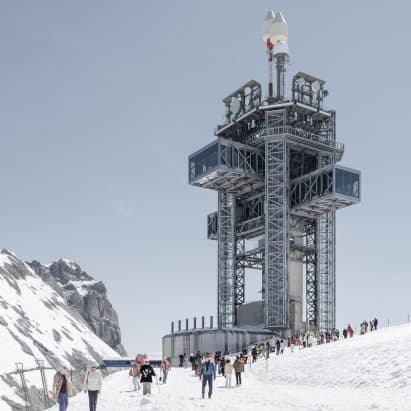
Herzog & de Meuron Reinvents the Titlis Antenna Tower as an Iconic Alpine Sculpture
When most people think of world-class architecture, they picture grand museums, soaring skyscrapers, or sweeping cultural centers. Rarely does a telecommunications antenna tower come to mind. Yet that is precisely what Pritzker Prize-winning Swiss firm Herzog & de Meuron has achieved at Mount Titlis in central Switzerland — transforming a purely functional piece of mountain infrastructure into what the architects themselves describe as an "iconic sculpture." The result is a project that challenges the very definition of what architecture can be, and where it can exist.
What Is the Titlis Tower Project?
The Titlis Tower renovation project centers on a pre-existing antenna mast situated at the summit of Mount Titlis, one of Switzerland's most visited alpine destinations, rising to approximately 3,238 meters above sea level. The tower had long served a purely utilitarian purpose — transmitting signals across the rugged terrain of the Swiss Alps. Over time, however, the structure became an eyesore rather than an asset, standing in stark contrast to the dramatic natural scenery surrounding it.
Herzog & de Meuron, the Basel-based practice co-founded by Jacques Herzog and Pierre de Meuron, was commissioned to reimagine the tower not simply as a piece of restored infrastructure, but as a deliberate architectural statement. The firm's approach has redefined what it means to retrofit a functional structure, turning necessity into an opportunity for bold creative expression high in the Alps.
Design Philosophy: Infrastructure Meets Art
At the heart of the Titlis Tower project is a philosophy that Herzog & de Meuron has championed throughout their career: the idea that architecture and art are inseparable disciplines. The firm has consistently blurred the boundaries between the built environment and sculpture, from the Beijing National Stadium (the "Bird's Nest") co-designed with Ai Weiwei to the Tate Modern's iconic Turbine Hall in London. The Titlis Tower continues this tradition in a dramatically different context — one defined not by urban density but by extreme altitude and raw natural power.
The redesigned tower is conceived as a vertical landmark that commands attention without overwhelming the alpine landscape. Rather than attempting to disguise or minimize the structure, Herzog & de Meuron embraced its presence, enhancing its silhouette so that it reads as a purposeful sculptural object against the sky and snow. This approach reflects a broader shift in contemporary architecture toward honest expression of structure and material, where what a building or tower truly is becomes the source of its aesthetic power.
Architectural Features of the Renovated Tower
While the full technical specifications continue to emerge, the Titlis Tower renovation incorporates several key architectural moves that set it apart from conventional infrastructure upgrades:
- Sculptural massing: The tower's exterior has been reconfigured to present a cohesive, sculptural form that feels intentional from every angle, whether viewed from the Titlis summit station, from approaching cable cars, or from the surrounding glacial terrain below.
- Material sensitivity: Herzog & de Meuron's material choices reflect the harsh alpine climate, prioritizing durability while maintaining a refined aesthetic vocabulary consistent with the firm's wider body of work.
- Public integration: In keeping with the leisure and tourism infrastructure already present at the Titlis summit, the tower has been conceived with public engagement in mind, reinforcing its status as a destination feature rather than a purely technical installation.
- Verticality as identity: The tower's height and slenderness are celebrated rather than apologized for, making the structure a readable element of the summit's visual identity — a marker that orients visitors and anchors the architectural landscape of the peak.
Why This Project Matters for Architecture and Alpine Tourism
The Titlis Tower project arrives at a significant moment for both the architecture profession and the Swiss tourism industry. As alpine resorts grapple with the impacts of climate change, shifting visitor expectations, and the need to update aging infrastructure, there is growing recognition that built interventions in sensitive mountain environments must work harder to justify their presence. A tower that is merely functional is no longer sufficient — it must contribute meaningfully to the experience of place.
By commissioning Herzog & de Meuron, the project stakeholders signaled a clear ambition: to make Mount Titlis not just a natural spectacle but a destination with architectural distinction. The tower now joins a small but growing canon of alpine structures — from Peter Zumthor's Therme Vals to Kengo Kuma's various mountain interventions — that demonstrate how world-class architecture can enhance rather than diminish the experience of being in nature at altitude.
For visitors arriving at the summit, the tower offers a new visual anchor — something to photograph, to marvel at, and to return to. This is no small thing in an era where experiences are curated and shared digitally; an iconic structure at a mountain summit can meaningfully extend a destination's reach and cultural relevance well beyond its immediate geography.
Herzog & de Meuron's Legacy in Swiss Architecture
It is fitting that one of Switzerland's most celebrated architectural exports has turned its attention to a Swiss mountain landmark. Herzog & de Meuron's body of work is defined by a willingness to engage with seemingly intractable problems — industrial buildings, power stations, railway depots — and discover within them the potential for transformation. Their 2001 Pritzker Prize citation specifically acknowledged their ability to find unexpected beauty in overlooked typologies, a quality that makes them ideally suited to the challenge of the Titlis Tower.
The firm has also always maintained a strong relationship with the Swiss landscape and Swiss craft traditions, even as their practice has grown into one of the world's most globally recognized studios. The Titlis Tower feels, in this sense, like a homecoming of sorts — an opportunity to bring their accumulated global experience back to the alpine terrain that has always been part of their cultural DNA.
A New Benchmark for Infrastructure Design
The Titlis Tower by Herzog & de Meuron is more than a renovation project. It is a provocation — a demonstration that even the most utilitarian structures can and should aspire to architectural excellence. As cities and landscapes alike continue to densify and evolve, the question of how infrastructure looks and feels will only grow more urgent. Projects like this one offer a compelling answer: with vision, courage, and the right architectural partnership, a functional antenna mast at 3,000 meters can become something genuinely iconic. And sometimes, that is exactly what a mountain summit needs.