
Home Flipping Profits Are Finally Moving in the Right Direction
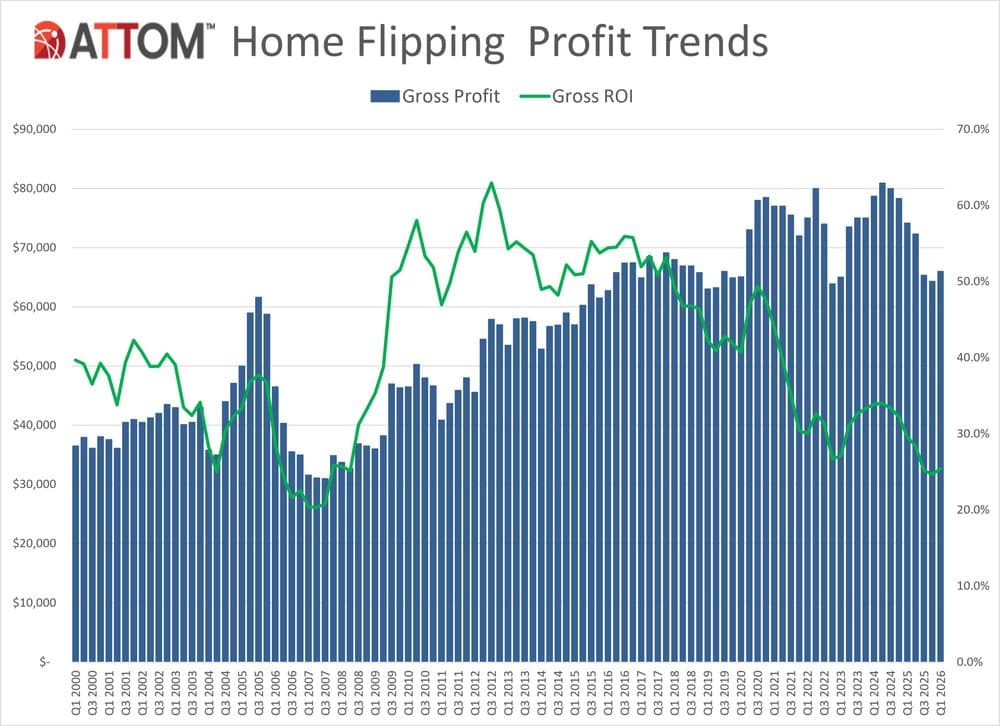
For real estate investors who have spent the better part of two years watching their margins shrink, there is finally some encouraging news on the horizon. According to a new quarterly report from real estate data analytics firm ATTOM, the typical profit margin for a flipped home climbed to 25.4% in the first quarter of 2026, up from 24.7% in the fourth quarter of 2025. That modest but meaningful uptick ends seven consecutive quarters of declining returns — a losing streak that had not been seen since the housing crash of 2008.
While the market is far from returning to its peak profit years, this reversal signals that conditions may finally be stabilizing for house flippers across the United States. For investors who have been sitting on the sidelines or grinding through thin margins, the data offers a reason for cautious optimism.
What the ATTOM Report Actually Says
ATTOM's Q1 2026 Home Flipping Report paints a picture of a market that has endured significant headwinds but is showing early signs of recovery. The report tracks gross flipping profit — the difference between the median purchase price paid by an investor and the median resale price after renovation — as well as the return on investment (ROI) expressed as a percentage of the original purchase price.
At 25.4%, the typical profit margin remains well below the levels investors enjoyed during the pandemic-era boom. For context, as recently as early 2024, the typical national return on investment was hovering around 35%. The current figure represents a market that is leaner and more demanding, but one that is no longer moving in the wrong direction.
ATTOM CEO Rob Barber noted the significance of the shift: "The first increase in flipping returns in nearly two years is a welcome sign for investors. The market remains far more competitive than it was during the peak profit years, but this quarter's gains suggest that conditions may be stabilizing."
Barber was also quick to temper expectations, emphasizing that outcomes vary considerably depending on geography. "Success still depends heavily on local market dynamics, with some metros producing strong returns while others remain difficult places to flip profitably."
Why Have Flipping Profits Been Falling?
To understand why this uptick matters, it helps to understand the forces that drove profits downward in the first place. Home flippers have faced a perfect storm of unfavorable conditions over the past two-plus years, stemming primarily from two interconnected problems: high home prices and elevated mortgage interest rates.
When home prices rise sharply, investors pay more to acquire properties. When interest rates are high, renovation financing becomes more expensive, holding costs increase, and the pool of qualified buyers who can afford to purchase the finished product shrinks. These dynamics squeeze margins from both ends — acquisition costs go up while buyer demand and resale prices face pressure from affordability constraints.
The result was a prolonged period of compression that eroded the profitability that had made house flipping so attractive during the low-rate, high-demand environment of 2020 through 2022. As median home sales prices peaked and average investors watched their returns shrink quarter after quarter, many scaled back activity or exited the market entirely.
What Is Driving the Rebound in Q1 2026?
While ATTOM's report does not point to a single catalyst, several factors likely contributed to the margin improvement seen in the first quarter of 2026.
- Softening acquisition costs in select markets: In some metros, home prices have moderated slightly from their peaks, giving investors more room to purchase properties at prices that allow for profitable resale after renovation costs.
- Stabilizing resale values: Even in a challenging affordability environment, certain markets have maintained or slightly improved their resale price levels, helping investors recapture value at the back end of a flip.
- Investor discipline and market selectivity: With thinner margins forcing greater precision, experienced flippers have become more selective about the deals they pursue. This self-selection may be contributing to better aggregate returns as low-quality deals get left on the table.
- Local market variation: As Barber pointed out, some metro areas continue to outperform the national average significantly. Investors who have concentrated their activity in high-performing local markets are driving some of the positive momentum reflected in the data.
What This Means for Real Estate Investors in 2026
For active house flippers and those considering entering the market, the Q1 2026 data carries several practical implications. First, the directional change in profit margins is a meaningful signal, even if the absolute improvement is less than one percentage point. Trends matter in real estate investing, and a reversal after seven consecutive quarters of decline is not something to dismiss lightly.
Second, local market research has never been more important. National averages tell only part of the story. Investors who take the time to analyze inventory levels, days on market, buyer demand, and renovation costs in their specific target markets will be far better positioned than those relying on broad national headlines.
Third, expectations need to remain grounded. A 25.4% gross margin is still a workable return for disciplined investors, but it requires tight cost control, accurate after-repair value (ARV) estimates, and efficient execution. The days of buying almost anything and profiting handsomely from rising prices alone are not back — and may not return for some time.
The Bigger Picture for House Flipping in 2026
The broader real estate market in 2026 remains one defined by tension between persistent affordability challenges and underlying demand. Housing inventory in many parts of the country is still below historical norms, which supports prices even as high interest rates dampen buyer enthusiasm. For investors, this creates both opportunity and risk depending on how local supply-and-demand dynamics play out over the coming quarters.
If mortgage rates begin to ease in the second half of the year — a scenario many economists have discussed — buyer activity could pick up, increasing the pool of potential purchasers for flipped homes and putting upward pressure on resale values. That scenario would be a meaningful tailwind for investor margins. Conversely, any further softening in home values or continued affordability constraints could stall the recovery before it gains real momentum.
Final Takeaway
The Q1 2026 ATTOM home flipping report delivers a modest but genuinely encouraging message: the prolonged decline in house flipping profit margins has ended, at least for now. With typical returns rising to 25.4% and the seven-quarter losing streak finally broken, investors have reason to look at the market with renewed interest. The path forward still demands careful deal selection, local market expertise, and disciplined cost management — but for the first time in nearly two years, the trend is pointing in the right direction.