
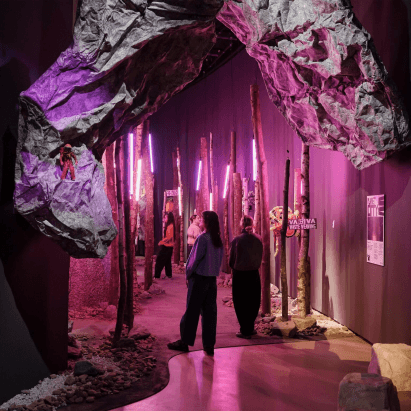
Liam Young's Vision of Tomorrow: AI Cities and Planetary Supercomputers Arrive at the Barbican
Speculative architect and filmmaker Liam Young has unveiled a strikingly ambitious immersive exhibition at London's iconic Barbican Centre, offering visitors a provocative and visually arresting glimpse into a future shaped by artificial intelligence, mega-scale urbanism, and planetary-sized computational infrastructure. The exhibition pushes the boundaries of what architecture, technology, and storytelling can achieve together, establishing Young once again as one of the most daring and thought-provoking voices in contemporary design and futures thinking.
Known for his cinematic explorations of technological landscapes and speculative urban environments, Young uses the Barbican's distinctive brutalist spaces as a backdrop for imagery and narratives that feel simultaneously fantastical and unsettlingly plausible. The result is an exhibition that challenges visitors not merely to observe a possible future, but to reckon with the decisions being made right now that will determine whether such futures come to pass.
What Is Speculative Architecture — and Why Does It Matter?
Before diving into the specifics of Young's Barbican show, it is worth understanding the discipline he works within. Speculative architecture — sometimes called critical design or design fiction — uses the tools of architecture, filmmaking, and visual art to imagine alternative futures, dystopian scenarios, and radical urban forms that may not yet exist but are grounded in real technological, political, and environmental trajectories.
Unlike conventional architecture, speculative practice is not constrained by planning permissions, engineering budgets, or client briefs. It is free to ask uncomfortable questions: What happens when artificial intelligence manages the entire infrastructure of a city? Who owns a supercomputer the size of a continent? What does human life look like inside structures built not for people, but for data?
Young has spent much of his career sitting precisely at this intersection of design, cinema, and critical inquiry. His previous projects have examined everything from automated logistics networks to the hidden geographies of rare earth mineral extraction. With this new Barbican exhibition, he turns his lens toward AI urbanism and the emerging reality of planetary-scale computing.
AI-Powered Mega Cities: The Architecture of Algorithmic Control
Central to the exhibition is Young's imagining of AI-powered mega cities — vast, hyper-dense urban agglomerations in which artificial intelligence does not merely assist city management but fundamentally organises and operates every dimension of civic life. Traffic flows, energy distribution, housing allocation, resource logistics, and even social scheduling are depicted as functions managed by unseen algorithmic systems operating at speeds and scales far beyond human cognition.
These are not utopian smart cities in the glossy corporate brochure sense. Young's mega cities carry an unmistakable ambiguity. They are efficient, yes — extraordinarily so. But they also raise immediate and urgent questions about agency, democracy, and the meaning of community when human decision-making is progressively offloaded to machine intelligence. The visual language of the exhibition reflects this tension, blending stunning computational imagery with an underlying unease that lingers long after visitors leave.
The scale of the urban environments Young depicts is deliberately overwhelming. These are not cities in the conventional sense of a few million inhabitants arranged around a historic centre. They are planetary in ambition — continuous, borderless zones of habitation and production that consume entire geographic regions and generate data at unimaginable volumes.
Planetary Supercomputers: When Infrastructure Becomes Landscape
Alongside the mega city imagery, the exhibition introduces what Young describes as planetary supercomputers — computational systems so large in physical scale that they effectively become geographical features. Drawing on real-world trajectories in data centre construction, undersea cable networks, and the explosive growth in AI training infrastructure, Young extrapolates toward a future in which the physical footprint of computation reshapes continents.
These structures are presented not as abstract concepts but as architectural realities — buildings, complexes, and networks with their own aesthetic logic, their own environmental demands, and their own strange beauty. Young's background in filmmaking is evident throughout: the exhibition uses cinematic techniques including large-format projection, spatial sound design, and carefully constructed visual narratives to make these hypothetical infrastructures feel viscerally real.
- Vast server complexes that consume entire desert valleys for cooling and power generation
- Undersea data highways connecting computational nodes across ocean floors
- Urban environments in which the boundary between human habitation and machine infrastructure has entirely dissolved
- Energy grids redesigned from the ground up to serve the insatiable appetite of AI computation
Each of these elements is grounded in technologies and trends that already exist today, projected forward along trajectories that are already underway. This is what makes Young's work so compelling — and so unsettling. The futures he depicts are not fantasy. They are extrapolation.
The Barbican as the Perfect Host
The choice of the Barbican Centre as the venue for this exhibition is itself significant. Built in the 1960s and 1970s as a utopian vision of urban living — high-density, self-contained, designed around a belief that architecture could engineer better human communities — the Barbican embodies many of the same aspirations and anxieties that Young's work addresses. Its brutalist geometry and monumental scale provide an architectural context that resonates deeply with the themes of the show.
Young is not the first artist to use the Barbican's spaces to comment on architecture's relationship with power, technology, and the future. But his immersive approach — using the entire space as a cinematic environment rather than simply hanging work on walls — makes for an experience that is unusually total and enveloping.
Why This Exhibition Matters Now
Liam Young's Barbican exhibition arrives at a moment when the questions it raises have never been more urgent. The global buildout of AI infrastructure is accelerating rapidly, with technology companies investing hundreds of billions of dollars in data centres, energy systems, and the physical networks that support machine learning at scale. Cities around the world are deploying AI systems to manage traffic, monitor public spaces, and allocate public resources. The futures Young imagines are not distant science fiction — they are emerging policy and investment realities.
By making these futures visible, tangible, and emotionally resonant, Young performs a vital cultural function. He creates space for conversations that technical reports and policy documents rarely open: conversations about what kind of world we actually want to build, who gets to decide, and what we risk losing if we allow the momentum of technology to substitute for the exercise of collective human judgment.
A Must-See for Architecture, Design, and Technology Enthusiasts
For anyone interested in the future of cities, the social implications of artificial intelligence, or the expanding role of speculative and critical design in public discourse, Liam Young's exhibition at the Barbican is essential viewing. It is a rare work that manages to be simultaneously spectacular and intellectually rigorous — beautiful, alarming, and deeply thought-provoking in equal measure. Whether you leave feeling inspired, disturbed, or simply compelled to think differently about the world being built around us, this is an exhibition that demands to be experienced.