
Manchester School of Architecture Presents Bold Student Visions for a Regenerative Future
The Manchester School of Architecture (MSA) has once again demonstrated why it stands among the United Kingdom's most forward-thinking design institutions. Its latest annual showcase of student work reveals a generation of architects deeply attuned to the pressing challenges of the 21st century — from ecological collapse and urban decay to the need for spaces that genuinely serve communities and heal the natural world. Among the standout submissions featured in Dezeen's School Shows is a remarkable ecological repair site project that captures the spirit of the entire exhibition: architecture not merely as construction, but as an act of care.
What Is Dezeen's School Shows and Why Does It Matter?
Each year, Dezeen's School Shows platform gives architecture and design schools from around the world an opportunity to present their most compelling graduate work to a global audience. For institutions like the Manchester School of Architecture — a joint school between the University of Manchester and Manchester Metropolitan University — this exposure is invaluable. It places student projects in dialogue with professional practice, inviting critique, conversation, and collaboration far beyond the studio walls.
The 2026 cohort from MSA is notable for its thematic coherence. Across multiple projects and disciplines, students are grappling with questions of environmental responsibility, post-industrial landscapes, and the role of architecture in fostering ecological and social resilience. The work reflects a curriculum that encourages experimentation while remaining grounded in real-world conditions.
Succession of Care: An Ecological Repair Site at the Heart of the Show
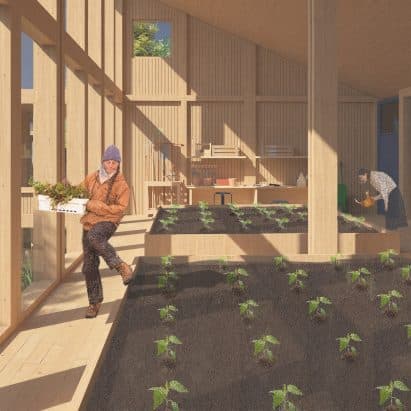
One of the most talked-about projects in this year's MSA showcase is "Succession of Care" by student Neel Naregal. This project centers on the concept of an ecological repair site — a designed intervention that prioritizes the restoration of degraded land and ecosystems over conventional architectural programs. Rather than imposing a new building onto a site, the project proposes a spatial and temporal framework that allows nature to gradually reclaim and replenish itself, guided by thoughtful human stewardship.
The concept of ecological succession — the natural process by which ecosystems recover and evolve over time — is embedded directly into the architectural strategy. Naregal's design creates a series of carefully considered infrastructures: observation platforms, composting areas, seed banks, and resting shelters, all arranged to support both ecological processes and the human visitors who come to witness and participate in them. It is architecture that steps back, that listens, and that draws its meaning from the slow, patient rhythms of the natural world.
This approach resonates powerfully with contemporary debates in landscape urbanism and regenerative design. As cities across the UK and beyond grapple with the legacy of industrial contamination, urban heat islands, and biodiversity loss, projects like "Succession of Care" offer a compelling alternative to the business-as-usual model of redevelopment.
Key Themes Running Through the 2026 MSA Showcase
While Naregal's ecological repair site is a centerpiece of the show, the broader exhibition reveals several interconnected themes that define this year's MSA graduate output.
- Regenerative and Restorative Architecture: Multiple projects challenge the assumption that new development is inherently progressive. Students are exploring how architecture can repair rather than replace, heal rather than overwrite, and serve future generations rather than present convenience alone.
- Post-Industrial Landscapes: Manchester's unique urban geography — shaped by centuries of industrial production, followed by deindustrialization and ongoing regeneration — provides a rich context for student exploration. Several projects engage directly with brownfield sites, former mill buildings, and neglected waterways.
- Community-Centered Design: A recurring commitment to social equity runs through the work. Students are asking who architecture is for, and how design processes themselves can become more inclusive, participatory, and responsive to the needs of marginalized communities.
- Material Honesty and Low-Carbon Construction: In an era of escalating climate anxiety, many projects foreground material choices, advocating for the use of locally sourced, low-embodied-carbon materials such as timber, rammed earth, and reclaimed industrial components.
- Temporal and Adaptive Design: Rather than conceiving of buildings as fixed, permanent objects, several students are designing for change — structures that can be adapted, extended, or even deconstructed as needs and conditions evolve over time.
The Manchester School of Architecture's Distinctive Approach to Education
Understanding why MSA produces work of this caliber requires a closer look at how the school operates. As a joint venture between two major universities, MSA benefits from an unusually diverse range of academic expertise, studio cultures, and research trajectories. Students are encouraged to develop strong conceptual positions while also engaging rigorously with technical and environmental performance. The result is work that is at once imaginative and intellectually grounded.
The school has long placed sustainability and social responsibility at the core of its pedagogical mission. This is not sustainability as a box-ticking exercise, but as a genuine design driver — a lens through which every spatial, material, and programmatic decision is examined. Projects like "Succession of Care" are the natural outcome of this sustained educational commitment.
Why Ecological Repair Is the Architecture of Our Moment
The emergence of ecological repair as an architectural ambition is not coincidental. It reflects a broader cultural shift in how we understand the relationship between the built environment and the living world. The biodiversity crisis, the accelerating pace of climate change, and the growing body of evidence linking access to nature with human health and wellbeing have all contributed to a renewed interest in restorative approaches to site design.
For architects and designers, this shift demands new skills, new vocabularies, and new forms of collaboration — with ecologists, hydrologists, community groups, and the land itself. The students at Manchester School of Architecture are clearly developing these capacities. Their work does not simply respond to a brief; it proposes new ways of thinking about what architecture can and should be.
Looking Ahead: A Generation Ready to Reimagine the Built Environment
The 2026 Manchester School of Architecture showcase is a reminder that the next generation of architects is arriving with ambition, urgency, and genuine creative intelligence. From ecological repair sites to adaptive community infrastructure, these projects collectively paint a picture of a profession in the midst of a meaningful transformation. If the built environment of the coming decades is to be more equitable, more sustainable, and more ecologically attuned, it will be shaped in no small part by graduates like those emerging from MSA today. The work is already here. Now it needs the world to catch up.