
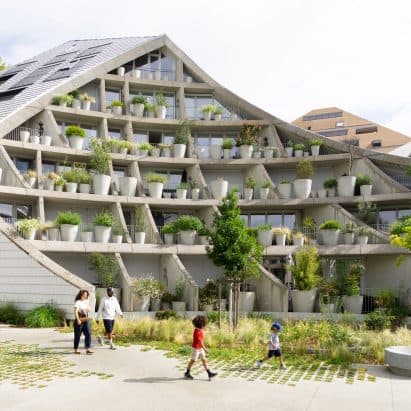
MVRDV Brings Bold Biophilic Vision to Bordeaux with La Vallée Verte
Dutch architecture firm MVRDV has completed a striking new residential development in Bordeaux, France, that challenges conventional ideas about what social and mixed-use housing can look and feel like. Named La Vallée Verte — or "The Green Valley" in English — the project uses oversized plant pots, lush greenery, and distinctive human-shaped portal openings to create a facade that is as expressive as it is functional. The result is a building that feels genuinely alive, blurring the line between architecture, landscape, and community identity.
A Facade Like No Other: The Design Concept Behind La Vallée Verte
The most immediately striking feature of La Vallée Verte is its facade treatment. MVRDV incorporated large-scale, sculptural plant pots directly into the building's exterior walls, allowing vegetation to spill outward in a way that feels organic and intentional rather than decorative or afterthought. These planters are not simply tacked onto balconies; they are integral to the architectural language, giving the building a layered, textured quality that changes with the seasons as plants grow, bloom, and shed.
Equally eye-catching are the people-shaped portal openings cut into the facade. These human-silhouette voids serve as both a visual device and a conceptual statement — a reminder that architecture ultimately exists to serve and celebrate the people who inhabit it. The portals create frames that animate the building's surface, casting dynamic shadows throughout the day and offering residents a sense of identity and individuality within what could otherwise feel like an anonymous urban block.
Biophilic Design Principles at the Heart of the Project
La Vallée Verte is a strong example of biophilic design philosophy applied at a residential scale. Biophilic design is built on the idea that human beings have an innate need for connection with the natural world, and that integrating nature into the built environment can improve wellbeing, reduce stress, and foster a greater sense of belonging among residents and the wider community.
MVRDV has long been interested in how greenery and vegetation can be embedded into dense urban housing rather than being relegated to distant parks or rooftop terraces. Here, the planting strategy is vertical and visible, making nature an active part of the street experience rather than a hidden amenity. Passersby and residents alike are engaged with the greenery from ground level upward, reinforcing the project's ambition to soften the boundary between the natural and the built.
Context and Location: Bordeaux's Evolving Urban Landscape
Bordeaux has undergone significant urban transformation over the past two decades, evolving from a city defined by its historic wine trade into one of France's most dynamic metropolitan areas. Significant infrastructure investment, including the extension of tram lines and the regeneration of the riverfront, has driven demand for new housing across a range of typologies. La Vallée Verte sits within this broader context of urban renewal, contributing not just units but architectural character to a city that is actively reshaping its identity.
The project's name — The Green Valley — is itself a nod to aspirations for a greener, more sustainable Bordeaux. By weaving planting so deeply into the architecture, MVRDV is participating in a wider conversation about how French cities can meet housing targets without sacrificing environmental quality or aesthetic ambition.
MVRDV's Approach to Housing: Community and Character
Founded in Rotterdam in 1993 by Winy Maas, Jacob van Rijs, and Nathalie de Vries, MVRDV has built a reputation for producing housing that refuses to be boring. The firm is known for questioning the assumptions that typically govern residential development — assumptions about scale, materiality, and the relationship between public and private space — and replacing them with something more inventive and humane.
La Vallée Verte continues this tradition. The building is designed not merely as a collection of apartments but as a piece of urban fabric that contributes positively to its neighbourhood. The ground floor activations, the sculptural facade elements, and the integration of greenery all work together to make the building a destination as much as a residence. This is architecture that invites engagement, encouraging residents and visitors to look closely and discover something new with each visit.
Sustainability and Long-Term Thinking
Beyond its visual impact, La Vallée Verte reflects a commitment to long-term environmental thinking. The planted facade contributes to thermal regulation, helping to moderate the building's internal temperatures during Bordeaux's increasingly warm summers. Vegetation also plays a role in managing rainwater, improving air quality, and providing habitat for urban wildlife — benefits that accumulate over time and become more valuable as the plants mature.
- Integrated planters reduce urban heat island effects by adding vegetative cooling to the building's exterior surfaces.
- The greenery supports biodiversity by providing nesting and foraging opportunities for insects and birds in an urban context.
- Shared planted spaces foster social interaction among residents, contributing to stronger community bonds and a greater sense of ownership over the building's upkeep.
- The distinctive facade reduces the need for conventional decorative cladding, channelling budget and materials into living systems that improve over time.
Architecture as Identity: What La Vallée Verte Tells Us About the Future of Housing
Perhaps the most significant contribution of La Vallée Verte is the argument it makes about identity. The people-shaped portals are not merely playful; they carry a message about architecture's responsibility to acknowledge and honour the human beings at its centre. In an era when housing is increasingly discussed in terms of density, affordability targets, and construction timelines, MVRDV is insisting that character, joy, and connection to nature belong at the same table.
As cities across Europe and beyond grapple with housing crises and the need to build more at pace, La Vallée Verte offers a compelling counter-narrative: that speed and scale need not come at the expense of quality and meaning. A residential block can be distinctive. It can be green. It can welcome its inhabitants with something that feels like warmth. And in doing so, it can make a neighbourhood feel like a place worth caring for.
La Vallée Verte is a reminder that the best housing architecture does not simply provide shelter — it shapes experience, builds community, and makes a quiet but persistent case for a more beautiful, more humane way of living together in cities.