
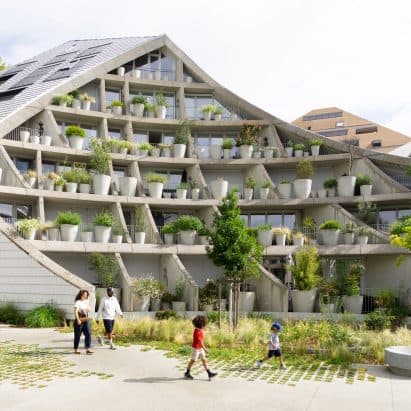
MVRDV's La Vallée Verte: Where Architecture Grows and Breathes in Bordeaux
In a city celebrated for its timeless elegance and UNESCO-listed riverfront, Dutch architectural firm MVRDV has delivered something entirely unexpected. La Vallée Verte — loosely translated as "The Green Valley" — is a new residential housing development in Bordeaux, France, that turns conventional apartment design on its head. Oversized plant pots cascade down façades, and openings cut in the unmistakable silhouette of human figures punctuate the building's exterior, creating one of the most visually arresting housing projects to emerge from Europe in recent years.
The project is a striking example of how contemporary residential architecture can move well beyond the functional and into the expressive, while still serving the practical needs of its inhabitants. For architecture enthusiasts, urban planners, and anyone curious about the future of housing design, La Vallée Verte deserves a close look.
Who Is MVRDV and Why Does This Project Matter?
Founded in Rotterdam in 1993 by Winy Maas, Jacob van Rijs, and Nathalie de Vries, MVRDV is a globally recognised practice known for pushing the boundaries of architecture, urbanism, and landscape design. The firm has long championed the idea that buildings should be more than shelter — they should contribute meaningfully to the social fabric and ecological health of their surroundings. Past projects like the Market Hall in Rotterdam, the Mirador housing block in Madrid, and the Crystal Houses in Amsterdam all demonstrate a consistent commitment to bold, concept-driven design.
La Vallée Verte continues this tradition. Situated in Bordeaux — a city undergoing significant urban transformation as it expands and modernises its residential districts — the project arrives at an important moment in European housing discourse. With cities across the continent grappling with housing shortages, sustainability targets, and questions about quality of urban life, MVRDV's design offers a model that is simultaneously practical and poetic.
The Design: Giant Plant Pots and the Human Form
The most immediately striking features of La Vallée Verte are the large, integrated plant pots that appear to grow directly out of the building's façade. These are not superficial add-ons or window boxes — they are substantial architectural elements, generously sized to support mature shrubs, grasses, and even small trees. The intention is to blur the line between the built environment and the natural world, bringing greenery into the vertical plane in a way that goes well beyond token planting.
This approach aligns with the broader movement toward biophilic design — a philosophy that recognises the deep human need for connection with nature and seeks to embed that connection into the built environment. Research consistently shows that access to greenery, even in urban settings, improves mental health, reduces stress, and enhances residents' sense of wellbeing. By integrating planting at scale directly into the architecture, MVRDV is making biophilic design structural rather than decorative.
Equally arresting are the people-shaped portals — openings and voids cut through the building's form in the silhouette of a standing human figure. These portals serve multiple purposes at once: they allow natural light to pass through the structure, create visual permeability between interior and exterior spaces, and function as a kind of civic symbolism, literally framing the human presence within the building. It is a gesture that is both playful and profound, reminding occupants and passersby alike that architecture ultimately exists to serve people.
Biophilic Design Principles at the Heart of La Vallée Verte
La Vallée Verte is deeply rooted in biophilic design principles, and MVRDV's approach demonstrates several key strategies worth examining:
- Vertical greening at scale: Rather than limiting planting to ground-level landscaping or rooftop terraces, the project distributes vegetation across multiple floors, ensuring that even residents on upper levels have direct visual and physical access to nature.
- Integration over addition: The plant pots are designed as part of the building's structure from the outset, not retrofitted as an afterthought. This ensures structural integrity, adequate drainage, and long-term horticultural viability.
- Community identity through form: The human-shaped portals give the development a distinctive identity that residents can genuinely relate to, fostering a sense of place and belonging that generic apartment blocks rarely achieve.
- Natural light and airflow: The openings and voids created by the portals improve ventilation and daylighting throughout the building, reducing reliance on artificial lighting and mechanical cooling.
Bordeaux as the Right Context for Bold Residential Design
Bordeaux is a city in transition. Long associated with its wine industry and its magnificent 18th-century urban core, the city has in recent decades invested heavily in contemporary architecture and urban renewal. The arrival of high-speed rail links to Paris, combined with a growing tech and creative economy, has brought new residents and new demands for quality housing. In this context, a project like La Vallée Verte is not an anomaly — it is a logical expression of a city that takes design seriously and recognises that housing can be a form of civic pride.
The development also reflects a broader European ambition to make cities greener and more liveable in the face of climate change. As urban heat islands intensify and biodiversity in cities declines, integrated green architecture is increasingly seen not as a luxury but as an essential part of resilient urban planning.
What La Vallée Verte Means for the Future of Housing Design
Perhaps the most important contribution of La Vallée Verte is the argument it makes about what housing can aspire to be. In too many cities, residential development defaults to the minimal and the generic — buildings that meet planning requirements and financial targets but do little to elevate the human experience of living in them. MVRDV's project challenges this default directly.
By investing in bold visual identity, meaningful ecological integration, and design gestures that speak to the residents who will inhabit the space, La Vallée Verte demonstrates that ambition and affordability, creativity and functionality, need not be mutually exclusive. The giant plant pots and people-shaped portals are not mere gimmicks — they are expressions of a deeply considered design philosophy that places human wellbeing and environmental responsibility at the centre of architectural thinking.
Conclusion: A Green Valley Rising in the City
La Vallée Verte by MVRDV is a reminder that the most compelling architecture often emerges from the simplest questions: What do people need? How can a building give back to its environment? What does it mean for a home to truly reflect the people who live there? In Bordeaux, MVRDV has answered those questions with plant pots that burst with life and portals that carry the shape of the human body — and in doing so, has created a residential development that will be studied, admired, and hopefully emulated for years to come.