
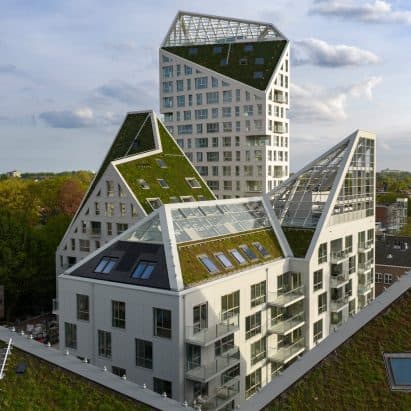
MVRDV Completes Nieuw Bergen: Where Bold Geometry Meets Urban Sensitivity in Eindhoven
Dutch architecture powerhouse MVRDV has once again demonstrated its ability to thread the needle between daring formal invention and respectful urban integration. The firm's latest completed residential project, Nieuw Bergen, rises in the heart of Eindhoven with a roofscape of sharp, angular pitches that immediately sets it apart from the surrounding cityscape — yet never shouts over it. The result is a housing complex that its creators have described as "polite yet radical," a phrase that captures the project's essential tension and, ultimately, its success.
For architecture enthusiasts, urban planners, and anyone watching the evolution of contemporary Dutch residential design, Nieuw Bergen offers a compelling case study in how ambition and context can coexist. From its sculpted silhouette to its street-level presence, the project represents MVRDV's ongoing commitment to housing that refuses to be ordinary without sacrificing its relationship to place.
The Concept: Politeness as a Design Strategy
In contemporary architectural discourse, "contextual design" can sometimes become a polite euphemism for timidity — buildings that disappear into their surroundings rather than contributing meaningfully to them. MVRDV's approach at Nieuw Bergen sidesteps this trap entirely. The concept revolves around the idea that a building can be a good neighbor and a bold visual statement at the same time, and that these qualities are not mutually exclusive.
The "polite" dimension of the project is expressed primarily through scale, materiality, and the careful articulation of its base. The complex engages the street in ways that feel familiar to Eindhoven's existing urban fabric, respecting established building lines and pedestrian rhythms. There is a groundedness to Nieuw Bergen that prevents it from feeling like an alien object dropped into the neighborhood.
The "radical" dimension, on the other hand, is concentrated in the roofline. MVRDV has crowned the complex with a series of angular, dramatically pitched roofs that fracture the skyline in unexpected ways. These are not the gentle gabled roofs of traditional Dutch domestic architecture, nor are they the flat, utilitarian tops of mid-century modernism. Instead, they form a jagged, geometric composition that reads almost like a mountain range rendered in contemporary materials — instantly recognizable, persistently memorable.
Angular Roofs as Architectural Signature
The decision to concentrate formal invention at the roofline is both strategic and deeply considered. MVRDV has long shown interest in the expressive potential of building tops, and Nieuw Bergen extends this exploration in a residential context. The angular roofs do several things simultaneously.
- They create a distinctive skyline silhouette that gives the complex a clear identity from a distance, helping to anchor it as a landmark within Eindhoven's evolving urban geography.
- They allow for varied interior typologies beneath, with sloped ceilings and upper-level spaces that gain character directly from the building's external form.
- They reference the tradition of pitched roofing in Dutch residential architecture while radically departing from its conventions, creating a dialogue between old and new that enriches the city rather than simply replacing one language with another.
- They modulate light in interesting ways, casting dynamic shadows across the building's facades as the sun moves throughout the day and across the seasons.
The roofs are not decorative afterthoughts applied to an otherwise conventional block. They are integral to the building's structural logic and spatial organization, shaping the dwellings below as much as they define the profile above. This integration of form and function is a hallmark of MVRDV's best work, and it is very much present here.
Housing Design in a Dutch Context
Nieuw Bergen arrives at a significant moment for Dutch housing. The Netherlands is navigating a serious and well-documented housing shortage, with cities like Eindhoven under considerable pressure to deliver new residential units quickly and at scale. In this environment, it would be easy for design ambition to be sacrificed at the altar of speed and cost efficiency. MVRDV's project makes an implicit argument against this trade-off.
High-quality, architecturally considered housing is not a luxury reserved for premium developments — it is a contribution to the long-term health and identity of the city. Eindhoven, with its strong industrial heritage and its growing reputation as a hub of design and technology, is a city that understands this. The decision to commission MVRDV, a firm known for pushing boundaries, reflects civic confidence in the value of architecture that aspires beyond the merely adequate.
The project also engages with questions of density and urban form that are central to contemporary Dutch urbanism. By concentrating housing volume intelligently and using the roofline to manage transitions between different scales, Nieuw Bergen achieves a density appropriate to an urban site without overwhelming its surroundings.
MVRDV and the Reinvention of Residential Architecture
Since its founding in Rotterdam in 1991, MVRDV has consistently challenged assumptions about what housing can look like and how it can relate to the city. From the stacked housing of VPRO headquarters to the pixelated facades of Mirador in Madrid, the firm has built a body of work that treats residential architecture as a field of genuine innovation. Nieuw Bergen adds another chapter to this ongoing investigation.
What makes the project particularly interesting is its willingness to find radicalism in a traditionally conservative building type. Houses, and housing complexes, are often the most conservative category of urban architecture — they need to appeal broadly, to reassure as much as to inspire. MVRDV has found a way to meet those expectations while still delivering something that surprises.
A New Landmark for Eindhoven
Eindhoven is a city that has remade itself repeatedly over the past century, from industrial powerhouse to design capital, and it continues to evolve. Nieuw Bergen takes its place in that ongoing transformation — a building that is clearly of its time while also speaking to the enduring Dutch talent for making the most of limited space with maximum ingenuity.
The angular roofs that top this housing complex are more than a formal gesture. They are a statement about what residential architecture can be when it refuses to settle for the predictable. In that sense, Nieuw Bergen is not just a new address in Eindhoven. It is a new benchmark.