
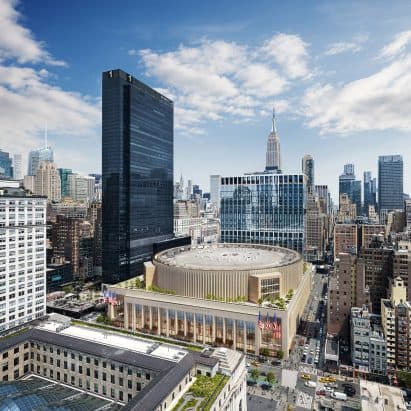
PAU Unveils a New Vision for Penn Station Built Around Political Reality
New York City's Pennsylvania Station has long stood as one of America's most criticized pieces of infrastructure — a sprawling, overcrowded underground labyrinth that bears almost no resemblance to the grand Beaux-Arts original demolished in 1963. Now, architecture studio PAU (Practice for Architecture and Urbanism) has stepped forward with a renovation proposal that takes a notably different approach from previous grand schemes: one explicitly designed to work within the constraints of what is politically and financially achievable right now.
PAU's Penn Station revamp is being framed as a solution tethered to the "political realities of the moment" — a phrase that signals a deliberate departure from the sweeping, billion-dollar master plans that have come and gone over the decades without producing meaningful change. The result is a design that prioritizes functional improvement, passenger dignity, and spatial clarity over architectural spectacle.
Why Penn Station Has Been So Difficult to Fix
Understanding PAU's approach requires understanding just how complicated the Penn Station problem really is. The station sits beneath Madison Square Garden and serves Amtrak, New Jersey Transit, and the Long Island Rail Road, processing over 600,000 passengers on peak days — making it the busiest rail hub in North America. Despite that volume, it has been widely described as a source of misery for commuters and travelers alike, plagued by poor wayfinding, low ceilings, inadequate lighting, and a general sense of spatial confusion.
Decades of proposals to transform or replace Penn Station have stalled for a variety of reasons. Political disagreements between city, state, and federal agencies, funding shortfalls, the contentious presence of Madison Square Garden above the station, and disagreements over the role of adjacent development projects have all conspired to prevent meaningful progress. The most high-profile recent effort, the Empire Station Complex plan, attracted significant controversy and criticism over its scale and the role of private real estate development in subsidizing public infrastructure.
Against this backdrop, PAU's decision to calibrate its design to current political realities feels less like a compromise and more like a strategy.
What PAU's Design Proposes
At the heart of PAU's proposal is a commitment to improving the passenger experience through thoughtful spatial reorganization rather than wholesale demolition and reconstruction. The design focuses on making the existing station legible — helping the hundreds of thousands of people who pass through it daily actually understand where they are, where they need to go, and how to get there.
Key elements of the proposal include improved wayfinding systems, better integration between the station's various transit operators, enhanced lighting conditions throughout the concourses, and a reorganization of circulation paths to reduce the bottlenecks and congestion that define the current experience. The design also looks at how the station's relationship with the street level can be improved, making entries and exits feel less like descending into a basement and more like arriving at a genuine civic space.
PAU has also addressed the longer-term question of what a more ambitious transformation might look like, while being transparent that the immediate phase of work is intentionally scaled to what can realistically move forward given current funding environments and political alignments.
The Architecture of Pragmatism
There is something quietly radical about a firm openly describing its design as shaped by political realities. Architecture, particularly at the civic scale, is often sold on the strength of bold vision — the daring rendering, the transformative gesture, the promise of a future that looks nothing like the present. PAU is doing something different: building credibility and momentum by showing that meaningful improvement is possible without waiting for a perfect political or financial moment that may never arrive.
This approach aligns with a broader conversation happening in urban planning and infrastructure design. After years of megaprojects that either never broke ground or ran catastrophically over budget and schedule, there is growing interest in what might be called incremental urbanism — the idea that cities improve through accumulated, realistic interventions rather than periodic grand reinventions.
For Penn Station, where the stakes are enormous and the history of failed grand plans is long, this kind of disciplined pragmatism may actually represent the best path forward.
PAU's Track Record and Why It Matters
PAU, founded by Vishaan Chakrabarti, brings a particular combination of architectural ambition and urban policy literacy to a project like this. Chakrabarti spent years in New York City government before founding the studio, giving him an unusually clear view of how decisions about infrastructure and development actually get made. That background is evident in how PAU has framed its Penn Station work — not just as an architectural exercise, but as a contribution to an ongoing civic and political negotiation.
The firm has worked on several significant urban projects, consistently demonstrating an interest in how design can serve broad public goals rather than purely aesthetic or commercial ones. That ethos seems well suited to Penn Station, a place where the public interest is enormous and the design challenge is as much organizational and political as it is spatial.
What Comes Next for Penn Station
The future of Penn Station remains genuinely uncertain. The station's renovation is entangled with questions about Madison Square Garden's lease, federal infrastructure funding, the ongoing Gateway Tunnel project, and the competing priorities of multiple transit agencies. PAU's proposal does not resolve all of those tensions — nor does it claim to.
What it does offer is a credible, grounded vision of how the station could be meaningfully improved in the near term, while leaving room for more ambitious transformation as conditions evolve. In a project defined by decades of gridlock, that kind of patient, realistic thinking may be exactly what Penn Station needs.
- PAU's design prioritizes passenger experience and spatial legibility over dramatic architectural gestures.
- The proposal is explicitly calibrated to current political and financial realities in New York City.
- Improved wayfinding, lighting, and circulation are central to the near-term vision.
- The firm leaves room for more ambitious long-term transformation as political conditions change.
- PAU's urban policy background gives the studio a distinctive lens on the project's complex stakeholder environment.
Whether PAU's approach ultimately leads to tangible change at Penn Station will depend on forces well beyond any single architecture firm's control. But as a statement of intent — and as a demonstration that serious, rigorous design thinking can coexist with political realism — it marks a notable moment in the long, complicated story of America's busiest train station.