
The Old Retirement Playbook Is Broken
For generations, the retirement housing script read like clockwork: wait until the kids leave home, sell the big family house, pocket the difference, buy something smaller and more manageable, and enjoy a simpler life. It was a rite of passage that made both practical and financial sense. The equity freed up from downsizing helped fund retirement, and the smaller home meant lower bills, less maintenance, and fewer headaches.
But in 2025, that script has been torn up. A combination of sky-high home prices, stubbornly elevated mortgage rates, and a deeply imbalanced housing market has flipped the calculus entirely. For a growing number of retirees, downsizing no longer pays off — and some are responding in a way that would have seemed unthinkable a decade ago: they're upsizing.
When Downsizing Stops Making Financial Sense
The core problem is simple: the gap between what retirees can sell their current home for and what a smaller replacement home costs has narrowed dramatically — and in many markets, it has nearly vanished altogether.
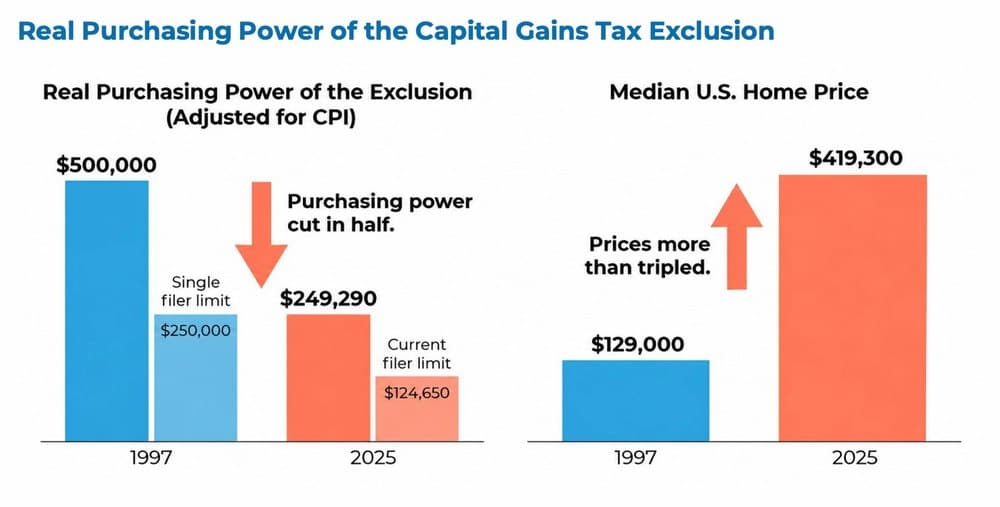
Starter homes, which were once an affordable entry point into homeownership, now cost close to or above $1 million in more than half the country. That means even a modest two-bedroom condo or a smaller single-family home in a desirable area can carry a price tag that consumes much of the equity a retiree spent decades building. After accounting for closing costs, moving expenses, and the reality of buying into today's market, many retirees are discovering that downsizing leaves them with far less financial cushion than they expected.
For retirees who had planned to preserve a significant portion of their home equity — either to fund their own retirement or to eventually pass along to their children — this is more than an inconvenience. It's a threat to long-term financial security and to the generational wealth they hoped to build.
Adult Children Locked Out of the Market
At the same time, the housing crisis isn't just affecting older Americans. Millennials and younger Gen X adults — the very children of today's retirees — are facing one of the most difficult homebuying environments in modern history. High home prices, elevated interest rates, and tight inventory have locked millions of would-be first-time buyers out of the market entirely.
For many of these adult children, the difference between buying a home and remaining a renter indefinitely comes down to one thing: family financial support. A parental gift or loan toward a down payment can make homeownership possible when saving independently would take decades.
This convergence — retirees whose downsizing equity is being eroded and adult children who desperately need housing help — has turned what was once a simple lifestyle decision into a deeply complex family finance question.
"This is no longer just a lifestyle question. It turns into an affordability question, turns into a wealth transfer question," says Evan Mills, associate financial adviser at Scholar Advising.
The Rise of the Upsize Strategy
Faced with these twin pressures, some retirees are choosing a counterintuitive path: instead of selling the family home and buying something smaller on their own, they're purchasing a larger home together with their adult children. The idea is to combine household resources, reduce the financial strain on everyone involved, and keep wealth within the family rather than watching it get absorbed by transaction costs and inflated replacement home prices.
On paper, the appeal is real. A multigenerational home purchase can allow a retiree to avoid a costly downsize while simultaneously giving an adult child access to homeownership they couldn't otherwise afford. It can reduce living expenses for both generations, provide built-in support as parents age, and serve as a vehicle for early inheritance — transferring wealth in the form of housing equity rather than waiting until death.
This approach also sidesteps one of the crueler ironies of the current market: that selling a paid-off family home only to buy something nearly as expensive means paying today's mortgage rates on a new loan, wiping out years of financial progress in a single transaction.
Upsizing Isn't Without Its Own Risks
But Mills and other financial advisers caution that upsizing with adult children is far from a perfect solution. A bigger home doesn't just mean more square footage — it means higher property taxes, larger utility bills, more maintenance costs, and potentially a larger mortgage than a retiree on a fixed income is comfortable carrying.
There are also the deeply human complications that come with blending households and finances across generations. What happens if the adult child wants to move? What if the financial contributions aren't equal? How is ownership structured legally? These are questions that require careful legal and financial planning before anyone signs a purchase agreement.
"Right now it's not choosing between two great options," Mills says. "It's more like deciding which heavy door you actually want to push open."
How Retirees Should Approach This Decision
For retirees weighing their housing options, experts suggest taking the following steps before making any moves:
- Run the actual numbers. Don't assume downsizing will generate meaningful equity until you've compared the realistic net proceeds from your current home against the true all-in cost of a replacement property in your target area.
- Consult a financial adviser. A retirement-focused financial planner can help model different scenarios — including multigenerational purchase options — and evaluate how each affects your long-term financial security.
- Get legal structures in place. If you're purchasing a home with an adult child, work with a real estate attorney to establish clear ownership arrangements, exit strategies, and financial responsibilities before closing.
- Have honest family conversations. Multigenerational living arrangements work best when expectations are set clearly from the start. Discuss finances, privacy, household responsibilities, and long-term plans openly.
- Consider the tax implications. Gifting, co-ownership, and inheritance each carry different tax consequences. A certified financial planner or tax adviser can help you structure arrangements to minimize tax exposure.
A Market That's Forcing New Thinking
The shift from downsizing to upsizing is a striking symptom of just how much the housing market has changed. What worked for previous generations — sell big, buy small, bank the difference — simply doesn't produce the same outcome in a market where home prices have outrun inflation, wages, and retirement savings by a wide margin.
For retirees, the challenge is to think about housing not just as a place to live, but as one of the most significant financial assets they own — and to make decisions that protect and extend the value of that asset across generations. Whether that means downsizing strategically, upsizing with family, or holding the current home longer than originally planned, the key is to approach the decision with clear eyes and sound professional guidance.
The old retirement script may be broken. But with careful planning, retirees can still write a new one that works — for themselves and for the next generation.