
New York Earns a Failing Grade as the Worst State for Homebuilding and Affordability in 2026
If you have been struggling to find an affordable home in New York, Massachusetts, or California, there is now hard data to validate your frustration. The newly released 2026 Realtor.com® Housing Report Card has confirmed what many buyers already suspected: coastal and Western states are failing residents when it comes to homebuilding activity and housing affordability. And leading the pack in the wrong direction is New York, which ranked dead last among all 50 states and the District of Columbia.
With a score of just 8.5 out of 100 and an F grade, the Empire State's performance is not merely disappointing — it is alarming. For anyone watching the national housing market, this report offers an important roadmap of where the crisis is most severe and which states are doing the least to address it.
How the 2026 Realtor.com Housing Report Card Works
The annual Housing Report Card evaluates every U.S. state and the District of Columbia on a 100-point scale. The rankings are built around two core categories: housing affordability and residential construction activity. Together, these two metrics paint a clear picture of which states are making it easier for residents to find and afford a home — and which are making it nearly impossible.
States that build more homes relative to their population and maintain lower housing costs relative to incomes tend to score higher. Those that restrict new construction through regulatory hurdles, geographic constraints, or political opposition — while simultaneously allowing home prices and rents to climb unchecked — fall to the bottom of the rankings.
The top scorer this year was Indiana, which earned an A grade with an impressive 76.3 points out of 100. The Hoosier State's combination of strong construction output and genuine affordability made it a standout performer. On the other end of the spectrum, New York's score of 8.5 points reflects the enormous gap between what the market demands and what state and local policy is delivering.
The 10 Worst States for Homebuilding and Affordability in 2026
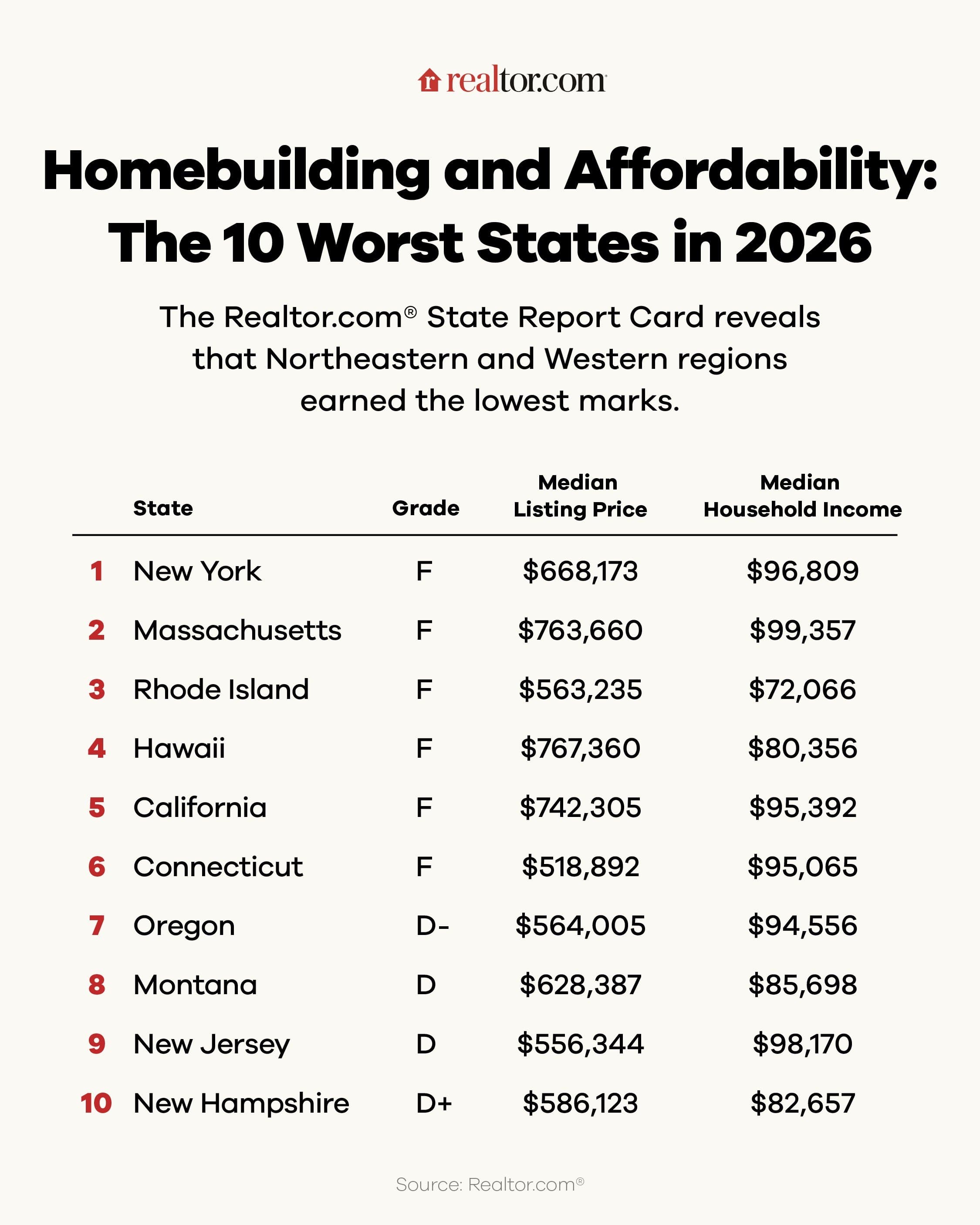
The bottom ten states in the 2026 report card are dominated by coastal regions and high-cost metro areas. Here is a breakdown of the states that received failing or near-failing grades:
- New York — Ranked dead last with a score of just 8.5 out of 100 and an F grade. Sluggish construction pipelines and some of the highest housing costs in the nation pushed the Empire State to the very bottom of the rankings.
- Massachusetts — Another F-grade state, Massachusetts continues to battle sky-high home prices driven by limited land availability, strict zoning laws, and intense demand in and around the Boston metro area.
- Rhode Island — The nation's smallest state also earns one of its worst housing grades. Rhode Island's limited developable land and persistent affordability pressures contributed to its failing score.
- Hawaii — Geographic isolation, scarce buildable land, and extremely high construction costs make Hawaii one of the most unaffordable housing markets in the country, earning it an F on the report card.
- California — Despite years of public debate about its housing crisis, California continues to struggle with inadequate new construction relative to demand, earning a failing grade once again in 2026.
- Connecticut — Rounding out the F-grade states, Connecticut faces stiff affordability challenges, particularly in its Fairfield County communities that sit in the shadow of the New York City metro area.
- Oregon — Earning a grade in the D range, Oregon performs marginally better than the F states but still reflects serious affordability and construction challenges, particularly in the Portland metro.
- Montana — A surge in in-migration over the past several years drove home prices to record levels in Montana, a state whose construction sector has struggled to keep up with newfound demand.
- New Jersey — One of the most densely populated states in the country, New Jersey faces severe land constraints and high property taxes that contribute to ongoing affordability struggles.
- New Hampshire — Completing the bottom ten, New Hampshire earned a D+ grade. While it offers more rural space than many of its New England neighbors, housing costs relative to local incomes remain a persistent challenge.
Why Coastal and Western States Keep Falling Behind
The pattern here is not accidental. Coastal and Western states share several structural characteristics that make it difficult to solve housing problems through the market alone. Dense existing development leaves little room for new construction without tackling complex zoning reform. Environmental regulations, while important, can add significant time and cost to new projects. Community opposition to new development — commonly known as NIMBYism — remains a powerful political force in many of these states. And in cities like New York and San Francisco, infrastructure costs alone can make new residential construction financially unfeasible without substantial subsidies.
The result is a vicious cycle: too few homes are built, prices stay elevated, residents are squeezed financially, and those who can leave often do — taking their tax contributions with them and making it even harder for governments to fund the housing solutions that remain.
What This Means for Homebuyers in 2026
If you are currently renting or trying to purchase a home in one of these bottom-ranked states, the 2026 Housing Report Card is a sobering reminder of the structural headwinds you face. Affordability is not improving quickly in these markets, and new construction remains well below the levels needed to meaningfully shift the balance between supply and demand.
For buyers who have flexibility on location, the data makes a compelling case for looking toward higher-scoring states like Indiana, Tennessee, or Texas, where housing costs remain more manageable and builders are actively adding inventory. For those who cannot or choose not to relocate, understanding the local market conditions in your state can help you make smarter decisions about timing, budgeting, and realistic expectations.
The Bigger Picture: A National Housing Crisis With Uneven Solutions
The 2026 Realtor.com Housing Report Card is a useful annual temperature check on the state of American housing. It reinforces a point that economists and housing advocates have been making for years: the housing affordability crisis is real, deeply rooted, and unevenly distributed across the country. While states like Indiana offer hope that affordability is achievable through smart policy and active construction, places like New York, California, and Massachusetts demonstrate how difficult it is to course-correct once a market spirals toward dysfunction.
Until policymakers in these underperforming states take bolder action on zoning reform, permitting timelines, and construction incentives, residents will continue to pay the price — literally — for inaction. The grades are in, and for the worst-performing states, the message could not be clearer: the current approach is not working.