
Why My Small Kitchen Was Driving Me Crazy
Anyone who has ever lived in a small apartment kitchen knows the particular frustration of it: not enough counter space, cabinets that are either too high or too shallow, and a nagging feeling that no matter how many drawer organizers you buy, you are always one cutting board away from total chaos. That was my reality for almost three years. I tried baskets, magnetic knife strips, hanging pot racks, and more over-the-door organizers than I care to admit. Nothing made a meaningful dent in the problem.
Then I turned to IKEA's KALLAX shelf unit — a piece I had always associated with living rooms and home offices — and everything changed. Within a single weekend, I effectively doubled my usable kitchen storage without knocking down a single wall, hiring a contractor, or spending more than a few hundred dollars. Even better, the result looks so intentional and polished that guests regularly assume it was professionally built in when we moved in.
What Is the IKEA KALLAX, and Why Does It Work So Well in a Kitchen?
The KALLAX is one of IKEA's most versatile and enduring shelf systems. Available in a range of sizes from a single cube all the way up to a five-by-five grid, it features a clean, modernist silhouette with thick, sturdy walls that can support significant weight. The unit is designed so that each square opening measures roughly 33 by 33 centimeters, which happens to be an almost perfect fit for a wide range of IKEA's own storage boxes, baskets, and drawer inserts — most of which are sold as compatible accessories.
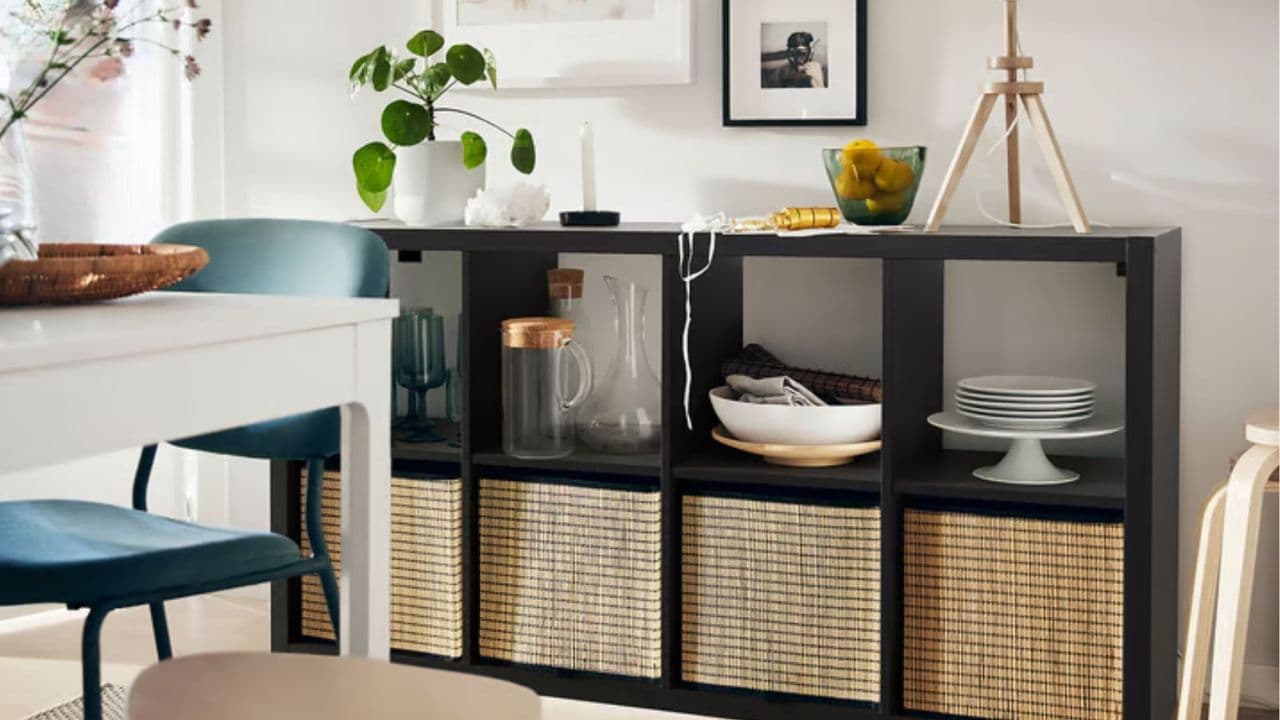
What makes the KALLAX particularly powerful in a kitchen setting is that combination of openness and modularity. You can dedicate certain cubbies to display items like cookbooks, olive oil bottles, or a small potted herb, while using inserts with doors or fabric bins in other cubbies to hide less photogenic things like batteries, takeout menus, and the ever-mysterious collection of rubber bands and mystery keys that accumulates in every kitchen over time.
How I Planned the Layout Before Buying Anything
The single most important step in this project was measuring carefully and planning the configuration on paper before setting foot in the store. I identified a wall in my kitchen adjacent to the refrigerator that was essentially wasted space — it held a single narrow shelf that wobbled when you looked at it the wrong way. That wall measured approximately 80 centimeters wide and had ceiling height of 240 centimeters.
I decided on a 4x2 KALLAX unit placed horizontally at counter height (roughly 90 centimeters from the floor), giving me both a wide work surface on top and eight spacious cubbies underneath. Above that, I mounted a second, smaller 2x2 KALLAX unit on the wall using IKEA's wall-mounting brackets, aligning its outer edges with the unit below. The visual effect of stacking and aligning the two units is what creates that convincing built-in appearance — the eye reads the whole assembly as one continuous piece of furniture rather than two separate shelves.
The Products and Accessories That Made It Look Custom
The KALLAX units themselves are only the starting point. The transformation into something that looks genuinely built-in comes from a handful of additional choices:
- Baseboard trim: Running a simple piece of painted MDF baseboard along the bottom of the lower KALLAX unit and caulking the edges where the unit meets the wall costs almost nothing and visually anchors the piece to the room.
- KALLAX inserts with doors: IKEA sells push-open door inserts that fit the KALLAX cubbies precisely. Using these on the lower unit creates the look of proper cabinet doors and hides utilitarian storage completely.
- Consistent hardware: Swapping the standard IKEA door knobs for matching hardware from a hardware store — brushed brass pulls in my case — immediately elevates the whole assembly and ties it into the rest of the kitchen's aesthetic.
- Paint matching: Painting the back interior of the open upper cubbies the same color as the kitchen wall makes the entire unit recede visually into the wall, reinforcing the built-in illusion dramatically.
- Crown molding: A single strip of crown molding across the top of the upper unit, painted to match the ceiling, completes the illusion. This one detail alone is responsible for most of the "wait, was that always there?" reactions from visitors.
What I Store in It — and How I Organized Everything
The lower unit, with its door inserts and solid shelving, now handles everything I previously crammed into overflowing cabinets: small appliances like my immersion blender and food processor, baking supplies, canned goods, and a dedicated cubby for reusable bags. The countertop surface created by the top of the lower unit serves as extra prep space — something that felt like an impossible luxury in my old kitchen layout.
The upper open unit holds items that benefit from being visible and accessible: my most-used cookbooks, a small oil and vinegar station, a fruit bowl, and a compact coffee setup. Having these things on display at eye level actually encourages me to use them more regularly and keeps the rest of my counter completely clear.
The Cost Breakdown
Transparency matters when it comes to budget projects, so here is what the whole thing actually cost. The 4x2 KALLAX retailed for approximately $109, and the 2x2 unit for around $55. Four door inserts added another $60. Hardware, trim pieces, paint, caulk, and wall anchors came to roughly $45 in total. The entire project cost under $270 — a fraction of what even the most basic kitchen cabinet installation would run.
What I Would Do Differently
If I were starting over, I would invest in proper furniture feet or a simple platform base for the lower unit rather than relying solely on trim to finish the bottom edge. Furniture feet add a few centimeters of height that makes it easier to clean the floor underneath and gives the unit a slightly more polished, furniture-grade appearance. I would also prime and seal the back panel cutouts before painting, since KALLAX back panels are made from a thin composite board that absorbs paint unevenly without a primer coat.
The Bigger Lesson About Small Space Living
The KALLAX kitchen project taught me something that goes beyond interior design: in small spaces, the biggest gains rarely come from renovations. They come from looking at what you already have — in this case, a perfectly good blank wall — and being willing to rethink how a piece of furniture can function in an unexpected context. IKEA's design philosophy has always leaned into this kind of adaptability, and the KALLAX is perhaps its best expression of that idea. It is not a kitchen product, technically. But in my kitchen, it is the best thing in the room.
If you are living with a small kitchen and feeling stuck, the KALLAX is genuinely worth your time to investigate. Measure your walls, browse the insert options, and spend an afternoon watching how other people have adapted it in spaces like yours. The renovation you have been putting off might not be necessary after all.