
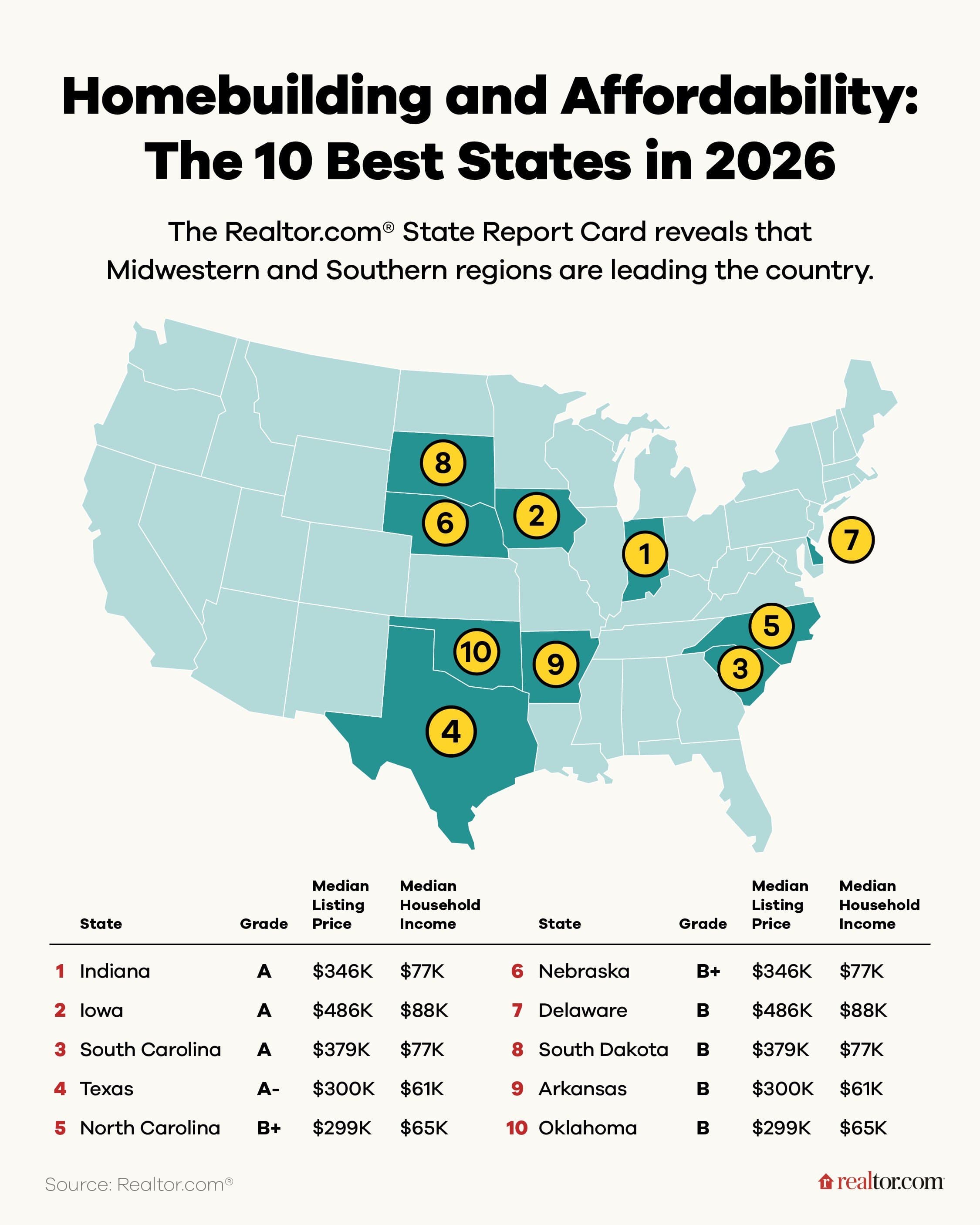
Indiana Claims the Top Spot in the 2026 Realtor.com Housing Report Cards
If you have been searching for the most affordable place to buy a home or the best market for new construction, the answer is increasingly clear: head to the Midwest. According to the newly released 2026 Realtor.com® Housing Report Cards, Indiana has climbed to the No. 1 position in the nation, earning an impressive A grade and dethroning 2025's leader, South Carolina. The report, which evaluates all 50 states and the District of Columbia across key housing metrics, paints a vivid picture of a country sharply divided between thriving interior markets and struggling coastal ones.
What Are the Realtor.com State Housing Report Cards?
Each year, Realtor.com releases its State Housing Report Cards as a comprehensive tool for understanding how each state performs across critical real estate metrics, including homebuilding activity, housing affordability, inventory levels, and overall market health. The grades range from A+ down to F, giving buyers, sellers, investors, and policymakers a quick but data-backed snapshot of where housing markets stand.
According to Realtor.com senior economist Joel Berner, this year's findings reveal both continuity and meaningful change: "This year's refresh reveals a familiar regional divide, but also some notable shifts beneath the surface, with a new state at the top of the class and a handful of states whose grades moved dramatically in either direction."
One of the most telling takeaways from the 2026 edition is that not a single state earned an A+ rating. Even the strongest housing markets in the country, it seems, still have measurable room to improve — a reality that reflects the lingering affordability and supply challenges that continue to define the post-pandemic housing landscape.
Indiana's Rise to the Top: What Makes It No. 1?
Indiana's jump to the top spot was not accidental. The state climbed three positions from its ranking in the prior year, ultimately unseating South Carolina, which slipped to third place in 2026. Indiana's success story is rooted in two fundamental pillars of a healthy housing market: affordability and new home construction.
Home prices in Indiana remain well below the national median, making it one of the few states where middle-income buyers can still realistically enter the market without being priced out. Simultaneously, builders in Indiana have remained active, adding new inventory at a pace that helps keep supply relatively healthy compared to high-demand coastal markets where construction faces steep regulatory, geographic, and financial barriers.
This combination — homes that people can actually afford paired with a steady pipeline of new construction — is precisely the formula that housing economists point to as the foundation of a sustainable, accessible market. Indiana appears to have cracked that code more effectively than any other state in 2026.
The Midwest and South Dominate the Top Rankings
Indiana's rise to the top is not an isolated story. The broader 2026 report underscores a powerful and persistent regional trend: the Midwest and South are outpacing the rest of the nation when it comes to housing affordability and new construction activity.
Of the 13 states that earned the highest marks — grades ranging from B- to A — a remarkable 12 were located in the Midwest or South. The lone exception among the top performers was Delaware, the only East Coast state to crack the top 10, landing in seventh place. This geographic clustering speaks to the structural advantages these regions hold, including lower land costs, more permissive zoning environments, favorable tax climates, and room to build outward rather than upward.
States consistently cited among the top performers in affordability and construction in these regions include Indiana, South Carolina, and a range of other Sun Belt and heartland markets that have attracted both builders and buyers in significant numbers over recent years. The demographic migration patterns seen during and after the COVID-19 pandemic, with residents leaving expensive coastal metros for more affordable interior cities, have reinforced and accelerated these trends.
Coastal States Continue to Struggle — New York Ranks Last
On the opposite end of the spectrum, the 2026 report delivers a sobering verdict for coastal and Western states. Mirroring the results from last year, six coastal states earned an F grade — the lowest possible score — with New York ranking dead last among all 51 markets evaluated.
These states face a combination of deeply entrenched challenges that are notoriously difficult to resolve quickly. Sky-high home prices, chronically low inventory, strict zoning laws that limit new development, high property taxes, and elevated construction costs all conspire to make homeownership increasingly out of reach for average buyers. California, Hawaii, and other Western states round out the bottom tier, reflecting housing crises that have been building for decades.
The gap between top and bottom performers is not just a matter of degree — it represents fundamentally different housing realities. While a first-time buyer in Indiana may realistically find a quality home within their budget, that same buyer in coastal markets might face prices several times higher with far fewer options.
What This Means for Homebuyers and Investors in 2026
For prospective homebuyers, the 2026 Realtor.com State Report Cards offer practical, actionable insight. If affordability is a top priority, the data firmly points toward Midwest and South markets as the most viable destinations. States like Indiana are not just affordable today — their active construction pipelines suggest that supply will continue to support buyers in the near term rather than tighten further.
For real estate investors, the report highlights where demand fundamentals are strongest relative to price. Markets earning top grades tend to attract population growth, employment expansion, and sustained buyer demand — all factors that support long-term property value appreciation and rental market health.
Even for those who cannot or do not wish to relocate, the report serves as a useful benchmark for understanding local market conditions. A state earning a C or D grade may still contain pockets of relative affordability or neighborhoods with active development, making granular local research an essential next step beyond the state-level picture.
Looking Ahead: Can Any State Earn an A+?
Perhaps the most thought-provoking finding from this year's report is the absence of any A+ grade across all 50 states and the District of Columbia. It is a reminder that even the best-performing housing markets face unresolved challenges — whether that means growing affordability pressures as populations increase, infrastructure limitations that cap how much new development can occur, or labor and materials costs that slow construction timelines.
Indiana's achievement in reaching the top of the class is genuinely significant, but the A grade rather than A+ signals that there remains work to do. As housing remains one of the most urgent economic concerns for American families in 2026, the Realtor.com State Report Cards serve as both a scorecard and a roadmap — showing where progress is being made, where it is urgently needed, and what the rest of the country might learn from the states leading the way.
Whether you are a buyer, seller, renter, policymaker, or simply someone watching the housing market, one message from the 2026 report is unmistakable: the Midwest, led by Indiana, is where America's housing future looks the most promising right now.