
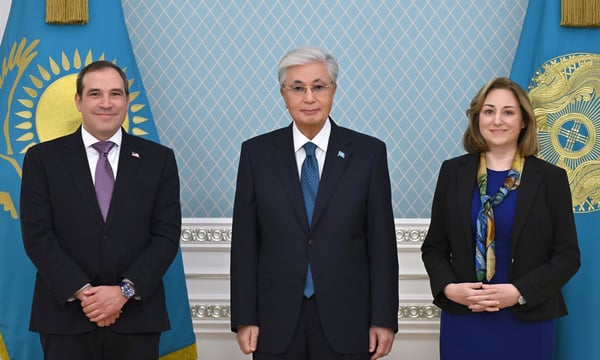
Kazakhstan and the Board of Peace: Membership Without the Price Tag
In the world of international diplomacy, perception often carries as much weight as reality. Kazakhstan appears to have taken that principle to heart. Despite opting out of the $1 billion fee required to secure permanent membership in Donald Trump's Board of Peace, Kazakhstan has continued to publicly promote and highlight its association with the initiative. It is a bold diplomatic maneuver — one that reveals a great deal about how Astana navigates its complex geopolitical position between major global powers.
To understand why this matters, it helps to first understand what the Board of Peace is, why Kazakhstan's participation is notable, and what the country stands to gain by straddling the line between formal membership and strategic ambiguity.
What Is Trump's Board of Peace?
Donald Trump's Board of Peace is a diplomatic initiative tied to his broader foreign policy vision of transactional international engagement. The concept centers on creating a coalition of nations committed to stability and conflict resolution, with permanent members expected to contribute financially to the initiative — a reported fee of $1 billion per country for full permanent membership.
The pay-to-play structure of the Board of Peace is consistent with Trump's long-standing approach to international alliances and partnerships: nations are expected to contribute materially, not just rhetorically. The initiative has attracted attention precisely because it blurs traditional lines of multilateral diplomacy with something closer to a membership club model, where financial contributions define status and influence.
For resource-rich nations with the means and the motivation, the $1 billion entry fee may represent a worthwhile investment in geopolitical alignment with Washington. For others, especially those walking a tightrope between the United States, Russia, and China, the calculus is far more complicated.
Kazakhstan's Unique Geopolitical Position
Kazakhstan is one of the most strategically situated countries in Central Asia. It shares an enormous border with Russia, maintains deep economic ties with China through the Belt and Road Initiative, and has simultaneously worked to strengthen relationships with Western partners, including the United States and European Union. This multi-vector foreign policy has been a defining characteristic of Kazakhstani diplomacy for decades.
Committing $1 billion to a U.S.-led initiative would send an unmistakable signal — and not necessarily a welcome one — to Moscow and Beijing. For a country that depends on balanced relationships with all three of the world's major power centers, such a visible financial commitment to a Trump-branded initiative could create friction that outweighs the benefits of formal membership.
And yet, complete disengagement from the Board of Peace carries its own risks. Appearing indifferent to a key U.S. foreign policy initiative, particularly one championed directly by a sitting American president, could cool relations with Washington at a time when Kazakhstan values that relationship as a counterbalance to Russian and Chinese influence.
The Strategy: Highlighting Membership Without Paying for It
This is where Kazakhstan's approach becomes particularly interesting. By continuing to publicly highlight its connection to the Board of Peace — referencing its membership in official communications and diplomatic settings — Kazakhstan is attempting to enjoy the reputational and relational benefits of association without formally committing the financial resources that permanent membership demands.
It is a strategy that relies heavily on ambiguity. There is no explicit public correction from Washington stating that Kazakhstan is not a full member. There is no formal exclusion. In the absence of a clear boundary being enforced, Kazakhstan occupies a gray zone that allows it to claim proximity to the initiative without triggering the political consequences of a formal $1 billion contribution.
This kind of diplomatic maneuvering is not unique to Kazakhstan. Smaller and middle powers frequently find ways to signal alignment with powerful patrons without fully committing to the terms those patrons set. What makes Kazakhstan's situation distinctive is the scale of the financial gap involved and the transparency with which it appears to be leveraging that ambiguity.
What Kazakhstan Gains From This Approach
The benefits of this strategy are several. First, Kazakhstan maintains a positive narrative in its relationship with the United States, signaling goodwill and engagement without the financial or political costs of full commitment. Second, it preserves Kazakhstan's reputation as a neutral, peace-oriented nation — a brand Astana has cultivated carefully through hosting major international negotiations, including talks related to the Syrian conflict under the Astana Process.
Third, and perhaps most importantly, it avoids provoking Russia or China in ways that a high-profile, billion-dollar financial commitment to a U.S. initiative might. Kazakhstan's economy and security remain closely tied to both neighbors, and the country cannot afford to be seen as drifting decisively into a Washington-aligned orbit.
The Risks of Playing Both Sides
No strategy is without risk. If the Board of Peace gains significant traction and formal membership begins to carry concrete diplomatic or economic benefits, Kazakhstan's non-paying status could eventually become a liability. Washington may also grow frustrated with a pattern of association without contribution — particularly given that financial commitment is central to the initiative's design.
Additionally, if Russia or China perceives Kazakhstan's continued public emphasis on Board of Peace membership as a signal of Western alignment regardless of the fee, the intended ambiguity of the strategy could collapse.
A Case Study in Middle Power Diplomacy
Kazakhstan's handling of the Board of Peace is ultimately a case study in the art of middle power diplomacy. With limited leverage but significant strategic geography, Astana has found a way to extract value from an international initiative without paying its price — at least for now. Whether this balancing act holds as the Board of Peace evolves remains one of the more intriguing questions in Central Asian geopolitics.
For observers of Kazakhstani foreign policy, it is yet another reminder that in diplomacy, what a country says about itself often matters as much as what it formally signs, pays for, or commits to in writing.