
Louisville's Housing Market Is Making Headlines — And It's Not About Horse Racing
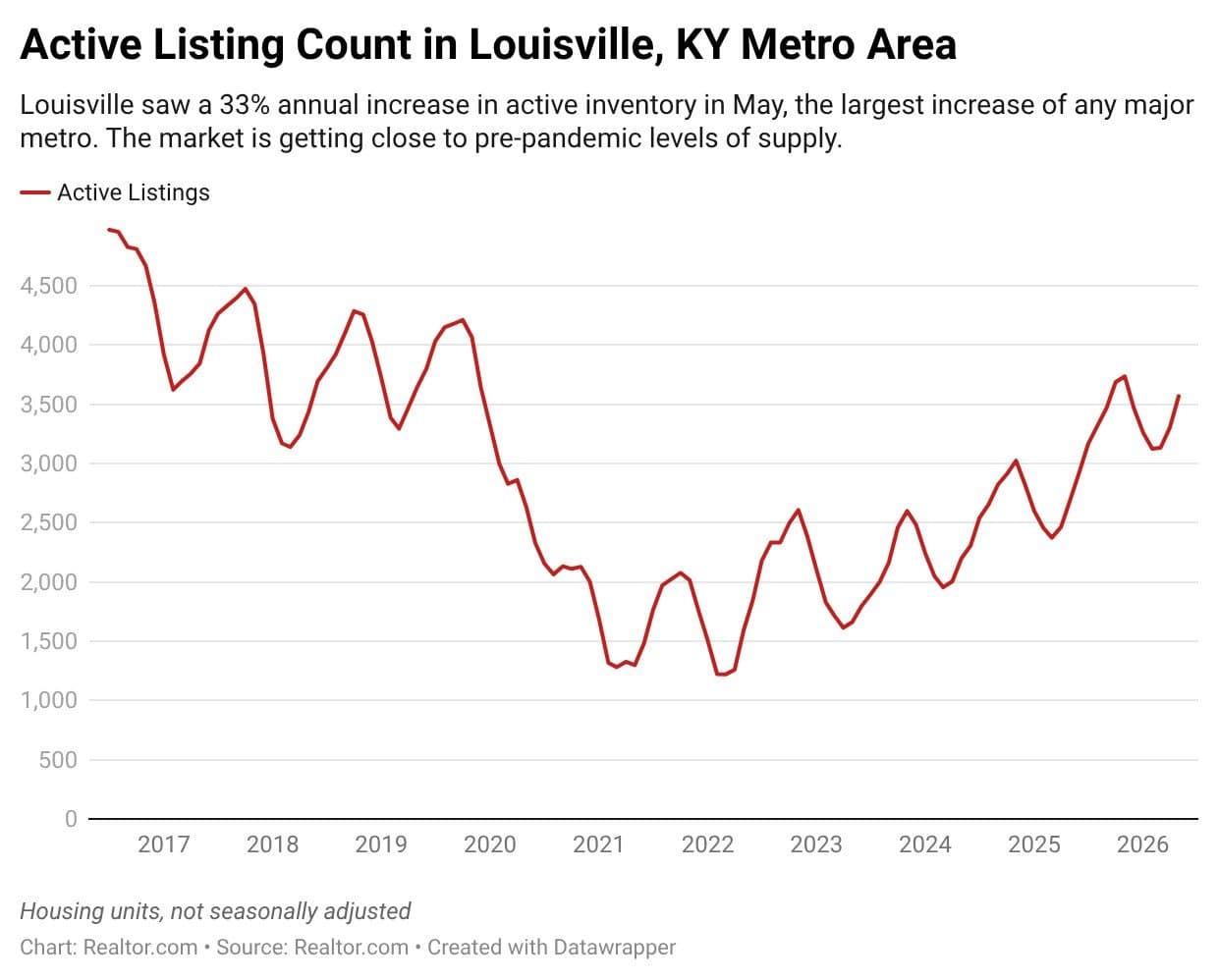
When most people think of Louisville, Kentucky, they picture the Kentucky Derby, bourbon distilleries, and Southern charm. But in May 2026, the city is grabbing attention for something entirely different: a historic surge in housing inventory that has real estate watchers across the country taking notice. According to the latest Realtor.com May 2026 housing report, Louisville posted the highest year-over-year inventory increase of any major metropolitan area in the United States — a remarkable 32.7% jump in homes available for sale.
To put that number in perspective, the national average inventory increase clocked in at just 2.2% over the same period, while the South as a whole saw a mere 0.3% uptick. Louisville didn't just outpace its peers — it lapped them. So what's driving this surge, what does it mean for the local market, and should buyers and sellers be paying close attention? Let's break it down.
Why Is Louisville's Housing Inventory Surging So Dramatically?
The short answer is that sellers are coming back. After years of historically tight inventory that defined the pandemic-era real estate market, Louisville homeowners appear to be regaining the confidence to list their properties. But experts caution against reading too much doom or boom into the numbers.
Realtor.com senior economist Jake Krimmel offers a measured interpretation of the data. "It looks like the market is in balance with a recent run-up and normalization in both supply and demand," he explains. "The market is getting more active compared to last year without big price swings, which is a great sign."
In other words, this isn't a flood of distressed sellers rushing to unload properties before values crater. Instead, it appears to represent a healthy correction — a return to the kind of inventory levels Louisville saw before the pandemic upended real estate norms nationwide. That distinction matters enormously when assessing the health of the market.
What's Happening With Home Prices in Louisville?
One of the most closely watched indicators in any housing market is price movement, and Louisville's numbers here are nuanced. The median list price in the city dipped approximately 2% year-over-year, landing at $319,900. For buyers who have spent the past few years being priced out of markets or forced into brutal bidding wars, even a modest price decline is welcome news.
However, that 2% dip should not be interpreted as a sign of market weakness. When inventory rises sharply, prices often soften slightly as buyers gain more negotiating power — that's basic supply and demand. The critical question is whether demand holds up when more homes enter the market, and in Louisville's case, the answer is a resounding yes.
Buyer Demand Remains Strong Despite the Inventory Jump
Here is the most encouraging data point from Louisville's May 2026 housing numbers: pending sales are up 5% year-over-year. That means that as new listings have flooded the market, buyers have shown up to absorb them. Krimmel puts it plainly: "Buyers didn't disappear when more homes came online."
This is a critical distinction between a healthy market rebalancing and a market correction driven by weakness. In a distressed market, inventory rises because sellers can't find buyers. In Louisville, the opposite dynamic appears to be at play — both supply and demand are growing in tandem, creating a more balanced environment that benefits everyone involved in a transaction.
For buyers, this means more choices, slightly softer prices, and less pressure to make snap decisions. For sellers, it means that while competition has increased, motivated and well-priced homes are still moving. It's the kind of equilibrium that real estate professionals dream about after years of extreme market conditions on both ends of the spectrum.
How Louisville Compares to the Rest of the Country
Louisville's 32.7% inventory surge stands in stark contrast to what's happening in much of the rest of the country. With a national average of just 2.2% inventory growth, most major markets are still contending with historically tight supply. The South, despite being one of the more active regions for real estate activity in recent years, is barely registering an increase at just 0.3%.
This makes Louisville something of an outlier — and a fascinating case study in how local market conditions can diverge dramatically from national trends. Factors like local employment, population growth, housing affordability relative to income, and the pace of new construction all play a role in shaping a city's real estate dynamics. Louisville's combination of relatively affordable home prices and steady economic activity may be drawing both new residents and move-up buyers back into the market simultaneously.
What This Means for Buyers in Louisville Right Now
If you've been sitting on the sidelines waiting for the Louisville market to loosen up, this data suggests your moment may have arrived. With inventory up sharply, you now have more homes to choose from than you would have a year ago. The slight softening in median list prices gives you a little more room to negotiate, and the overall market balance means you're less likely to find yourself in an all-out bidding war on every property you visit.
That said, the 5% increase in pending sales is a reminder that competition hasn't evaporated. Well-priced homes in desirable neighborhoods are still moving. The key takeaway for buyers is to act with informed confidence — come prepared with financing in order, know what you want, and don't assume that rising inventory means you can lowball every listing.
What This Means for Sellers in Louisville Right Now
For sellers, the picture requires a bit more nuance. The good news is that buyer demand remains healthy — your home can absolutely sell in this market. The adjustment is in expectation-setting. With 32.7% more homes available compared to a year ago, pricing your property competitively from day one is more important than ever. Overpriced listings will linger, while well-positioned homes will continue to attract serious buyers.
This is also an excellent time to invest in presentation. Professional photography, strategic staging, and a thoughtful marketing plan can make a meaningful difference when buyers have more options to choose from. Working with an experienced local real estate agent who understands the nuances of Louisville's neighborhoods will be especially valuable in this shifting landscape.
The Bottom Line: Louisville's Housing Market Is Finding Its Footing
The 32.7% inventory surge in Louisville is not a warning sign — it's a rebalancing. After years of pandemic-era distortions that squeezed supply to historic lows and pushed prices to uncomfortable highs, Louisville appears to be finding its way back to a healthier equilibrium. Sellers are returning, buyers are keeping pace, prices are gently moderating, and the market is moving.
As Krimmel summarizes, this is "a great sign" for the market's long-term health. Whether you're buying, selling, or simply watching from the sidelines, Louisville's housing story in 2026 is one worth following closely. It may well be a preview of what a successful, sustainable real estate recovery looks like for mid-sized American cities in the years ahead.