
A Rare Bright Spot in a Challenging Housing Market
The 2026 housing market has not been easy on buyers. Mortgage rates remain stubbornly elevated, economic uncertainty continues to weigh on consumer confidence, and inventory in many regions still falls short of demand. Yet amid all this turbulence, a meaningful and increasingly consistent trend is emerging: asking prices are falling. For prospective homebuyers who have spent months — or even years — on the sidelines, this development may finally signal that the window of opportunity is beginning to open.
According to the Realtor.com economic research team's weekly market update for the week ending May 23, 2026, the national median asking price for active listings dropped 2.4% compared to the same period a year earlier. More significantly, this marks the 19th consecutive week of year-over-year asking price declines — the longest such streak in at least a decade. That kind of sustained downward movement is not a blip. It is a trend, and one that carries real implications for anyone currently navigating the home search process.
What Is Driving Asking Prices Lower?
To understand why asking prices are declining, it helps to look at seller behavior. In previous years, many sellers approached the market with lofty expectations, listing homes at aspirational prices and then gradually reducing them as weeks or months passed without offers. That strategy often led to frustration on both sides — sellers were forced into awkward price cuts, and buyers were left wondering whether a home was truly worth what it was listed for.
That dynamic appears to be shifting. Realtor.com senior economist Hannah Jones notes that sellers now seem to be approaching the market with greater pragmatism. "More homes may be coming to market at realistic prices," Jones explains. "Sellers appear to be listing at more modest prices from the start, rather than listing high and cutting later." This behavioral shift is meaningful because it suggests that price corrections are becoming embedded in initial listing strategies, rather than being reactive afterthoughts.
Several macroeconomic forces are likely contributing to this recalibration. Persistently high mortgage rates have reduced the pool of qualified buyers, which in turn reduces competitive pressure on sellers. When fewer buyers are competing for each home, sellers lose the leverage they once had to command premium prices. The result is a more balanced negotiating environment — one that is gradually tipping in favor of buyers for the first time in years.
Are Lower Asking Prices Translating Into Lower Closing Prices?
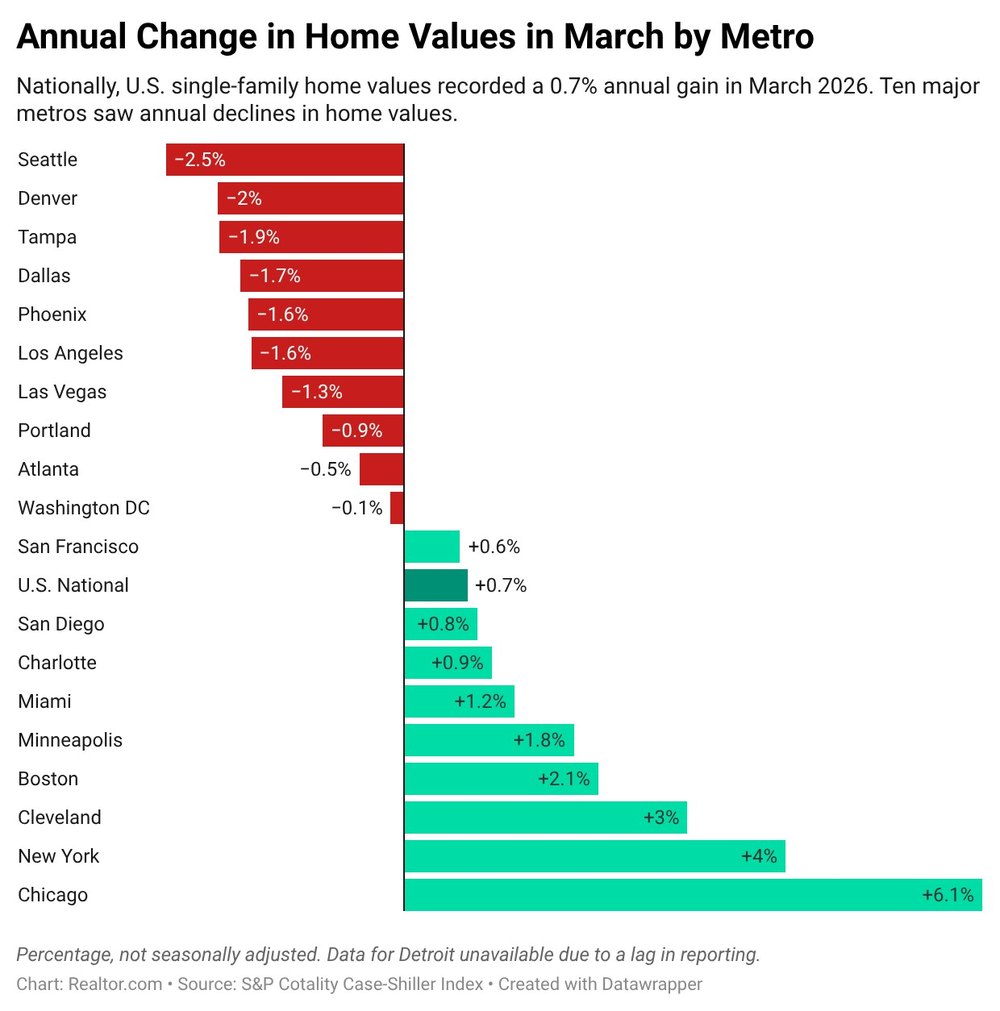
One of the most important questions for buyers is whether the decline in asking prices is actually leading to lower final sale prices. The answer, increasingly, is yes — at least in some markets. While final sales prices on a national basis remain slightly positive year-over-year, data from the widely followed Case-Shiller index, released this week, showed that more metro areas are beginning to record price softening at the closing stage as well.
This is a critical development. Asking prices are, after all, just a starting point for negotiation. What ultimately matters to a buyer's financial outcome is the price they pay at the closing table and the monthly payment they carry for the life of the loan. When lower asking prices begin to feed through into lower closing prices, buyers gain in two ways: they pay less upfront and they potentially borrow less, reducing long-term interest costs even if rates themselves do not move.
It is worth noting that the pace of this transmission — from lower asking prices to lower closing prices — varies considerably by market. Cities with high inventory growth and slower population inflows are seeing the fastest adjustment, while supply-constrained coastal metros continue to show more resilience in final sale values. Buyers should therefore look carefully at local data, not just national headlines, when assessing their purchasing power in a specific area.
The Mortgage Rate Headwind Still Looms Large
While falling asking prices are unquestionably good news for buyers, they do not exist in isolation. The same market that is offering lower list prices is also presenting buyers with mortgage rates that remain well above the historically low levels seen between 2020 and 2022. For many households, the monthly payment on a home — even one priced modestly lower than a year ago — remains a significant financial stretch.
This is the central tension of the 2026 housing market. Price relief and rate pain are occurring simultaneously, partially offsetting each other's impact on affordability. Whether the net effect is positive for a given buyer depends heavily on their down payment size, credit profile, local price trends, and long-term plans for the property.
What This Means for Homebuyers Right Now
For buyers who are financially prepared, the current environment offers some of the most negotiating leverage seen in years. Here are several practical takeaways to consider as you navigate your home search:
- Do not anchor to last year's prices. With asking prices down 2.4% nationally, comparable homes in your target area may be listed meaningfully lower than similar properties sold 12 months ago. Run fresh comparables before making any offer.
- Recognize the negotiating window. Sellers listing at realistic prices from the start are also signaling a willingness to transact. This is a better environment for negotiation than one where sellers are emotionally anchored to an inflated original list price.
- Think long-term on rates. While current mortgage rates are elevated, refinancing remains an option if rates fall in the future. Buying at a lower price now and refinancing later can be a sound strategy if you plan to stay in the home for several years.
- Watch local inventory closely. National trends provide context, but your decision should be grounded in what is happening in your specific market. Rising local inventory typically increases buyer leverage and reinforces the downward pressure on prices.
- Get pre-approved and move decisively. Even in a softening market, well-priced homes in desirable neighborhoods attract attention quickly. Having your financing in order positions you to act when the right opportunity appears.
Is the Worst Over for Buyers?
Whether the current streak of asking price declines continues, accelerates, or reverses depends on factors that remain genuinely uncertain — including the trajectory of mortgage rates, the health of the broader economy, and the pace at which new inventory enters the market. What is clear is that nineteen consecutive weeks of year-over-year price declines represents a sustained and statistically significant shift in market dynamics, not a temporary anomaly.
For buyers who have felt locked out of homeownership by years of rapid price appreciation, this trend offers something that has been in short supply: a reason for measured optimism. The market is far from easy, but it is moving in a direction that favors those with the patience to wait and the preparation to act.
The clouds over the housing market have not fully cleared. But for buyers keeping a close eye on the horizon, the silver lining is becoming easier to see.