
The Luxury Housing Market Is Cooling — But Not Everywhere
The American luxury real estate market is facing undeniable headwinds. Across most of the country, top-tier home prices are slipping, inventories are shifting, and the euphoric pandemic-era appreciation that defined the early 2020s has largely faded into memory. According to the Realtor.com® May 2026 Luxury Housing Report, the national median list price for luxury homes — defined at the 90th price percentile — stood at $1,283,432 in May 2026, representing a 1.4% decline year-over-year and an even more sobering 8.5% drop from the national pandemic peak recorded in May 2023.
For buyers, sellers, and investors tracking the luxury segment, those numbers paint a picture of a market in retreat. Yet buried within the data is a compelling counternarrative — two cities that refuse to follow the script. While virtually every other tracked luxury metro has pulled back from its pandemic-era highs, Minneapolis, Minnesota and Boise, Idaho have not only held their ground but surpassed it entirely.
Minneapolis and Boise: The Only Two Luxury Markets Still Above Their Pandemic Peaks
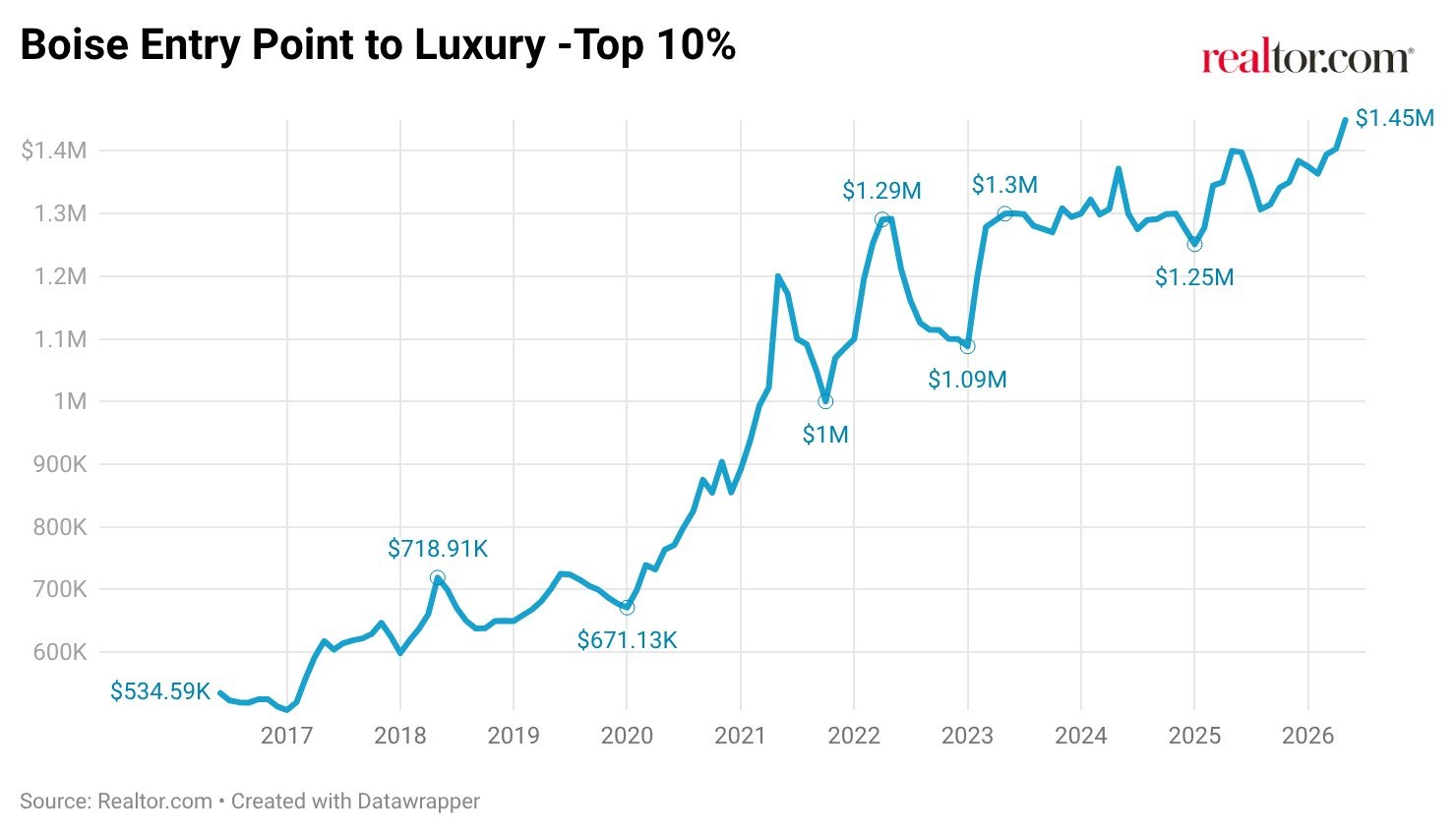
According to metro-level data through February 2026, Minneapolis posted a 5.0% increase above its pandemic-era peak, while Boise came in at a 4.2% gain — making them the sole two markets among all tracked luxury metros to have fully eclipsed their previous highs. That distinction is significant. In a landscape where most markets are still trying to reclaim lost ground, these two cities are writing a different chapter altogether.
So what sets them apart? The answers lie in a combination of economic fundamentals, inventory constraints, and demographic trends that have continued to fuel demand even as the broader national market has softened.
Why Minneapolis Keeps Defying the Odds
At first glance, Minneapolis might not seem like an obvious candidate for luxury real estate outperformance. It doesn't carry the same glamour as Miami or Scottsdale, nor the tech-driven prestige of Austin or Seattle. But what it does have is something arguably more durable: a deeply diversified, Fortune 500-anchored economy that has provided consistent demand across market cycles.
"We are seeing consistent buyer activity in the luxury market," says Jeffrey Dewing of Coldwell Banker Realty in Minneapolis. "I think the local economy and lack of inventory have played a significant role. We have numerous Fortune 500 companies such as Cargill, so we have a diverse and consistent economy."
That economic backbone — which includes major employers across sectors like agriculture, retail, finance, and healthcare — creates a steady pipeline of high-income buyers capable of competing in the luxury segment. Unlike cities whose luxury markets surged on the back of remote work migration alone, Minneapolis's demand is rooted in employment-driven wealth that doesn't evaporate when interest rates climb or remote work policies change.
The inventory picture adds another layer to the story. The Minneapolis metro recorded its highest 90th-percentile price in May 2024 at approximately $1.12 million — a figure that, while sitting just outside the formal pandemic-growth measurement window of June 2020 through December 2023, remained only marginally above the $1.10 million level recorded in May 2026. This relative stability reflects a market that never experienced the dramatic boom-and-bust volatility seen elsewhere, making its current strength more sustainable.
The Boise Story: From Pandemic Darling to Enduring Market
Boise's trajectory is somewhat different. During the pandemic, the Idaho capital became one of the most talked-about real estate markets in the country. Remote workers fleeing California and the Pacific Northwest flooded in, drawn by lower costs, outdoor amenities, and a quality of life that felt like a bargain compared to coastal metros. Prices skyrocketed, and observers began to wonder whether the gains were real or simply a temporary sugar rush.
The data now suggests they were — at least in part — real. Despite the national luxury correction, Boise's luxury market has not only retained its pandemic-era gains but pushed 4.2% beyond its previous peak. This indicates that a meaningful portion of the demand that arrived during the pandemic has stayed, and new demand continues to materialize.
Boise benefits from ongoing population growth, continued in-migration from higher-cost states, and a burgeoning tech and professional services sector that supports a growing class of high-income residents. The city's relative affordability compared to coastal luxury markets — even at elevated price points — continues to attract buyers who can command premium properties without the sticker shock of San Francisco or New York.
What This Means for Luxury Real Estate Buyers and Investors
For buyers considering luxury real estate in 2026, the divergence between markets like Minneapolis and Boise and the broader national trend offers several important takeaways:
- Economic fundamentals matter more than ever. Markets with diversified employment bases and strong corporate anchors tend to weather correction cycles better than those driven by speculative migration alone.
- Inventory constraints remain a powerful price floor. In markets where supply has not kept pace with demand, luxury prices have proven more resilient. Both Minneapolis and Boise continue to face limited high-end inventory relative to buyer interest.
- Not all pandemic gains were illusory. Cities that attracted genuine long-term residents and businesses during the pandemic — rather than purely speculative buyers — are now demonstrating the staying power of those gains.
- Secondary markets deserve serious consideration. The outperformance of Minneapolis and Boise challenges the conventional wisdom that luxury real estate only appreciates reliably in the country's largest coastal metros.
A Broader Market Still Searching for Its Footing
It would be premature to declare the national luxury market in crisis. Corrections from pandemic-era peaks are a natural and healthy part of any real estate cycle, and many markets are finding new equilibrium levels that better reflect underlying demand. Still, a nationally averaged 8.5% decline from peak prices is a meaningful number that signals the extraordinary appreciation of 2020 through 2023 has largely run its course at the macro level.
For sellers in most luxury markets, the days of effortless double-digit annual appreciation appear to be in the rearview mirror — at least for now. For buyers, the cooling trend creates opportunities that weren't available at the height of the frenzy. And for anyone watching Minneapolis and Boise, those two cities serve as a reminder that even in a challenging environment, the right combination of economic drivers, constrained supply, and genuine demand can keep a market not just afloat, but climbing.
The Takeaway: Fundamentals Win in the Long Run
The luxury housing market of 2026 is a tale of two trajectories. Nationally, the post-pandemic correction continues to exert downward pressure on top-tier home prices. But in Minneapolis and Boise, the story is one of resilience — proof that markets grounded in strong economic fundamentals and sustained demand can outperform even in difficult conditions.
Whether you're a prospective buyer, an investor tracking luxury real estate trends, or simply a market watcher, the performances of these two cities are worth paying close attention to. In a market searching for direction, they may be pointing the way forward.