
Luxury Housing Market 2026: Two Cities Defy the National Downturn
The luxury housing market across the United States is facing a notable correction. Median list prices for top-tier homes — those at the 90th price percentile — have been declining in most regions nationwide, painting a challenging picture for high-end sellers and developers alike. Yet amid this broad softening, two metropolitan areas are writing a very different story. According to the Realtor.com May 2026 Luxury Housing Report, Minneapolis, Minnesota, and Boise, Idaho, stand alone as the only tracked luxury markets to have fully surpassed their pandemic-era price peaks. Understanding why these two cities are thriving while others retreat offers critical insight for buyers, investors, and real estate professionals watching the luxury segment.
The National Luxury Market at a Glance
To appreciate how remarkable Minneapolis and Boise's performances are, it helps to understand just how much pressure the broader luxury market is facing. Nationally, the median list price for luxury homes sat at $1,283,432 in May 2026, representing a 1.4% decline year-over-year. More striking still is the comparison to the national pandemic price peak reached in May 2023 — current prices are down a steep 8.5% from that high-water mark.
That kind of pullback reflects a market that overheated during the pandemic-era buying frenzy and is now recalibrating. Remote work, historically low interest rates, and a surge in lifestyle-driven relocation all drove luxury prices to unsustainable levels in many metros between 2020 and 2023. As those tailwinds faded, prices followed. Most luxury markets are still trying to find their footing — but not Minneapolis and Boise.
Minneapolis: Steady, Diverse, and Built to Last
Minneapolis recorded a 5.0% increase above its pandemic-era peak as of the latest available metro-level data from February 2026, making it the top-performing luxury market in the country by this measure. The city's strength isn't rooted in a single industry or a speculative rush — it reflects the kind of deep, diversified economic foundation that tends to support long-term real estate stability.
Jeffrey Dewing of Coldwell Banker Realty in Minneapolis, who works directly in the city's luxury segment, points to a clear explanation for the market's resilience. "We are seeing consistent buyer activity in the luxury market," Dewing told Realtor.com. "I think the local economy and lack of inventory have played a significant role. We have numerous Fortune 500 companies such as Cargill, so we have a diverse and consistent economy."
That economic diversity is a crucial differentiator. Minneapolis is home to a remarkable concentration of Fortune 500 headquarters, spanning industries from agriculture and retail to healthcare and finance. Companies like Cargill, Target, UnitedHealth Group, and Best Buy collectively anchor a robust employment base that generates consistent high-income earners — exactly the demographic fueling the luxury housing market.
Equally important is the supply side of the equation. Minneapolis did not experience the same explosive pandemic-era price surge seen in markets like Phoenix, Austin, or Miami. The city's highest 90th-percentile price point was recorded in May 2024 at approximately $1.12 million — a figure that, while slightly above the $1.10 million recorded in May 2026, demonstrates a market that has remained relatively measured and grounded rather than wildly inflated. Low inventory has continued to support pricing even as demand stays strong, preventing the kind of oversupply-driven correction seen elsewhere.
Boise, Idaho: The Pandemic Darling That Kept on Giving
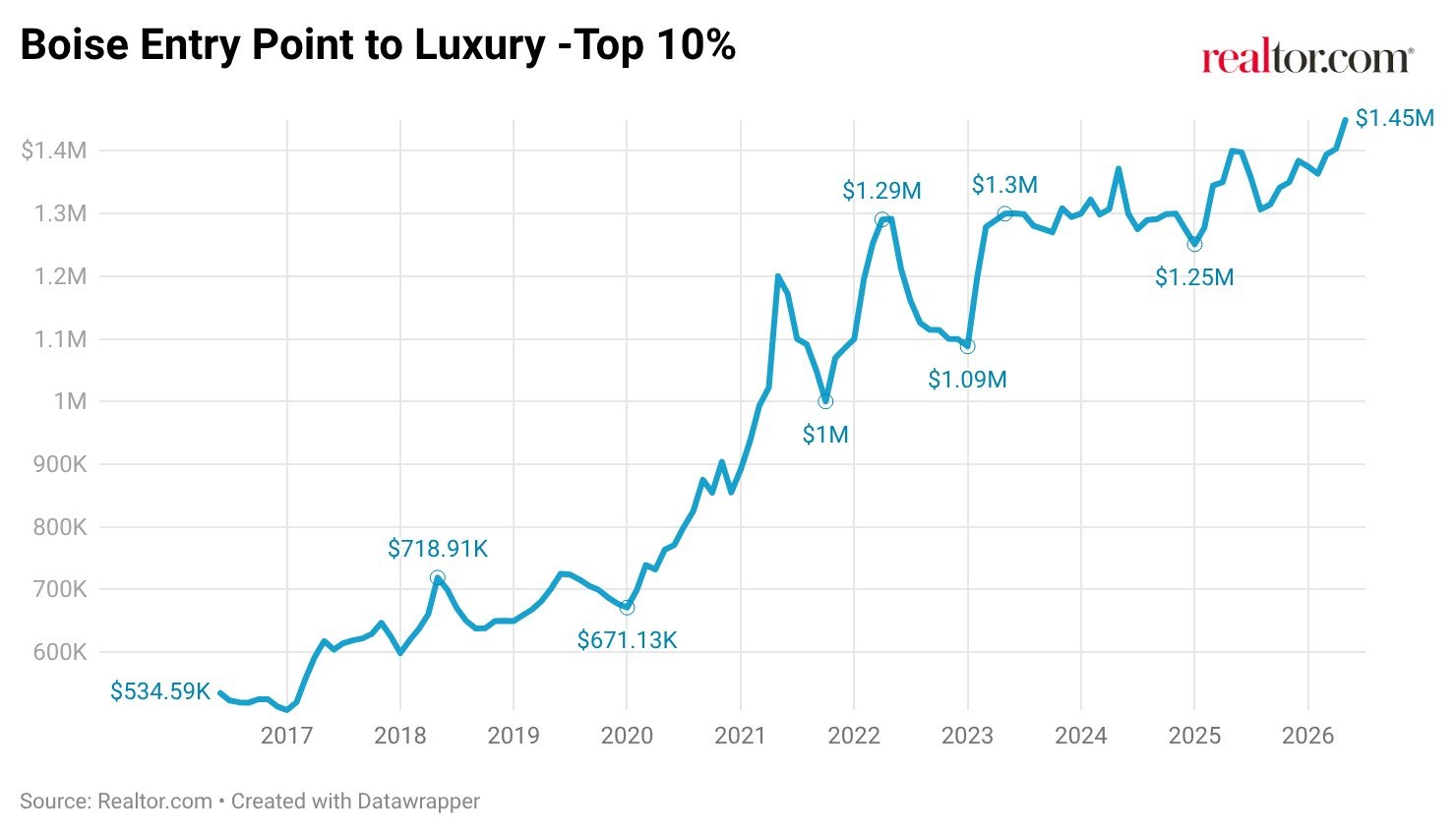
Boise's story is in some ways more surprising. The Idaho capital became one of the most talked-about pandemic relocation destinations in the country, drawing remote workers, retirees, and outdoor lifestyle seekers from California and the Pacific Northwest in droves. Many analysts expected a sharp correction once the pandemic boom faded — but Boise's luxury market has proven more durable than its critics predicted.
With a 4.2% gain above its pandemic-era peak, Boise is the second and final metro on the list of markets that have not only held their ground but exceeded previous highs. Several factors explain this persistence. First, Boise continues to attract high-income transplants who find the region's combination of natural amenity, relative affordability compared to West Coast markets, and growing tech-sector presence genuinely compelling — not just as a pandemic-era novelty, but as a long-term lifestyle choice.
Second, Boise's luxury inventory remains constrained. The geographic and regulatory limitations on new development in desirable areas of the Treasure Valley have helped underpin prices even as demand from out-of-state buyers has moderated slightly from its frenzied 2021–2022 peak. The fundamentals, in other words, have held up.
What These Markets Tell Us About Luxury Real Estate in 2026
The outperformance of Minneapolis and Boise carries broader lessons for anyone navigating the luxury real estate landscape in 2026.
- Economic diversification matters. Markets with broad, recession-resistant employment bases — like Minneapolis with its Fortune 500 density — tend to produce steadier luxury demand than markets reliant on a single boom sector.
- Measured growth beats speculative spikes. Cities that did not see extreme pandemic-era price inflation are less vulnerable to steep corrections. A slower climb often means a more stable plateau.
- Lifestyle appeal has staying power. Boise's continued strength suggests that pandemic-era migration motivations — quality of life, outdoor access, relative value — have not entirely reversed. People who moved to places like Boise often chose to stay.
- Supply constraints are the great price defender. In both markets, limited inventory has prevented the kind of buyer's-market oversupply that has dragged down luxury prices elsewhere.
Should Buyers and Investors Pay Attention?
For luxury buyers, the data from Minneapolis and Boise suggests that both markets remain competitive and are unlikely to offer bargain-hunting opportunities in the near term. Sellers in these cities hold more leverage than their counterparts in declining metros, and well-positioned properties continue to attract qualified buyers. For investors, the resilience of these two markets argues for treating them as reliable long-term holds rather than speculative plays.
That said, no market is immune to broader macroeconomic forces. Rising mortgage rates, potential corporate layoffs among major Minneapolis employers, or a shift in remote-work policies could alter the calculus. Prospective buyers and investors should conduct thorough due diligence and work with experienced local agents who understand the nuances of each market.
The Bigger Picture: A Tale of Two Luxury Markets
The May 2026 Luxury Housing Report makes one thing unmistakably clear: the luxury real estate market is not monolithic. While national headlines rightly reflect a broad cooling trend, they obscure the reality that some markets are not just holding on — they are genuinely thriving. Minneapolis and Boise have each, in their own way, demonstrated that the right combination of economic strength, supply discipline, and authentic lifestyle appeal can sustain luxury price growth even when the national tide is going out.
Whether you are a buyer searching for a resilient market, a seller weighing your timing, or an investor looking for data-backed confidence, the performance of these two cities in 2026 offers a compelling case study in what luxury real estate success looks like when it is built on solid foundations rather than pandemic-era hype.