
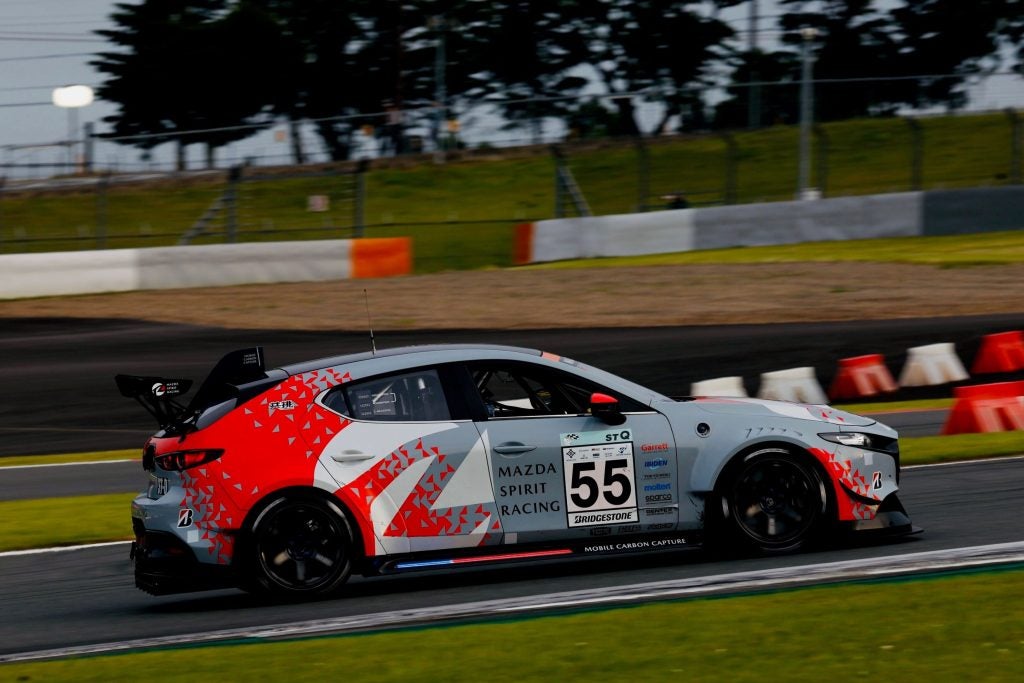
Mazda Takes a Giant Leap Toward Carbon-Neutral Driving with Onboard CO2 Capture
The automotive industry has long been searching for practical, real-world solutions to reduce vehicle carbon emissions — and Mazda may have just delivered one of its most compelling answers yet. During Round 3 of the Super Taikyu Series 2026, Mazda Motor Corporation conducted a landmark demonstration test of its onboard CO2 capture system, successfully capturing and storing carbon dioxide while the vehicle was in motion. The results were remarkable: 804 grams of CO2 captured over the course of a single 24-hour race, representing approximately 9.6 times the performance of its previous test. This breakthrough marks a pivotal step in Mazda's mission to contribute meaningfully to net CO2 emission reductions by 2035.
What Is Mazda's Onboard CO2 Capture System?
Mazda's onboard CO2 capture technology — officially branded as Mazda Mobile Carbon Capture — was first unveiled at the Japan Mobility Show 2025 under the theme "The Joy of Driving Fuels a Sustainable Tomorrow." The concept is straightforward but ambitious: rather than simply reducing the amount of CO2 a vehicle emits, why not capture the CO2 at the source, directly from the exhaust stream, while the car is being driven?
The system works by integrating a CO2 absorption unit within the vehicle that uses zeolite — a naturally occurring mineral with a highly porous structure — as the primary adsorbent. Zeolite is particularly well-suited for this application because it can readily release absorbed CO2 when subjected to heat, a property known as thermal desorption. This makes it possible to use the vehicle's own exhaust heat to trigger the CO2 release process, keeping the energy demands of the system relatively low and practical for real-world use.
How the System Works: From Capture to Storage
The engineering behind Mazda Mobile Carbon Capture involves several tightly integrated stages, each of which must function reliably under the demanding conditions of active driving. Here is how the complete process unfolds:
- Absorption: Exhaust gases pass through the zeolite-based absorption unit, where CO2 molecules are adsorbed onto the porous surface of the zeolite material.
- Desorption: Heat generated by the engine's exhaust system is redirected to the absorption unit, raising the temperature of the zeolite. This causes the captured CO2 to be released in a concentrated form — a process called desorption.
- Compression: The released CO2 is then directed to an electric compressor, which pressurizes the gas to make it suitable for storage in a compact onboard tank.
- Storage: The compressed CO2 is stored in a dedicated tank fitted within the vehicle, preventing it from being released back into the atmosphere during the drive.
For this round of testing, the desorption function and the storage tank were newly introduced to the system installed in the Mazda Spirit Racing 3 Future Concept race car, making this the first time Mazda has demonstrated the entire capture-to-storage pipeline as a fully integrated, functioning system.
The Role of HVO Fuel in Mazda's Sustainability Strategy
An equally important detail in this demonstration is the fuel powering the test vehicle. The Mazda Spirit Racing 3 Future Concept ran on Hydrotreated Vegetable Oil (HVO), a renewable diesel alternative already widely adopted across Europe. HVO is produced from biological feedstocks such as used cooking oils, animal fats, or plant oils, and it burns significantly cleaner than conventional fossil-derived diesel while remaining compatible with standard diesel engines without modification.
By pairing HVO with its onboard CO2 capture system, Mazda is demonstrating a layered approach to decarbonization — one that combines lower-carbon fuels with active carbon capture to push total lifecycle emissions even further toward net-zero territory. This dual strategy reflects a pragmatic understanding that no single solution will solve automotive emissions on its own, and that multiple complementary technologies must work in concert.
Why This Result Matters: 804 Grams and What It Means
Numbers tell a powerful story here. In its previous demonstration, Mazda's system captured 84 grams of CO2 — itself a noteworthy early result, but modest in scope. The 2026 Super Taikyu test captured 804 grams over 24 hours, a 9.6-fold improvement that signals the system is maturing rapidly from a proof-of-concept into something approaching a viable, scalable technology.
Of course, context matters. A passenger car driving normal daily routes generates several kilograms of CO2 per journey depending on engine size and conditions, so 804 grams across 24 hours of racing is still a fraction of total emissions. But the trajectory of improvement — nearly a tenfold increase in a single development cycle — is what excites engineers and sustainability advocates alike. The speed of progress suggests that with continued refinement, particularly in adsorbent capacity and desorption efficiency, meaningful per-trip capture rates could become achievable in production vehicles within the decade.
Mazda's Broader Vision: Net CO2 Reductions by 2035
This demonstration is one piece of a larger strategic puzzle Mazda is assembling. The company has positioned Mazda Mobile Carbon Capture not as a standalone silver bullet, but as a supporting technology that complements electrification, renewable fuels, and engine efficiency improvements. The overarching goal is to support efforts to reduce net CO2 emissions by 2035, aligning with broader global climate commitments and the automotive industry's accelerating shift toward carbon neutrality.
Mazda's willingness to test and iterate this technology in the competitive, high-stress environment of endurance racing speaks to its engineering confidence. Motorsport has historically served as a proving ground for automotive innovations — from disc brakes to turbocharging to hybrid powertrains — and onboard carbon capture could be the next technology to make that journey from racetrack to road.
The Road Ahead for Onboard Carbon Capture Technology
As climate targets grow more urgent and regulatory pressure on automakers intensifies globally, technologies like Mazda's onboard CO2 capture system will attract increasing attention from engineers, policymakers, and consumers alike. The key milestones ahead include scaling up CO2 capture volume per journey, developing lightweight and cost-effective storage solutions, establishing infrastructure for offloading and processing captured CO2, and validating system durability across a wide range of real-world driving conditions.
Mazda has demonstrated both the technical ambition and the engineering discipline to push this technology forward at pace. The results from Round 3 of the Super Taikyu Series 2026 are a clear signal that onboard carbon capture is no longer a distant concept — it is rapidly becoming a credible part of the automotive sustainability toolkit, and Mazda is leading the charge.