
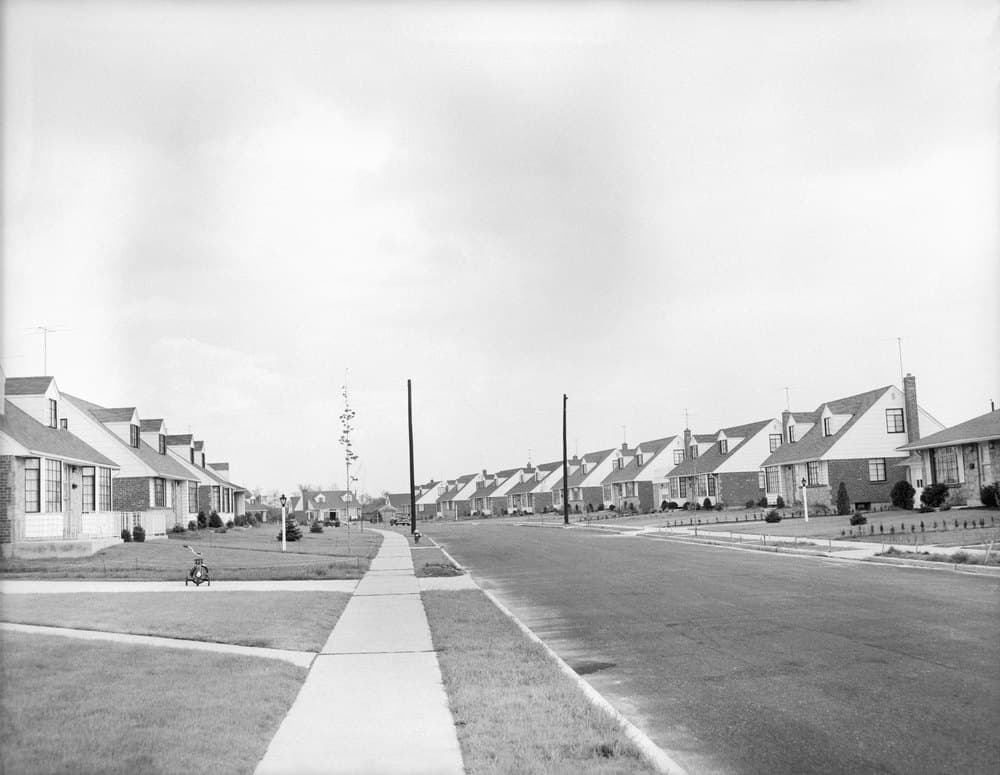
A Nation That Couldn't House Its Own Heroes
When World War II ended and millions of American veterans came home, they expected to step into the lives they had risked everything to protect — a job, a family, and a home of their own. Instead, they were met with a country that was woefully unprepared to house them. By one federal estimate, the United States needed more than 2.5 million new housing units in 1946 just for returning veterans and their families. The housing shortage was so severe that people were forced into makeshift trailers and even tents.
One protest slogan from the era said it all: "From foxholes to shacks!! We had more room in the foxholes." The bitter irony was inescapable — men who had liberated Europe couldn't find a decent place to sleep in their own country.
Yet somehow, America solved it. Over the following two decades, the nation unleashed one of the greatest construction booms in modern history, fundamentally reshaping American life, expanding the middle class, and turning homeownership into the defining symbol of the American dream. The question now, as the country grapples with another generational housing affordability crisis, is whether we can find the will — and the way — to do it again.
How America Built Its Way Out
The post-WWII housing boom didn't happen by accident. It was the result of deliberate, coordinated policy decisions that lowered barriers and unleashed private-sector energy at a massive scale.
Several forces converged to make it possible:
- The GI Bill (1944): The Servicemen's Readjustment Act made low-interest, zero-down-payment mortgages available to millions of veterans, dramatically expanding who could afford to buy a home and igniting demand across the country.
- The rise of mass homebuilders: Entrepreneurs like William Levitt pioneered assembly-line construction techniques that brought down costs and build times dramatically. Levittown, New York — a planned community of nearly 18,000 homes — became the symbol of this era, proving that quality housing could be produced quickly and affordably at scale.
- Zoning designed for growth: Local governments in suburban areas actively rezoned land to accommodate expansion, not restrict it. The philosophy was that more housing was good for communities, not a threat to them.
- Federal mortgage infrastructure: Institutions like Fannie Mae and the Federal Housing Administration (FHA) standardized mortgage lending and made home financing predictable and accessible to ordinary families for the first time.
The result was transformational. Homeownership rates climbed from around 44% before the war to nearly 62% by 1960. The starter home became the cornerstone of the middle-class experience, and millions of families — many of them first-generation homeowners — built wealth that echoed across generations.
Today's Housing Crisis: Familiar Roots, Different Challenges
Fast forward to 2025, and the parallels to the post-WWII era are hard to ignore — but so are the differences. America is once again facing a deep, structural housing shortage. Decades of underbuilding have left the country millions of units short of what's needed to meet demand. The downstream effects have been severe and widespread.
Starter homes — once the entry point to homeownership for young, working-class families — have crossed the $1 million threshold in more than half the country. The typical first-time homebuyer is now 40 years old, compared to the mid-20s average that defined earlier generations. Young adults are delaying marriage, family formation, and wealth-building as a direct result of being locked out of the housing market. Renters are stretching budgets to the breaking point, and homelessness rates in many cities are climbing.
In short, the promise that defined the American dream for the postwar generation is fraying for millions of people today.
What Would a Modern Housing Boom Require?
Replicating the success of the postwar building era is not simply a matter of nostalgia — it requires an honest reckoning with the structural barriers that have replaced the structural enablers of that period. Here's what experts and housing advocates increasingly agree would need to change:
- Zoning reform at scale: Exclusionary zoning laws in thousands of cities and suburbs actively prevent the construction of multi-family housing, accessory dwelling units, and higher-density development. Reforming these laws is arguably the single most powerful lever available. Several states, including California, Montana, and Florida, have taken meaningful steps in this direction, but progress remains uneven.
- Streamlined permitting: In many jurisdictions, the time and cost required to obtain building permits have ballooned to the point where they function as an effective construction tax. Cutting permitting timelines could unlock substantial new supply relatively quickly.
- Workforce and materials investment: The construction industry is facing a skilled labor shortage that constrains how fast new homes can actually be built even when approvals are in place. Expanding vocational training, apprenticeship programs, and immigration pathways for construction workers is essential.
- Modern financing tools: Just as the GI Bill and the FHA democratized homeownership in the 1940s, new financial instruments — such as expanded down payment assistance programs, shared equity models, and community land trusts — can help today's buyers overcome the affordability gap.
- Federal and state incentives for builders: Tax credits, density bonuses, and direct subsidies targeted at affordable and workforce housing can make projects pencil out that otherwise wouldn't in today's high-cost environment.
The Political Will Problem
Perhaps the most significant difference between then and now is political. The postwar housing boom had the moral clarity of rewarding veterans who had sacrificed for their country and a broad national consensus that growth was good. Today, housing policy is tangled up in deeply local politics, where existing homeowners — who benefit financially from rising prices — often have more political power than renters and aspiring buyers who are harmed by them.
Changing that dynamic requires shifting the conversation. Housing isn't just a real estate issue; it's an economic issue, a family issue, a generational equity issue. The communities and states that have embraced pro-housing policies are beginning to see early results. The question is whether the rest of the country will follow before the gap between those who can afford a home and those who cannot becomes a permanent, defining feature of American life.
History Doesn't Repeat — But It Can Rhyme
America has solved enormous, seemingly intractable housing problems before. The post-WWII era proved that when the right policies, private-sector energy, and political will align, it is possible to build enough homes to meet demand — and to do it fast enough to make a real difference in people's lives.
That history should be a source of inspiration, not just nostalgia. The tools are different today, the challenges are more complex, and the politics are harder. But the fundamental task is the same: build more homes, in more places, for more people. America did it once. The urgency to do it again has never been greater.