
A Nation Without Enough Roofs: The Post-WWII Housing Crisis
When the guns fell silent in 1945 and millions of American servicemen began flooding back to their hometowns, they expected to claim the lives they had crossed oceans and endured foxholes to protect. A steady job, a modest house with a yard, a family, and a future—these were the promises that had kept morale alive through the bloodiest years of the twentieth century. What they found instead was a country completely unprepared to house them.
By a federal government estimate in 1946, the United States needed more than 2.5 million new housing units just to shelter returning veterans and their families. At the time, the total U.S. population was roughly 151 million—less than half of today's 331 million—yet the shortage was so extreme that families squeezed into garages, converted chicken coops, repurposed army barracks, and lived in flimsy trailers with no running water. A protest sign from those bitter months put it bluntly: "From foxholes to shacks!! We had more room in the foxholes."
It was a crisis born not just of pent-up demand, but of years of suppressed construction during both the Great Depression and the war itself. Lumber, steel, and labor had been rationed for the war effort; residential building had ground nearly to a halt. By the time victory was declared, the housing deficit was staggering.
The Response: One of the Greatest Building Booms in American History
What happened next was remarkable. Through a combination of bold federal policy, private enterprise, affordable credit, and raw American ingenuity, the country staged one of the most dramatic housing buildouts in modern history. The government played a central role in making it possible.
The GI Bill of 1944 gave veterans access to low-interest, zero-down-payment mortgages backed by the Veterans Administration. Congress loosened lending restrictions, the Federal Housing Administration expanded its mortgage insurance programs, and new financial instruments made homeownership accessible to working-class families who had never imagined it as a realistic option.
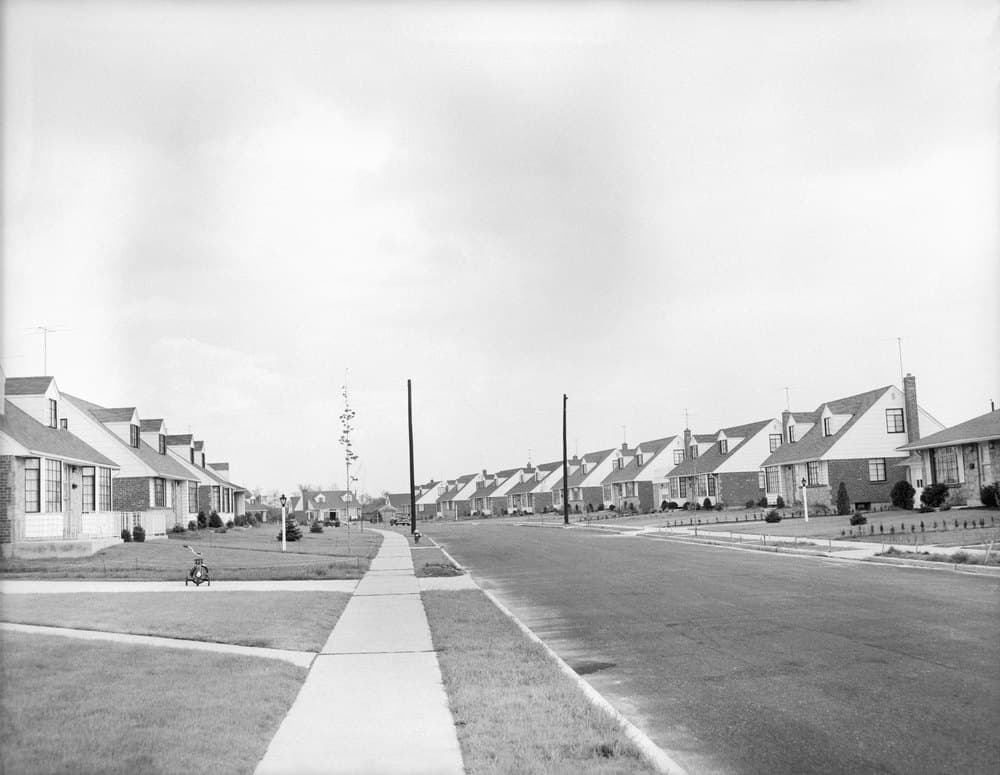
On the construction side, developers like William Levitt essentially industrialized homebuilding. Levittown—the legendary planned community built on Long Island beginning in 1947—demonstrated that homes could be mass-produced almost like cars on an assembly line. Workers specialized in single tasks, moving from lot to lot. A new house went up every sixteen minutes at peak production. By the early 1950s, Levitt & Sons was building 36 houses per day.
The Starter Home and the Birth of the American Dream
The postwar boom didn't just build houses—it built a new vision of American life. The starter home emerged as a cultural institution: a modest, affordable entry point into the middle class. These were small by today's standards, often between 700 and 1,000 square feet, but they were newly built, solidly constructed, and, crucially, within reach of ordinary wage earners.
Homeownership rates surged from around 44 percent in 1940 to more than 62 percent by 1960. Suburban communities sprung up across the country. The middle class expanded dramatically. Homeownership became the cornerstone of the American Dream—not just a shelter, but a savings vehicle, a source of community, and a signal of hard-won prosperity.
Today's Housing Crisis: Eerily Familiar, Critically Different
Seventy years on, America is again confronting a housing shortage of historic proportions—and the echoes of the postwar crisis are impossible to ignore. Current estimates suggest the country is short somewhere between 4 and 7 million housing units, depending on the methodology. Supply has been squeezed for decades by restrictive zoning, rising construction costs, labor shortages, and NIMBYism that has made building new homes in high-demand areas extraordinarily difficult.
The consequences show up clearly in the data. The starter home—once the affordable on-ramp to the middle class—has crossed the $1 million threshold in more than half of all U.S. markets. The median age of a first-time homebuyer has climbed to 40 years old, up from the late twenties just a generation ago. Homeownership, once accessible to young families starting out, has become a privilege increasingly reserved for those who already have wealth or who benefit from family transfers.
Key Differences That Make This Crisis Harder to Solve
While the parallels to the postwar era are striking, the current crisis comes with complications that didn't exist in 1946. Several factors make today's challenge structurally more difficult:
- Zoning and land-use restrictions are far more entrenched today. Many municipalities actively resist new housing construction, and local political incentives often favor existing homeowners over prospective ones.
- Construction costs have ballooned due to material price inflation, supply chain disruptions, and labor shortages—particularly in skilled trades like plumbing and electrical work.
- Environmental and regulatory review processes can add years and millions of dollars to housing projects before a single foundation is poured.
- The mortgage market, while more sophisticated, also carries the memory of 2008—making lenders and regulators cautious about the kind of aggressive credit expansion that powered the postwar boom.
What the Postwar Era Teaches Us
Despite these differences, the postwar housing boom offers a template—or at least a set of principles—that remain relevant. The most important lesson is that housing crises don't resolve themselves. The 1940s boom was not spontaneous; it was engineered through deliberate policy choices that removed barriers, expanded access to credit, incentivized production, and created the conditions for private industry to build at scale.
Today, a growing bipartisan consensus is beginning to treat the housing shortage with similar urgency. Several states—including California, Montana, and Florida—have passed laws to override local zoning restrictions and allow higher-density construction in previously single-family-only neighborhoods. The federal government has explored incentive grants tied to localities that permit more housing. New construction technologies, including modular and 3D-printed homes, offer the potential to reduce costs and speed timelines in ways that would have seemed fantastical to William Levitt.
The Stakes: More Than Just Real Estate
It would be a mistake to view the current housing crisis as merely a real estate problem. Like the postwar shortage, today's housing deficit has deep implications for social mobility, economic growth, family formation, and the health of American democracy itself. When ordinary working families cannot afford to buy a home—when the foundational asset of middle-class stability is priced beyond reach—the compact between aspiration and reward that holds society together begins to fray.
America has solved a housing crisis of this magnitude before. It required political will, creative policy, and a willingness to build boldly and quickly. The question confronting policymakers, developers, and communities today is whether that same combination of urgency and ingenuity can be summoned again—before another generation of would-be homeowners is left waiting on the outside of the American Dream, looking in.