
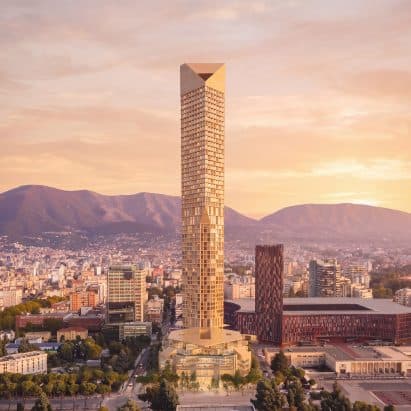
Herzog & de Meuron Set to Transform Tirana's Iconic Communist-Era Palace of Congresses
One of architecture's most celebrated firms is turning its attention to one of the Balkans' most historically charged buildings. Swiss practice Herzog & de Meuron has been commissioned to revitalise the Palace of Congresses in Tirana, Albania — a monumental structure built during the communist era that has long stood as a symbol of the country's complex political past. The project promises to breathe new life into a landmark that, while architecturally significant, has struggled to find a relevant role in contemporary Albanian society.
The announcement has generated considerable excitement among architecture enthusiasts, urban planners, and historians alike. For a city that has been undergoing rapid transformation over the past two decades, the reimagining of the Palace of Congresses represents a pivotal moment — one that bridges a turbulent history with an ambitious vision for the future.
A Building Steeped in History
The Palace of Congresses was constructed during Albania's isolationist communist regime under Enver Hoxha, a period that stretched from the end of World War II until 1985. During those decades, Albania was one of the most closed societies on earth, cut off from both the Western world and, eventually, the Soviet Union. Architecture from this era bore the hallmarks of socialist monumentalism — imposing scale, authoritative geometry, and a deliberate effort to project state power through built form.
The Palace itself served as a venue for high-level political gatherings, party congresses, and state functions. Its design reflects the ideological priorities of the time: grandeur without frivolity, functionality in service of political theatre. For many Albanians, the building carries layered and sometimes painful associations. Yet it also represents an undeniable piece of the nation's architectural heritage — one that cannot simply be erased or ignored.
Since the fall of communism in 1991, Albania has grappled with how to deal with the physical remnants of that era. Some structures have been demolished, others repurposed, and many left in states of disrepair. The Palace of Congresses has remained standing in Tirana's city centre, but its future has long been a subject of debate. The decision to commission Herzog & de Meuron signals a clear intent: preservation and transformation, rather than demolition.
Why Herzog & de Meuron?
The choice of Herzog & de Meuron for this sensitive commission is telling. The Basel-based firm, led by Jacques Herzog and Pierre de Meuron, has built an unrivalled reputation for projects that engage deeply with context, history, and material culture. Their portfolio includes some of the world's most admired buildings — from the Tate Modern in London (itself a transformation of a decommissioned power station) to the Bird's Nest Olympic Stadium in Beijing and the Elbphilharmonie concert hall in Hamburg.
What unites many of their most celebrated works is an ability to honour the memory embedded in a place while introducing a new architectural language that feels entirely contemporary. The Tate Modern, perhaps their most iconic adaptive reuse project, demonstrated that an industrial shell of enormous scale could be transformed into a thriving cultural institution without erasing its industrial identity. That project became a template for how cities around the world approach the challenge of redundant heritage buildings.
Tirana's Palace of Congresses presents a similar opportunity and a similar challenge. The building's weight — both physical and symbolic — demands an architect of rare sensitivity. Herzog & de Meuron's track record suggests they are well equipped for the task.
Tirana's Urban Renaissance
The revitalisation of the Palace of Congresses does not exist in isolation. It is part of a broader and sustained effort by Tirana to reinvent itself as a dynamic, liveable, and architecturally distinguished European capital. Under Mayor Erion Veliaj, the city has pursued an ambitious programme of public space improvements, green infrastructure, and cultural investment that has drawn international attention.
Tirana has attracted a number of high-profile architectural commissions in recent years, reflecting growing confidence in the city as a destination for bold design thinking. The revitalisation of the Palace of Congresses, overseen by one of the world's leading architectural practices, underlines Albania's aspirations on a European and global stage.
The building's central location in Tirana makes it a strategically important site. A successfully reimagined Palace of Congresses could serve as a new cultural and civic anchor for the city — a place where residents gather not out of political obligation, as they once did, but out of genuine desire for culture, community, and public life.
What the Revitalisation Could Mean
While full details of Herzog & de Meuron's design proposals are yet to be widely published, the direction of the project points toward a mixed-use cultural revitalisation. Key ambitions are likely to include:
- Preserving and restoring the building's existing architectural fabric while introducing modern interventions that enhance its functionality and public appeal.
- Creating flexible spaces for cultural programming, including performance, exhibition, and community use — breathing relevance into a building long associated with exclusionary political ritual.
- Improving the building's relationship with its surrounding public realm, making it more permeable, welcoming, and integrated into the life of the city.
- Addressing issues of sustainability and energy performance that are central to any responsible large-scale renovation in the current climate context.
Heritage, Identity, and the Architecture of Memory
At its heart, the Herzog & de Meuron commission in Tirana raises profound questions about how societies relate to difficult heritage. Buildings associated with authoritarian regimes occupy an uncomfortable position in cultural memory. They are simultaneously evidence of oppression and examples of human craft and ambition. Destroying them erases history; leaving them unchanged can feel like endorsement. Thoughtful transformation offers a third way — acknowledging what happened while refusing to be defined by it.
Albania has come a long way since 1991. Its journey from one of Europe's most isolated and impoverished states to an aspiring EU candidate nation with a growing creative economy is remarkable. The revitalisation of the Palace of Congresses by Herzog & de Meuron is, in many ways, a metaphor for that journey — a country taking one of its most charged historical spaces and daring to imagine it anew.
A Project to Watch
As details of the scheme continue to emerge, the Palace of Congresses renovation is set to become one of the most closely watched architectural projects in Europe. It combines the prestige of one of the world's great architectural practices with a building of genuine historical weight, in a city that is increasingly asserting itself on the international stage.
For architects, historians, and anyone interested in how cities evolve and heal, the transformation of Tirana's Palace of Congresses by Herzog & de Meuron will be essential viewing. It is a reminder that architecture, at its best, does not just shape space — it shapes the stories we tell about who we are and where we are going.