
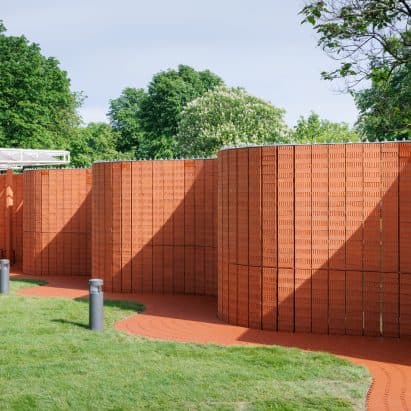
Lanza Atelier's 2026 Serpentine Pavilion: Architecture as Protection
Every year, the Serpentine Gallery in London's KHyde Park commissions one of the world's most anticipated temporary structures — a pavilion that doubles as an architectural statement, a cultural gathering place, and a conversation starter. For 2026, that honour falls to Lanza Atelier, a practice whose approach to the commission is rooted in something primal, symbolic, and surprisingly tender: the serpent. "The serpent is something that provides protection," the studio has said, reframing an ancient symbol that cultures across history have interpreted in wildly different ways. In Lanza Atelier's vision, the snake is not a predator. It is a guardian.
Who Is Lanza Atelier?
Lanza Atelier is an architecture studio known for its thoughtful engagement with material culture, local craft traditions, and the emotional resonance of built form. The practice has built a reputation for designs that feel simultaneously ancient and urgently contemporary, drawing from vernacular construction methods while asking pointed questions about what architecture is for — not just formally, but socially and spiritually. Being selected to design the Serpentine Pavilion represents one of the most high-profile platforms the architecture world offers, and Lanza Atelier has responded with a concept that is layered in meaning.
The Serpent as Architectural Metaphor
At the heart of the 2026 Serpentine Pavilion is a powerful reinterpretation of serpent symbolism. Across global mythology and cultural history, the serpent occupies an ambiguous space. In some traditions, it is the embodiment of danger and deceit. In others — from ancient Egypt to indigenous American traditions to classical Greek medicine — the serpent is a symbol of healing, wisdom, renewal, and yes, protection. The ouroboros, the snake devouring its own tail, represents eternity and cyclical continuity. Snakes shed their skin and are reborn. They coil around what they love.
Lanza Atelier reaches for this more generous reading. The pavilion's form, defined by curving red-brick walls that wind and wrap upon themselves, is designed to evoke the body of a serpent at rest — present, watchful, enclosing a space for people to inhabit safely. The walls do not tower or intimidate. They curve inward with a sense of embrace, creating a sheltered interior that feels protected rather than enclosed.
Red Brick and the Language of Craft
The material choice for the 2026 pavilion is as intentional as the symbolism. Red brick is a material deeply embedded in the architectural memory of Britain — it speaks of permanence, of warmth, of buildings that have endured across centuries of weather and change. In the context of a temporary pavilion, this choice introduces an interesting tension. The structure will stand for a season, yet its material vocabulary carries the weight of something meant to last.
This tension is productive. Lanza Atelier seems to be asking: what does it mean to build something protective, something that feels solid and safe, knowing it will eventually be dismantled? Perhaps it reinforces the idea that protection is not always about permanence. A shelter can be temporary and still be real. A guardian can be present for a season and still matter profoundly.
The sinuous curves of the brick walls also showcase considerable technical ambition. Curved brickwork is among the more demanding feats of masonry, requiring precise calculation and skilled labour. Rather than opting for sleek, industrially produced surfaces, Lanza Atelier has leaned into the handmade quality of the material — each brick laid by human hands, each curve negotiated between the logic of the material and the aspiration of the design.
A Space for People, Not Just Ideas
The best Serpentine Pavilions are not merely sculptural objects to be photographed from a distance. They are spaces that draw people in, that invite lingering, conversation, and community. Lanza Atelier's serpentine walls create distinct interior zones — areas of shade and enclosure, thresholds that feel like transitions from the wider park into something more intimate. The pavilion is designed to function as a true gathering place across its seasonal run, hosting talks, performances, and the kind of informal socialising that great public architecture quietly enables.
This social dimension is inseparable from the protective symbolism the architects have foregrounded. A structure that wraps around its visitors, that creates a sense of being held, is one that actively invites people to slow down and feel welcome. In a cultural moment defined by anxiety, fragmentation, and the relentless pace of public life, there is something quietly radical about an architecture that says: you are safe here.
The Serpentine Pavilion Commission: A Global Stage
Since its inception in 2000, the annual Serpentine Pavilion commission has launched or amplified the international profiles of architects including Zaha Hadid, Oscar Niemeyer, Alvaro Siza, SANAA, Selgas Cano, Frida Escobedo, and Sumayya Vally. Each pavilion becomes part of an ongoing dialogue about what architecture can be when freed from the usual constraints of brief, budget, and programme.
For Lanza Atelier, the commission is an opportunity to bring their particular sensibility to one of the world's most watched architectural stages. Their decision to anchor the design in serpent symbolism — to make protection the pavilion's central argument — feels both personal and universal.
Why This Pavilion Matters
- It reframes ancient symbolism for a contemporary architectural conversation, challenging audiences to reconsider what the serpent means across cultures.
- It demonstrates that temporary architecture can carry genuine emotional and material depth, using red brick to evoke warmth and permanence within a seasonal structure.
- It positions the act of building itself as an act of care — the idea that to design a shelter is to express a form of love for the people who will inhabit it.
- It continues the Serpentine's commitment to platforming voices that push architecture toward questions of meaning, community, and human need.
Final Thoughts
Lanza Atelier's 2026 Serpentine Pavilion arrives at a moment when architecture's capacity for comfort and shelter feels more relevant than ever. By rooting their design in the figure of the serpent — not as a threat, but as a protector — the studio has produced a concept that is intellectually rich, materially grounded, and deeply human. The curving red-brick walls do not just define a space. They wrap around it, hold it, and in doing so, hold us. That is a remarkable thing for a temporary building to achieve, and it is exactly the kind of ambition the Serpentine commission was created to inspire.