
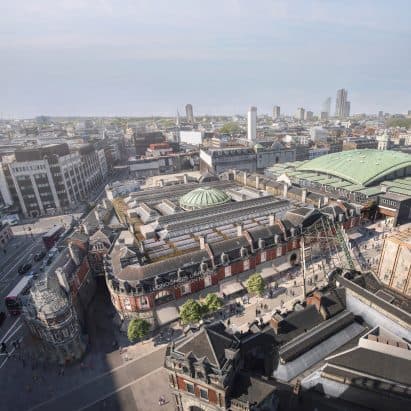
First Look: The Relocated London Museum at Smithfield Unveiled
One of the most anticipated architectural projects in the United Kingdom has taken a major step forward. Newly released images of the relocated London Museum — set to open at the historic Smithfield site in the City of London — offer the most detailed public glimpse yet of a building that promises to redefine how the capital tells its own story. Designed through a bold creative collaboration between architecture studio Stanton Williams and renowned designer Asif Khan, the project is as much a cultural statement as it is an architectural achievement.
The images reveal a structure that is sensitive to its Victorian surroundings while confidently asserting a contemporary identity. For Londoners and architecture enthusiasts around the world, this is a moment worth paying close attention to.
Why the London Museum Is Moving to Smithfield
The London Museum — formerly known as the Museum of London — has called the Barbican area its home since 1976. While that building served the institution well for decades, it was ultimately deemed too limited in scale and too constrained in layout to meet the ambitions of a 21st-century museum. The decision to relocate to the former General Market buildings at Smithfield, part of the broader Smithfield Market complex in the City of London, represents a once-in-a-generation opportunity.
Smithfield itself is a location dripping with history. The area has functioned as a market since the 10th century, hosted public executions, survived the Great Fire of London, and witnessed centuries of transformation. For a museum dedicated to the story of London and its people, few sites could be more fitting. The relocation is not just logistical — it is deeply symbolic.
The Architectural Vision of Stanton Williams and Asif Khan
Stanton Williams, the London-based architecture studio known for their meticulous approach to heritage and contemporary design, won the commission alongside Asif Khan, a designer celebrated for creating immersive, experiential spaces that challenge how people engage with built environments. Their combined approach to the London Museum project appears to balance rigorous historical respect with a genuine appetite for the new.
The newly revealed images show how the design team has chosen to work with the existing Victorian and Edwardian fabric of the Smithfield buildings rather than against them. Exposed ironwork, grand market halls, and original masonry appear to be preserved and integrated into the museum's circulation and gallery spaces. Rather than imposing a glass-and-steel shell over the old bones of the market, the architects have found ways to let the building breathe — opening up skylights, creating dramatic internal vistas, and threading modern interventions through heritage structures with precision and care.
Key Architectural Features Revealed in the Images
- A dramatic aerial view shows the scale of the museum footprint within the Smithfield complex, illustrating how the existing market structures have been woven together into a coherent whole.
- Interior renders suggest vast, light-filled gallery spaces capable of housing the museum's extensive collection of over seven million objects.
- Public-facing areas appear designed to blur the boundary between street life and museum life, with generous access points that invite the city in rather than keeping it at arm's length.
- Visible material choices — stone, weathered metal, and timber — echo the industrial and mercantile character of Smithfield's long history as a working market.
A Museum Designed for All of London
One of the central ambitions driving the new London Museum project is accessibility — not just in the physical sense, but in terms of who the museum speaks to and who feels welcome within its walls. The existing museum at the Barbican, while beloved by many, suffered from relatively poor footfall partly due to its somewhat hidden location. Smithfield, by contrast, sits at a major crossroads in the City of London, adjacent to Farringdon station and its Elizabeth line connections, making it one of the most transport-accessible cultural destinations in the capital.
The design appears to embrace this opportunity. Public space around and through the building looks generous, suggesting that the museum intends to function not just as a destination for planned visits but as a place that Londoners might pass through, linger in, or discover organically as part of their daily lives. This is a meaningful shift in how major museums think about their relationship with the city.
The Broader Cultural Significance of the Project
Beyond the architectural details, the relocation of the London Museum to Smithfield is significant for what it says about London's evolving relationship with its own heritage. Smithfield has seen substantial regeneration pressure over recent years, and the arrival of a major public cultural institution at its heart signals a commitment to preserving the area's identity while making it accessible to a broader public.
The museum's collection — spanning Roman Londinium, medieval plague, the Blitz, the Swinging Sixties, and modern multicultural London — deserves a home worthy of its breadth. Based on the images now made public, it appears that Stanton Williams and Asif Khan are delivering exactly that.
What to Expect When the Museum Opens
- A significantly expanded gallery footprint compared to the existing Barbican site, allowing far more of the collection to be on permanent display.
- Flexible event and community spaces designed to host performances, debates, and educational programming alongside traditional exhibitions.
- An enhanced restaurant, café, and retail offering positioned to serve both museum visitors and the surrounding neighbourhood.
- Improved facilities for researchers and archives, consolidating the museum's role as a centre of scholarly inquiry into London's history.
Looking Ahead: A New Chapter for London's Story
The revealed images of the new London Museum at Smithfield have generated considerable excitement among architects, historians, and Londoners alike — and rightly so. This is a project that carries enormous responsibility: to honour a city of extraordinary complexity and depth, to serve communities across all 33 boroughs, and to create a physical space that feels as alive and contradictory and layered as London itself.
Stanton Williams and Asif Khan appear to be rising to that challenge with both ambition and sensitivity. As the project moves closer to completion, all eyes will remain fixed on Smithfield — a place that has always been at the beating heart of the capital, and is about to become even more so. The London Museum's next chapter is not merely a building project. It is a promise to the city.