
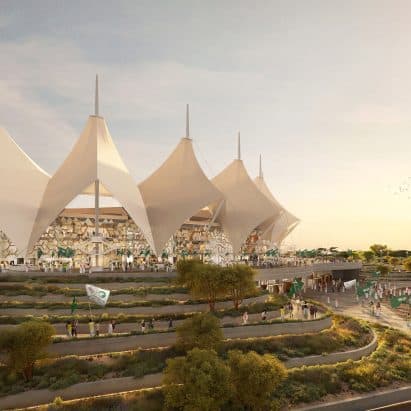
Populous Set to Revamp King Fahd Stadium While Honoring Its Iconic Design
Global architecture and design firm Populous has unveiled plans to transform Riyadh's King Fahd Sports City Stadium ahead of the 2034 FIFA World Cup, with a commitment to preserving the venue's instantly recognizable silhouette. The project stands as one of the most high-profile stadium redevelopments in the world, blending heritage sensitivity with the demands of modern elite football infrastructure. As Saudi Arabia gears up to host the global tournament, this revamp signals the country's intent to marry architectural legacy with world-class sporting ambition.
A Stadium Steeped in History
The King Fahd Sports City Stadium, located in the Saudi capital of Riyadh, is one of the most architecturally distinctive sports venues in the Middle East. Completed in 1987, the stadium is celebrated for its dramatic tent-like roof structure, a series of soaring white fiberglass canopies that lend the venue a skyline presence unlike almost any other stadium on the planet. The design was groundbreaking for its time, combining structural engineering innovation with an aesthetic that echoed traditional Arabic architectural forms and the sweeping lines of desert tents.
Over the decades, the stadium has hosted some of the most significant football matches in the region, including the 1989 and 1995 FIFA Confederations Cup. It has long been considered a national landmark, and any intervention on its structure carries enormous cultural weight. For Populous, the challenge was clear from the outset: upgrade the stadium to meet FIFA's stringent World Cup requirements without erasing the design legacy that makes it iconic.
What Populous Is Planning
Populous, the firm behind some of the world's most celebrated sporting venues, has approached the King Fahd Stadium project with a philosophy rooted in respectful transformation. The practice has confirmed that its design strategy will center on preserving the stadium's iconic silhouette — particularly the distinctive tent-roof canopies — while substantially upgrading the interior, fan experience, and technical infrastructure.
The revamp is expected to include a significant expansion of seating capacity to meet FIFA World Cup standards, with the stadium needing to accommodate tens of thousands of spectators in comfort and safety. Modern amenities, enhanced sightlines, improved accessibility, and state-of-the-art media and broadcast facilities are all central to the brief. Critically, however, Populous has made clear that these upgrades will be integrated in a way that works with the existing architectural language rather than against it.
The design team has reportedly spent considerable time studying the original structure to understand not just how it looks, but how it performs — examining everything from crowd flow and thermal comfort in the Saudi climate to the structural behavior of the existing roof system. This deep-dive approach reflects a growing trend in stadium architecture toward renovation and adaptive reuse rather than outright demolition and rebuild.
Why Preservation Matters in Stadium Architecture
The decision to preserve the King Fahd Stadium's silhouette is significant beyond just this one project. It reflects a broader shift in how architects, cities, and governing bodies think about sporting infrastructure. For much of the late twentieth century, the answer to an ageing stadium was simply to tear it down and start again. Today, sustainability, cultural heritage, and civic identity are reshaping that calculus.
- Cultural continuity: Preserving a landmark building maintains a city's sense of architectural identity and collective memory, something that matters deeply to local communities and visiting fans alike.
- Sustainability credentials: Retaining and upgrading an existing structure is almost always less carbon-intensive than demolishing and rebuilding, aligning with FIFA's own sustainability commitments for future World Cups.
- Economic efficiency: Renovation projects, when well managed, can deliver significant cost savings compared to new-build alternatives, redirecting resources toward other infrastructure priorities.
- Tourist appeal: Iconic buildings draw visitors. Preserving the King Fahd Stadium's famous roofline ensures Riyadh retains a genuine architectural attraction that resonates with global audiences.
Saudi Arabia's Broader 2034 World Cup Vision
The King Fahd Stadium revamp is just one piece of an extraordinarily ambitious infrastructure programme that Saudi Arabia is rolling out ahead of 2034. The country has committed to hosting matches across multiple cities, including Riyadh, Jeddah, and NEOM, with a mix of newly constructed venues and upgraded existing ones forming the tournament's backbone.
Saudi Arabia's Vision 2030 programme, which aims to diversify the nation's economy and elevate its global cultural profile, underpins much of this investment. Sport is a central pillar of that vision, and the World Cup represents the most high-visibility expression of Saudi Arabia's ambitions on the world stage. Architecture firms like Populous are playing a key role in translating those ambitions into built reality.
The emphasis on preserving the King Fahd Stadium also sends a message to the global architectural community: that the 2034 World Cup is not simply about spectacle and newness, but about building something enduring, rooted in place and history.
Populous and the Art of Stadium Design
Populous is arguably the world's leading specialist in sports venue design, with a portfolio that includes Tottenham Hotspur Stadium in London, State Farm Stadium in Arizona, and Brisbane Stadium in Australia. The firm has long understood that the best stadiums are not just functional containers for sport, but civic landmarks that shape identity and inspire communities.
Their approach to the King Fahd Stadium project draws on decades of experience balancing technical demands with architectural vision. By committing to preserve the iconic silhouette, Populous is not taking the easy road — engineering and design solutions that work with an existing structure are often far more complex than starting from scratch. But the firm's track record suggests it is well equipped to meet that challenge.
Looking Ahead to 2034
With the 2034 FIFA World Cup still several years away, the King Fahd Stadium revamp will continue to evolve through detailed design and planning stages. But the direction of travel is clear. Riyadh will have a modernized, world-class venue that pays genuine respect to one of the Middle East's most celebrated pieces of sports architecture. For football fans arriving in Saudi Arabia a decade from now, the sight of those soaring white canopies against the Riyadh skyline will be both a welcome to the present and a nod to the past.