
What Happens to Social Security in 2032?
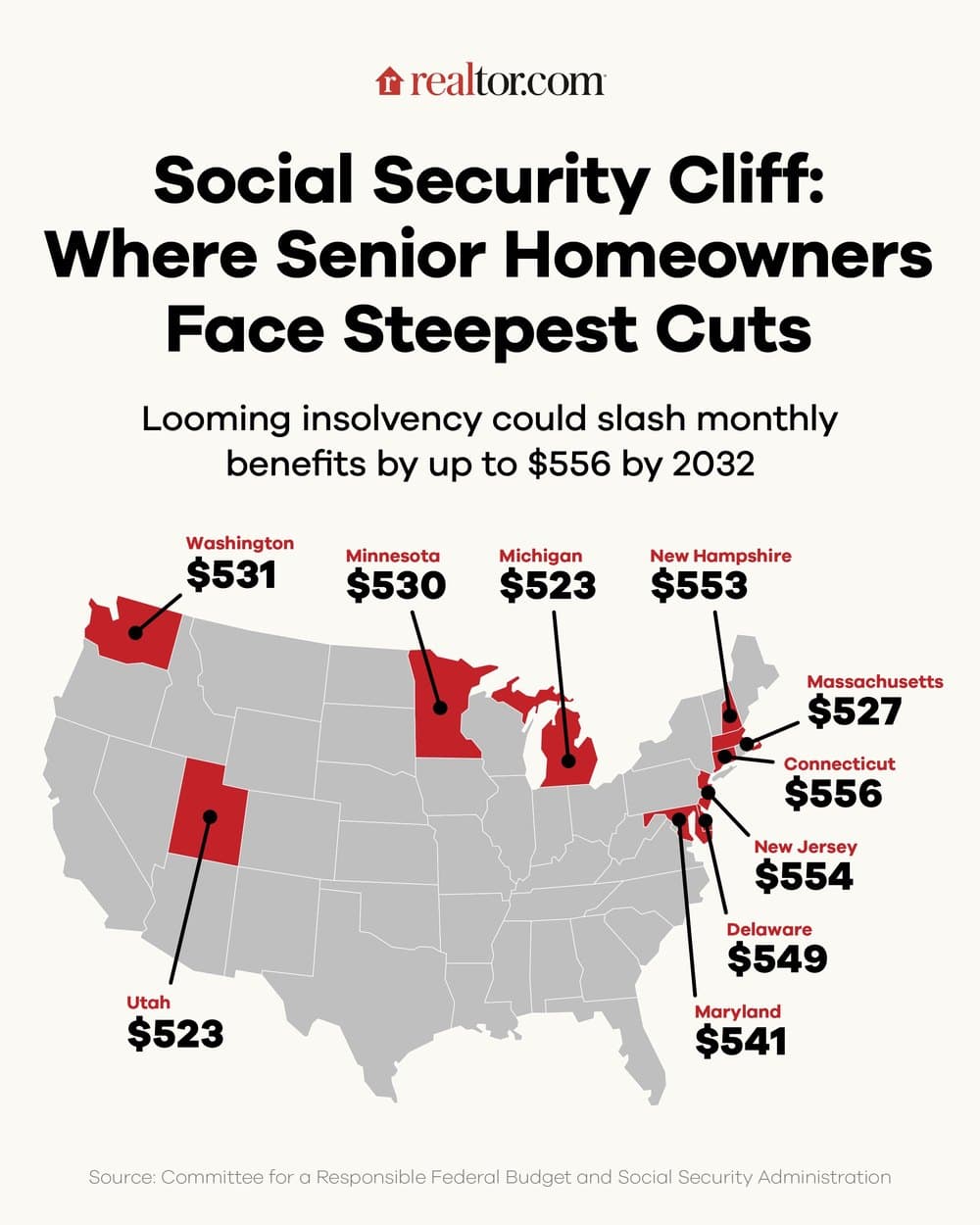
American retirees are facing a looming financial crisis that could reshape retirement as we know it. According to a landmark analysis by the Committee for a Responsible Federal Budget (CRFB), the Social Security trust fund reserves are projected to be completely depleted by 2032. If Congress fails to act before that deadline, beneficiaries across the country could see their monthly checks slashed by an average of 24 percent — a loss of roughly $500 per month for the average recipient.
For millions of older Americans who rely on Social Security as their primary or sole source of income, a cut of that magnitude is not just financially painful — it could be catastrophic. It could mean the difference between keeping a roof over their heads and facing eviction or foreclosure. The situation is made even more urgent by the fact that seniors in certain states stand to lose significantly more than the national average.
Why Is the Social Security Trust Fund Running Out?
The Social Security retirement program has been spending more than it collects in payroll taxes for the past 16 years. To cover the gap between incoming tax revenue and outgoing benefit payments, the program has been drawing from its accumulated trust fund reserves — essentially, a savings cushion built up over decades when the program ran surpluses.
The core driver of this imbalance is demographic. The massive Baby Boomer generation has been retiring in large numbers, swelling the ranks of Social Security recipients, while a comparatively smaller working-age population is contributing taxes into the system. This structural mismatch is not a new discovery — economists and policy experts have been warning about it for decades — but the window for a legislative fix is growing dangerously narrow.
Once those trust fund reserves are exhausted, federal law currently does not permit the program to pay out more than it takes in. At that point, automatic, across-the-board benefit cuts would be triggered — not because of policy choice, but by legal default.
The States Where Seniors Will Be Hit the Hardest
While every retiree in every state would feel the sting of a 24 percent benefit reduction, the CRFB's state-by-state analysis makes clear that the impact will not be felt equally. Seniors living in states with higher average Social Security payments, higher costs of living, or greater reliance on benefits as a share of total income face uniquely severe financial exposure.
In high-cost states where housing, healthcare, and basic goods are more expensive, a $500-per-month reduction doesn't just hurt — it dismantles carefully built retirement budgets. Consider that in many metropolitan areas in states like California, New York, New Jersey, Connecticut, and Massachusetts, monthly housing costs alone can far exceed what Social Security provides. Cutting benefits by nearly a quarter in these environments pushes a significant share of seniors below the poverty line.
States with large elderly populations that have fewer alternative income streams — such as pensions, 401(k) savings, or investment income — are especially vulnerable. In rural states and those with below-average median incomes, seniors often depend on Social Security for 80 percent or more of their household income, leaving almost no financial buffer to absorb a dramatic cut.
Putting Your Home at Risk: The Housing Connection
One of the most alarming dimensions of this crisis is its potential impact on homeownership among retirees. Many older Americans carry mortgage payments, property taxes, homeowner's insurance, and maintenance costs that are carefully calibrated against their current benefit levels. A sudden 24 percent reduction could make those payments unmanageable.
According to housing analysts, a meaningful portion of senior homeowners could be forced to sell their homes, take on reverse mortgages under duress, or — in worst-case scenarios — face foreclosure. Renters face an equally grim outlook, with reduced incomes making it far harder to compete in already tight rental markets, particularly in urban and suburban areas where rents have surged in recent years.
The ripple effects could extend well beyond individual households. Communities with large retiree populations could see significant economic disruption as consumer spending declines, local tax revenues fall, and demand for social services spikes simultaneously.
What Can Be Done? Policy Options on the Table
The good news — if it can be called that — is that the Social Security shortfall is a known problem with known solutions. Policymakers have a menu of options available, though each carries significant political trade-offs:
- Raising the payroll tax cap: Currently, income above a certain threshold is not subject to Social Security taxes. Lifting or eliminating that cap would generate substantial additional revenue.
- Gradually increasing the retirement age: Adjusting the full retirement age upward to reflect longer life expectancies would reduce the program's long-term obligations.
- Adjusting the benefit formula: Modifying how benefits are calculated, particularly for higher-income earners, could reduce outlays while protecting the most vulnerable recipients.
- A combination approach: Most experts agree that a blended package of modest tax increases and targeted benefit adjustments is the most realistic and equitable path forward.
Congress has addressed Social Security solvency crises before — most notably in 1983, when a bipartisan commission led by Alan Greenspan negotiated a package of reforms that extended the program's solvency by decades. A similar bipartisan solution is possible today, but it requires political will that has so far been in short supply.
What Seniors Should Do Right Now
Regardless of how Congress ultimately responds, financial advisors strongly recommend that current and near-future retirees take proactive steps to reduce their vulnerability to potential benefit cuts.
- Diversify your retirement income streams by building savings in IRAs, 401(k)s, or other investment accounts to reduce dependence on Social Security alone.
- Delay claiming Social Security if possible, since waiting until age 70 maximizes your monthly benefit and gives you more cushion in the event of future cuts.
- Review your housing costs and consider whether downsizing or relocating to a lower-cost area could reduce your financial exposure.
- Consult a financial planner who specializes in retirement income planning to model different benefit-cut scenarios and build a contingency plan.
- Stay informed and engaged politically, since the ultimate outcome here depends on congressional action — and voters have a powerful voice in shaping that outcome.
The Bottom Line
The Social Security crisis of 2032 is not a distant abstraction — it is a rapidly approaching reality that will affect tens of millions of American seniors, with some states bearing a disproportionate share of the pain. The CRFB's analysis serves as a stark reminder that inaction has a price, and that price will be paid most heavily by those who can least afford it. The time for Congress to act is now, and the time for individuals to plan is equally urgent. Understanding the stakes — both nationally and in your specific state — is the essential first step toward protecting your retirement security.