
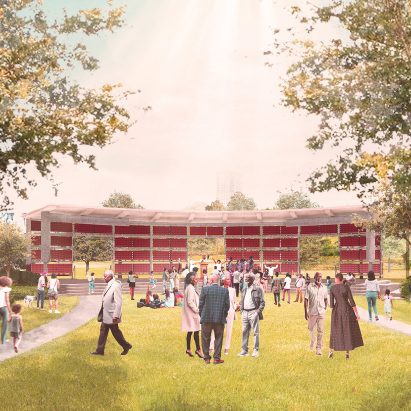
Theaster Gates and Studio Zewde Announce Landmark Performance Space for Houston's Freedmen's Town
Two of the most compelling creative voices in contemporary American culture are joining forces to transform one of the country's most historically significant Black neighborhoods. Renowned artist and urban planner Theaster Gates and the celebrated landscape architecture and urban design practice Studio Zewde have announced a collaboration to create a new cultural performance space in Houston's Freedmen's Town — a project that promises to be as much a statement of identity as it is a work of architecture and design.
The project represents a deeply meaningful convergence of art, history, and community-centered design. Freedmen's Town, located in Houston's Fourth Ward, was established by formerly enslaved African Americans after emancipation in 1865 and stands as one of the oldest and most culturally rich Black communities in the United States. The new performance space is poised to become a vital gathering point for residents and visitors alike, honoring the legacy of the neighborhood while investing in its future.
What Is Freedmen's Town and Why Does It Matter?
Understanding the weight of this project requires understanding the place itself. Freedmen's Town — sometimes called "Frenchtown" or simply the Fourth Ward — was born out of the Juneteenth moment, when enslaved people in Texas were finally informed of their freedom on June 19, 1865. In the decades that followed, the neighborhood flourished as a center of Black commerce, religion, music, and civic life in the American South.
By the early twentieth century, Freedmen's Town had its own economy, its own vibrant jazz and blues scene, its own hospitals and schools. The neighborhood's brick-paved streets — many of which were laid by freed Black laborers — still survive today as a tangible connection to that history. However, like many historically Black urban neighborhoods across the United States, Freedmen's Town has faced persistent pressures from gentrification, demolition, and neglect throughout the latter half of the twentieth century and into the twenty-first.
Today, community organizations and cultural advocates continue to fight for the neighborhood's preservation. The new performance space designed by Gates and Studio Zewde is seen as a powerful act of cultural investment — one that frames architecture as a tool of memory, resilience, and joy.
Who Are the Collaborators Behind This Vision?
Theaster Gates: Artist as Urban Activist
Theaster Gates is one of the most influential figures working at the intersection of art, architecture, and social transformation today. Based in Chicago, Gates is perhaps best known for his Rebuild Foundation, through which he has converted vacant and neglected buildings on Chicago's South Side into thriving cultural spaces — including the Stony Island Arts Bank and the Black Cinema House. His practice draws deeply on African American cultural traditions, ceramics, music, and urban history, always centering community as both audience and collaborator.
Gates has long argued that the built environment is one of the most powerful tools for restoring dignity to disinvested communities. His involvement in the Freedmen's Town project signals a continuation and expansion of that philosophy into Houston, a city with its own complex and underappreciated Black cultural geography.
Studio Zewde: Landscape as Cultural Infrastructure
Studio Zewde, founded by landscape architect and designer Tise Zewde, has emerged as one of the most exciting and intellectually rigorous landscape design practices in the United States. The firm approaches landscape architecture not merely as the design of outdoor spaces, but as the creation of what Zewde calls "cultural infrastructure" — places that carry meaning, encourage gathering, and reflect the identities of the communities they serve.
Studio Zewde has developed a strong reputation for work that is simultaneously aesthetically sophisticated and deeply rooted in research, community engagement, and social justice. The firm's projects consistently demonstrate how landscape can serve as a form of storytelling, embedding histories and values directly into the physical environment. For a project in Freedmen's Town, that capacity for narrative landscape design is particularly resonant.
The Vision for the Performance Space
While specific design details are still emerging, the performance space is envisioned as a flexible, community-centered venue capable of hosting a wide range of cultural programming — from music and theater to spoken word, civic gatherings, and educational events. The design is expected to draw on the architectural and cultural traditions of Freedmen's Town itself, incorporating materials, forms, and references that speak directly to the neighborhood's history.
The project is also anticipated to function as an outdoor or semi-outdoor space, integrating Studio Zewde's landscape expertise to blur the boundaries between interior programming and the surrounding urban fabric of the Fourth Ward. Rather than inserting a foreign architectural object into the neighborhood, the collaborative approach seeks to grow something from the soil of the community — something that feels inevitable, rooted, and alive.
Architecture as an Act of Cultural Preservation
The Freedmen's Town performance space sits within a broader national conversation about who gets to shape the built environment of historically marginalized communities, and whose histories are deemed worthy of commemoration through architecture. Too often, cultural institutions in Black neighborhoods are designed by outsiders without meaningful engagement from the communities they are meant to serve. The Gates and Studio Zewde collaboration explicitly rejects that model.
By centering the voices and histories of Freedmen's Town residents in the design process, this project offers a compelling model for what culturally responsive architecture can look like in practice. It demonstrates that the highest function of design is not aesthetic spectacle but the creation of spaces where people feel genuinely seen, celebrated, and at home.
A New Chapter for an Historic Neighborhood
The announcement of the Theaster Gates and Studio Zewde collaboration has generated significant excitement among architects, artists, historians, and community members in Houston and beyond. The project arrives at a moment when Freedmen's Town is fighting hard to assert its identity against the pressures of a rapidly changing Houston real estate market.
For many in the community, a new performance space designed with such intentionality and creative ambition represents far more than a building. It is a declaration that Freedmen's Town is still here, still vital, and still capable of producing culture that the rest of the world should pay attention to. As the design develops and construction timelines become clearer, this project will undoubtedly continue to draw attention as one of the most significant works of culturally engaged architecture and landscape design in the United States.
The collaboration between Theaster Gates and Studio Zewde in Houston's Fourth Ward is a reminder that the most powerful architecture does not simply occupy space — it transforms it, and in doing so, transforms the people who inhabit it.