
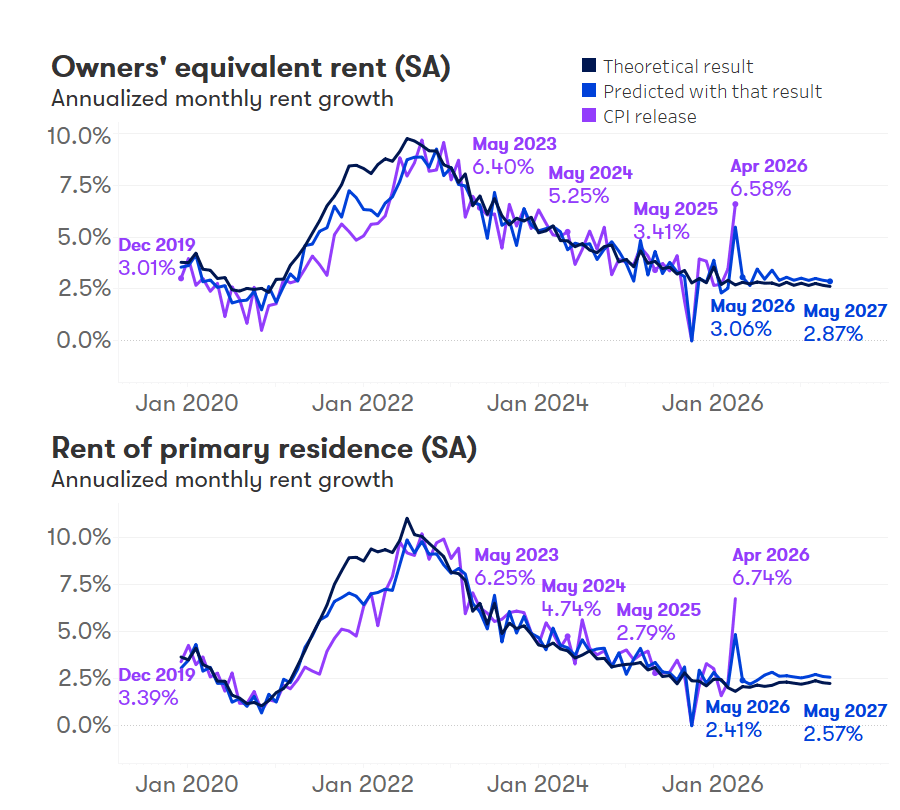
Zillow's May 2026 CPI Shelter Forecast: Housing Inflation Holds Firmer Than Expected
Every month, millions of Americans track the Consumer Price Index (CPI) for one simple reason: it tells them whether the cost of living is getting better or worse. Within that index, shelter costs carry enormous weight, making up the single largest component of overall inflation. On Wednesday, June 10, 2026, the Bureau of Labor Statistics is scheduled to release new shelter inflation data at 8:30 AM ET — and Zillow Research has already published its forecast for what those numbers are likely to show.
The headline finding from Zillow's May 2026 CPI Shelter Forecast is clear: housing inflation is now expected to hold near its current pace for the remainder of 2026. That's an upward revision from prior estimates, and it carries real implications for renters, homeowners, policymakers, and anyone watching the Federal Reserve's next moves. Here's a detailed breakdown of what Zillow is forecasting, why the outlook shifted, and what it means for you.
Why the CPI Shelter Forecast Was Revised Upward
The driving force behind Zillow's revised shelter forecast is something that caught analysts somewhat off guard: single-family market rents rose more than expected in April 2026. Spring is traditionally the busiest leasing season, and firmer-than-anticipated new-lease prices during this period have pushed the near-term inflation trajectory higher.
When new leases are signed at elevated prices during the spring surge, those prices feed into the broader rental market data over time. The CPI's shelter components — particularly Owners' Equivalent Rent (OER) and Rent of Primary Residence (RPR) — reflect these trends with a well-documented lag. That lag means the stronger spring pricing will continue to show up in official inflation readings well into the second half of 2026, keeping measured housing inflation from decelerating as quickly as previously assumed.
In short, the upward revision isn't a sign that the housing market is overheating again. Rather, it reflects the mechanical way in which real-world rent changes flow through to the CPI over a period of several months.
Normalization, Not Re-Acceleration: Understanding the Nuance
One of the most important distinctions Zillow Research makes in its May 2026 forecast is between normalization and re-acceleration. These two concepts may sound similar, but their implications for the economy — and for Federal Reserve policy — are very different.
Re-acceleration would mean that rent growth is picking up speed after a period of cooling, suggesting new inflationary pressures building in the housing market. Normalization, by contrast, means that rent growth is settling at a sustainable level after the extreme volatility of the post-pandemic years.
Zillow's interpretation firmly falls in the normalization camp. The research team notes that market rent growth is closely tied to the gap between the current rental vacancy rate and its so-called "natural rate" — the level that keeps rents stable over time. During the pandemic and its immediate aftermath, vacancy rates plummeted to historic lows, unleashing a surge in rents that rippled through the CPI for years. Since then, vacancy rates have gradually normalized, and with them, the underlying pressure driving rent growth has largely dissipated.
What we are seeing now, according to Zillow, is rental inflation stabilizing at a higher absolute level rather than reigniting. That's an important signal for markets: shelter inflation may remain elevated relative to pre-pandemic norms, but the explosive upward trajectory has run its course.
The Gap Between Market Rents and CPI Shelter Components
Another key insight from Zillow's forecast involves a persistent and often misunderstood gap between what landlords are charging on the open market and what the CPI's shelter components actually measure.
Currently, CPI shelter components — both OER and Rent of Primary Residence — are rising at a faster pace than on-market rents for new leases. This divergence exists because the CPI measures the full stock of rental housing, including leases that were signed months or even years ago. Many longer-term tenants are still seeing rent hikes as their leases renew, even as the prices being offered to new tenants on the open market have softened considerably.
This structural dynamic means that headline CPI shelter inflation can remain elevated even when the real-time rental market has calmed. It also explains why the Federal Reserve and many economists look at a range of alternative rent measures — including Zillow's own Observed Rent Index — to get a more current read on where housing costs are actually heading.
What This Means for Renters and Homeowners in 2026
For renters, the Zillow forecast suggests that meaningful relief from housing cost pressures is unlikely to arrive quickly. While new-lease price growth on the open market has moderated from its pandemic peaks, it remains positive, and the CPI's shelter components will continue to reflect elevated costs through the rest of the year. Anyone negotiating a new lease this spring or summer should be prepared for prices to remain firm, particularly in single-family rental properties.
For homeowners, the OER component of the CPI is directly relevant because it measures the implicit rental value of owner-occupied housing. A sustained OER means that the imputed cost of homeownership, as captured in the inflation data, is not falling. This matters for anyone tracking their real cost of living or managing a budget tied to inflation indices.
For prospective homebuyers, the broader picture painted by Zillow's forecast reinforces the complex environment that has characterized housing in the post-pandemic era: elevated costs, tight supply in many markets, and inflation that is cooling but doing so more slowly than many had hoped.
Federal Reserve Implications: Shelter Inflation Still in Focus
Shelter inflation remains one of the stickiest and most closely watched components of the CPI, and Zillow's upward revision to the 2026 forecast adds a modest but meaningful complication to the Federal Reserve's path forward. With housing costs holding near their current pace rather than decelerating as expected, the overall CPI may run somewhat hotter than prior projections through the back half of the year.
That doesn't necessarily mean the Fed will change course dramatically. Policymakers are well aware of the lag between real-time market rents and measured CPI shelter inflation, and they have made clear that they weigh a broad set of indicators when making rate decisions. However, a stickier shelter component does reduce the Fed's room to maneuver and could push back the timeline for meaningful rate cuts if other areas of inflation also prove resilient.
Looking Ahead: Key Dates and Data to Watch
With the BLS releasing new CPI data on June 10, 2026, the coming days will offer the first official confirmation of how closely Zillow's forecast aligns with reality. Investors, economists, and housing market watchers will be paying particularly close attention to the month-over-month and year-over-year figures for both Owners' Equivalent Rent and Rent of Primary Residence.
Beyond June, the trajectory of rental vacancy rates will be the most important leading indicator to monitor. If vacancy rates remain near their normalized levels, Zillow's thesis of stable-but-elevated rent growth should hold. If vacancy rates shift meaningfully in either direction — tightening again due to demand or loosening further as new supply enters the market — the shelter inflation forecast would need to be revisited accordingly.
Zillow's May 2026 CPI Shelter Forecast ultimately tells a story of a housing market that has moved past the worst of its post-pandemic volatility, but has not yet returned to the calm conditions of earlier eras. For renters, homeowners, and policymakers alike, understanding the distinction between normalization and re-acceleration — and recognizing the structural lags built into CPI measurement — is essential context for navigating what comes next in 2026 and beyond.