
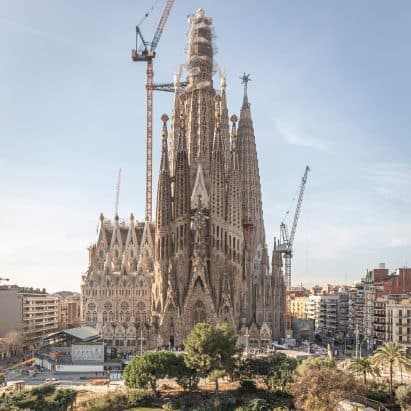
A Century Later, Gaudí's Vision Finally Stands Complete
One hundred years after the death of Antoni Gaudí, the world is finally witnessing the completion of his most ambitious and enduring dream. The central tower of the Sagrada Familia — the towering Jesus Christ spire that crowns the basilica's skyline in Barcelona — has been inaugurated by Pope Leo XIV, marking a moment of architectural and spiritual significance unlike any other in recent memory. It is a milestone that Gaudí himself never lived to see, yet in many ways he already had: every proportion, every curve, every structural logic of that soaring tower was mapped out in his mind, and increasingly, it seems, in a mathematical language that the rest of the world would not catch up with for decades.
For architects, historians, and design enthusiasts alike, the Gaudí Centenary is not simply an occasion to mourn a genius lost too soon. It is an opportunity to reassess just how far ahead of his time Antoni Gaudí truly was — and the answer, as experts are now confirming, is staggering. The algorithmic and computational thinking embedded in the Sagrada Familia's design predates the digital tools that would eventually make such geometry possible by more than half a century.
What Is Algorithmic Design, and Why Does It Matter?
To appreciate the full weight of Gaudí's achievement, it helps to understand what algorithmic design actually means in an architectural context. In modern practice, algorithmic design refers to the use of computational processes and mathematical rules to generate architectural forms. Rather than drawing shapes by hand and then calculating whether they will stand, designers use algorithms — sets of precise instructions — to generate geometry that is inherently structural, rational, and often breathtakingly organic in appearance.
This approach has only become widespread in architecture since the late twentieth century, powered by software tools and computing power that simply did not exist in Gaudí's era. Parametric design platforms and generative modeling software have allowed a new generation of architects — from Zaha Hadid Architects to Bjarke Ingels Group — to create buildings that echo the same flowing, nature-derived logic that Gaudí pursued by hand more than a century ago.
And yet Gaudí got there first. Without a computer, without a screen, without a line of code, he engineered a building whose structural logic is now described by mathematicians and architects as essentially algorithmic in nature. The word that keeps appearing in expert assessments of his work is "clairvoyant" — as if he could somehow see the computational future and build for it anyway.
The Mathematics Hidden Inside the Sagrada Familia
The genius of the Sagrada Familia lies not in its visual drama alone, though that is considerable. It lies in the structural systems beneath the surface — systems that Gaudí derived not from convention or academic training, but from obsessive observation of the natural world. He studied the branching of trees, the geometry of shells, the load-bearing efficiency of bones, and he translated what he saw into architectural principles of extraordinary sophistication.
- Catenary arches: Gaudí used hanging chain models — called catenaries — to calculate the ideal form for load-bearing arches. When inverted, a hanging chain naturally finds the most structurally efficient curve. Gaudí's famous upside-down models allowed him to design arches that required no additional buttressing, a revolutionary departure from Gothic tradition.
- Hyperboloid structures: The columns and vaulted ceilings of the Sagrada Familia are built from hyperboloids — double-curved geometric surfaces that distribute weight with remarkable efficiency. These forms are now staples of parametric design software, but Gaudí calculated them by hand and with physical models.
- Paraboloids and ruled surfaces: Throughout the basilica, Gaudí used ruled surfaces — complex three-dimensional forms generated by moving a straight line through space — to create shapes that are simultaneously structural, aesthetic, and almost impossible to achieve through conventional architectural drafting.
What makes all of this so remarkable is that these geometric families are precisely the ones that modern algorithmic design tools are best equipped to generate. Gaudí arrived at them through intuition, physical experimentation, and a profound mathematical sensibility that operated entirely outside the mainstream of his profession.
The Centenary Inauguration and Its Meaning
The inauguration of the central tower by Pope Leo XIV is a moment freighted with symbolism. The Sagrada Familia is, above all else, a sacred building — a Roman Catholic basilica funded entirely by private donations and the entrance fees of the millions of tourists who visit each year. Gaudí devoted the last decades of his life entirely to its construction, living on-site and famously dressing so simply that, when he was struck by a tram in Barcelona in 1926, passersby assumed he was a beggar and initially left him without aid. He died three days later, never knowing whether his cathedral would ever be finished.
That it has been finished — or near enough, with the central tower now inaugurated and further work continuing — is itself a testament to the power of an architectural vision so clear and so complete that it could survive its creator by a century. The detailed models, drawings, and structural logic that Gaudí left behind, painstakingly reconstructed after many were destroyed during the Spanish Civil War, have guided subsequent generations of architects and builders with a precision that feels almost supernatural.
Why the Sagrada Familia Still Matters in 2026
In an era of rapid digital design and mass-produced architecture, the Sagrada Familia stands as a powerful reminder of what architecture can be when it is rooted in deep structural logic and genuine creative vision. Its surfaces are not merely decorative; every curve earns its place by doing structural work. Its columns do not simply hold up a roof; they branch like trees in a forest, distributing loads with biological efficiency. And its towers do not simply rise; they spiral and taper according to mathematical rules that make them simultaneously elegant and stable.
For the architecture community, the Gaudí Centenary is an invitation to look backward in order to move forward. The tools have changed — today's architects have computational power that Gaudí could never have imagined — but the underlying questions remain the same: How does a building stand? How should it look? How can form and structure become one? Gaudí answered those questions with a clarity that still instructs and still inspires, a century on.
A Legacy Built in Stone and Mathematics
What the Sagrada Familia ultimately demonstrates is that great architecture is never purely of its time. Gaudí's work belongs to the nineteenth century in its craft, its devotion, and its Catholic iconography. But it belongs to our own century — and perhaps to the next — in its structural intelligence, its computational logic, and its insistence that nature, not convention, should be the architect's deepest teacher.
As the central tower rises above Barcelona and catches the light of a new century, it does so as proof that a single human mind, working without the tools we now take for granted, can produce something so precisely right, so structurally true, and so formally beautiful that the world is still catching up. Antoni Gaudí did not merely design a building. He wrote, in stone and geometry, a set of instructions that architecture is still learning to follow.