
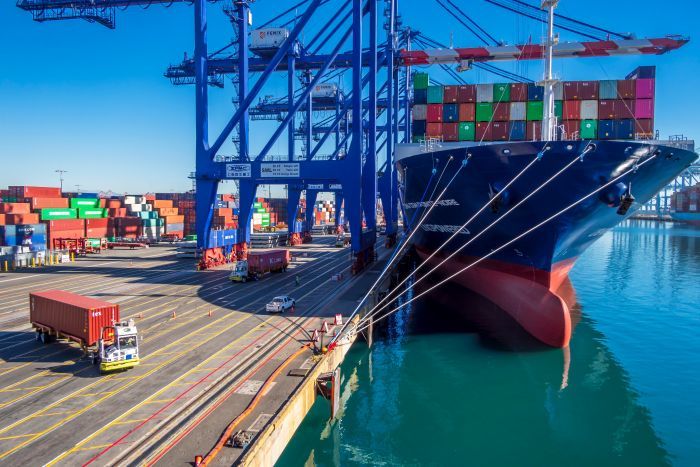
Senate Democrats Urge Trump Administration to Reinstate China-Linked Port Fees
A growing tension at the intersection of trade policy, national security, and global shipping has come back into focus on Capitol Hill. Senators Elizabeth Warren and Mark Kelly are pressing the Trump administration's United States Trade Representative (USTR) to reinstate port fees targeting China's maritime industry once the current one-year suspension comes to an end in November 2025. The bipartisan pressure reflects deepening concern about China's dominance over global shipping infrastructure and its long-term implications for American economic competitiveness.
What Are China-Linked Port Fees?
The port fees in question stem from a USTR investigation launched under Section 301 of the Trade Act of 1974, which allows the U.S. government to take action against foreign trade practices deemed unreasonable or discriminatory. Following a probe into China's shipbuilding sector and its maritime, logistics, and supply chain dominance, the USTR proposed levying fees on Chinese-built vessels calling at American ports.
The proposed structure would impose fees on ships built in China or operated by Chinese carriers every time they dock at a U.S. port. The intent was twofold: to financially penalize China's state-subsidized shipbuilding industry and to incentivize a revival of domestic American shipbuilding, a sector that has declined sharply over the past several decades.
However, in response to concerns raised by U.S. shipping companies, agricultural exporters, and port operators who warned of higher costs and supply chain disruptions, the Trump administration suspended the fees for one year. That window is now closing, and Democratic lawmakers are making their position clear: the fees should return.
Warren and Kelly's Case for Reinstatement
Senators Elizabeth Warren (D-MA) and Mark Kelly (D-AZ) sent a formal letter to the USTR urging the agency to follow through on reinstating the fees when the suspension period expires. Their argument rests on several pillars.
First, they argue that China's grip on global shipbuilding is not simply a commercial issue — it is a national security concern. China currently builds the vast majority of the world's commercial ships, and Chinese state-owned companies control a significant share of port operations and logistics infrastructure globally. In the senators' view, allowing Chinese-flagged or Chinese-built ships to dock at American ports without cost penalties gives Beijing undue leverage over U.S. supply chains.
Second, Warren and Kelly contend that without the port fees, the original policy goals — revitalizing the American maritime industry and reducing dependence on Chinese shipping — will remain aspirational at best. A fee structure, they argue, creates real financial pressure that can redirect capital toward domestic shipbuilding and encourage U.S. companies to seek non-Chinese shipping alternatives.
Third, the senators are concerned that an indefinite or repeated suspension effectively renders the USTR's findings meaningless. If the administration continues to delay enforcement, it sends a signal to China that U.S. trade remedies lack teeth, potentially emboldening further subsidization and market manipulation in the shipbuilding sector.
Industry Pushback and the Counterarguments
Not everyone shares the senators' urgency. A broad coalition of U.S. industries — from agriculture and retail to energy and manufacturing — has lobbied aggressively against the reinstatement of port fees. Their concern is straightforward: because China dominates global commercial shipbuilding, there are currently not enough non-Chinese vessels available to meet U.S. shipping demand. Imposing fees would, in effect, raise costs across the board for American exporters and importers without offering any near-term supply-side alternative.
- Agricultural exporters worry that higher shipping costs will make American grain and soybeans less competitive on global markets, particularly in Asia where Chinese competitors are waiting to fill the gap.
- Energy companies that export liquefied natural gas (LNG) have flagged similar concerns, noting that many LNG tankers are built in Chinese shipyards.
- Retailers who rely on trans-Pacific shipping routes have warned that reinstatement of the fees could translate into higher consumer prices at a time when inflation remains a sensitive political issue.
These industries make the case that any reinstatement of fees should be phased in gradually, or paired with robust investment incentives to accelerate the construction of U.S.-flagged and non-Chinese-built vessels, giving American supply chains time to adjust.
The Broader U.S.-China Trade Policy Context
The debate over port fees does not exist in a vacuum. It is part of a much larger and increasingly contentious U.S.-China trade relationship that has featured escalating tariffs, export controls on advanced semiconductors, restrictions on Chinese investment in sensitive U.S. industries, and ongoing scrutiny of Chinese entities operating in American markets.
The Biden administration's original USTR investigation and the Trump administration's subsequent suspension of the resulting fees illustrate a bipartisan consensus that something must be done about China's maritime dominance — even as the two parties disagree sharply about tactics and timing. Warren and Kelly's letter underscores that Democrats are not willing to let the issue fade quietly into the background as the November deadline approaches.
What Happens Next?
The USTR has not yet publicly indicated whether it intends to reinstate the fees, extend the suspension, or pursue a modified version of the original fee structure. The agency faces competing pressures: domestic industries seeking relief, lawmakers demanding enforcement, and a geopolitical landscape in which every trade decision involving China carries outsized diplomatic weight.
As November approaches, all eyes will be on the USTR's next move. The outcome could set a significant precedent — not only for U.S.-China maritime policy, but for how seriously Washington intends to use trade enforcement tools to push back against Chinese industrial dominance in critical global sectors.
For American businesses, policymakers, and trade analysts, the port fee debate is a bellwether. It will reveal whether the United States is prepared to accept short-term economic friction in pursuit of long-term strategic resilience — or whether the immediate costs of disrupting Chinese-dominated supply chains remain too politically difficult to bear.