
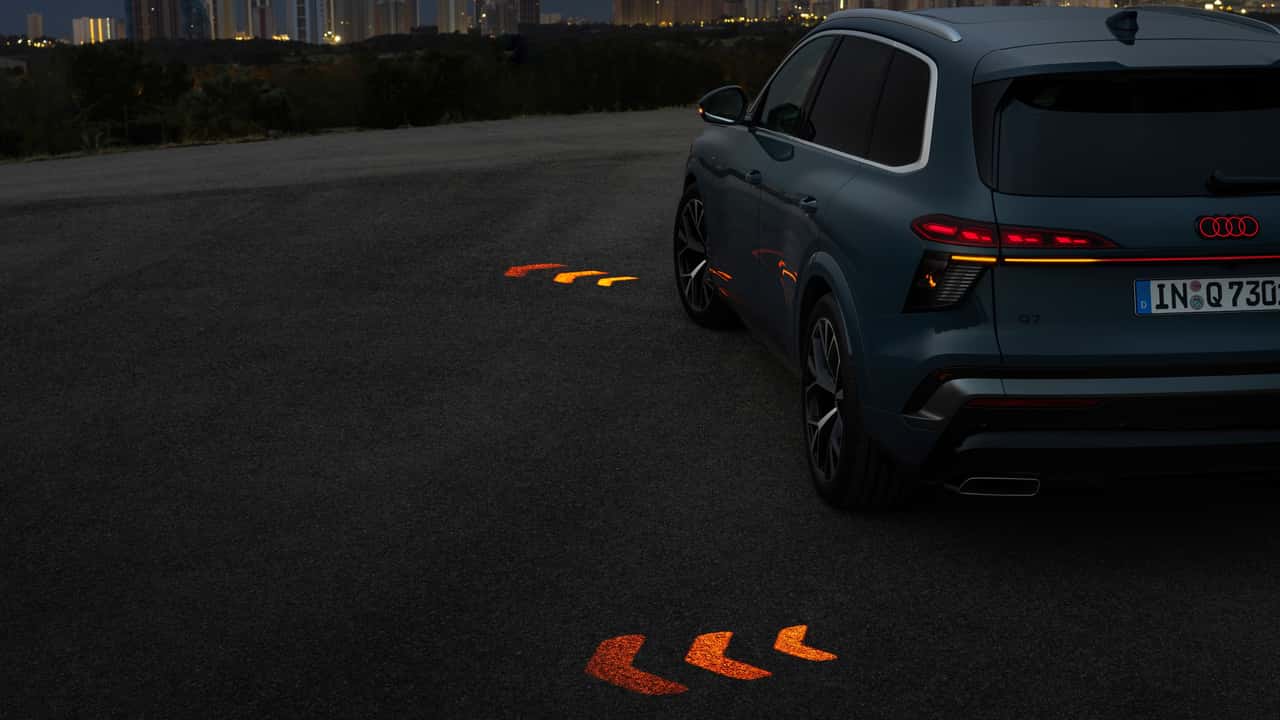
The New Audi Q7 Projects Turn Signals Onto The Road
Audi has never been a brand content with standing still. From its pioneering quattro all-wheel drive system to its laser-sharp Matrix LED headlights, the German automaker has consistently pushed the boundaries of what a luxury SUV can do. Now, with the latest iteration of the Audi Q7, the brand is raising the bar yet again — this time by projecting turn signals directly onto the road surface. It sounds like something out of a science fiction film, but it is very much the reality of modern automotive engineering, and it is arriving in driveways sooner than you might think.
What Exactly Is Road-Projected Turn Signal Technology?
At its core, the technology does exactly what the name suggests. Rather than — or in addition to — flashing a traditional amber indicator light on the side of the vehicle, the new Audi Q7 uses its advanced headlight system to cast a dynamic, animated turn signal indicator directly onto the road ahead of the vehicle. The projected image is bright, crisp, and immediately recognizable to other road users, cyclists, and pedestrians alike.
This is made possible through Audi's continued investment in high-resolution digital light projection systems. The headlights in the new Q7 are not simply light sources; they are precision instruments capable of displaying detailed graphics with remarkable accuracy. The turn signal projection adds a layer of communication between the vehicle and the surrounding environment that traditional lighting simply cannot match.
Why Road-Projected Signals Are a Safety Game-Changer
The safety implications of this technology are significant and far-reaching. Consider the everyday scenarios where a traditional turn signal can be missed or misread. A cyclist riding alongside a large SUV may be positioned too close to the vehicle's flanks to clearly see a side-mounted indicator. A pedestrian stepping off a curb might be focused on their footing rather than the amber light flickering on a car door. Road-projected turn signals address these real-world blind spots by putting the signal exactly where attention is most naturally directed — on the road itself.
Research has consistently shown that road-level visual cues are processed more quickly by the human brain in traffic situations. By shifting part of the signaling function down to the tarmac, Audi is working with human perception rather than against it. The result is a vehicle that communicates its intentions earlier and more clearly, reducing the window of ambiguity that so often precedes collisions at intersections and lane changes.
- Improved visibility for cyclists and pedestrians who may not see traditional side indicators.
- Faster recognition due to road-level visual processing by the human brain.
- Reduced ambiguity at intersections, roundabouts, and during lane changes.
- Enhanced communication in low-visibility conditions such as fog or heavy rain.
How Audi's Headlight Technology Has Evolved
To appreciate just how remarkable this development is, it helps to understand the journey Audi has taken to get here. The brand introduced its Matrix LED headlight system back in 2013, which allowed individual LED segments to be switched on and off independently to avoid dazzling oncoming drivers. That was already a landmark moment in automotive lighting. Since then, Audi has progressively refined and expanded the capabilities of its lighting systems with each new generation.
The Digital Matrix LED technology that underpins the road-projection feature in the new Q7 takes this further still. Instead of controlling a limited number of LED segments, the system uses an array of microscopic mirrors — similar in principle to a digital cinema projector — to shape light with extraordinary precision. Each headlight unit in the Q7 can control over one million pixels of light output, enabling it to display complex images, animations, and yes, turn signal graphics, with stunning clarity.
Audi has previously demonstrated projection capabilities on concept and flagship models, but the integration of road-projected turn signals into a mainstream production SUV like the Q7 marks a meaningful step toward this technology becoming standard across the automotive industry.
The Design Language Behind the Feature
Audi has always treated its lighting design as a signature element of each vehicle's visual identity, and the Q7 is no exception. The animated turn signal projection is designed to be instantly legible and visually consistent with the brand's broader aesthetic language. The projected graphic is purposeful and clean, avoiding unnecessary complexity while remaining impossible to miss. It complements the exterior design of the refreshed Q7 rather than existing as a gimmick bolted onto an otherwise conventional vehicle.
Inside the cabin, drivers benefit from a sense of confidence that comes from knowing their intentions are being communicated in multiple ways simultaneously. The integration is seamless, requiring no additional input from the driver — the system simply activates whenever the turn signal stalk is engaged, as naturally as any other function in the vehicle.
What This Means for the Future of Automotive Lighting
The Audi Q7's road-projected turn signals are more than a clever feature on a new luxury SUV. They represent a broader philosophical shift in how vehicles will communicate with the world around them as roads become increasingly shared between human drivers, pedestrians, cyclists, and autonomous vehicles. Clear, unambiguous communication between a vehicle and its environment is one of the foundational requirements of a safer transportation future, and Audi is demonstrating that this future does not have to wait for full autonomy to arrive.
Expect other premium manufacturers to follow Audi's lead in the coming years. What begins as a differentiating feature in the flagship SUV segment has a habit of filtering down through the market until it becomes an expected standard. For now, though, the new Audi Q7 stands as a compelling example of what it looks like when thoughtful engineering, genuine innovation, and a commitment to safety all point in the same direction — projected, quite literally, onto the road ahead.