
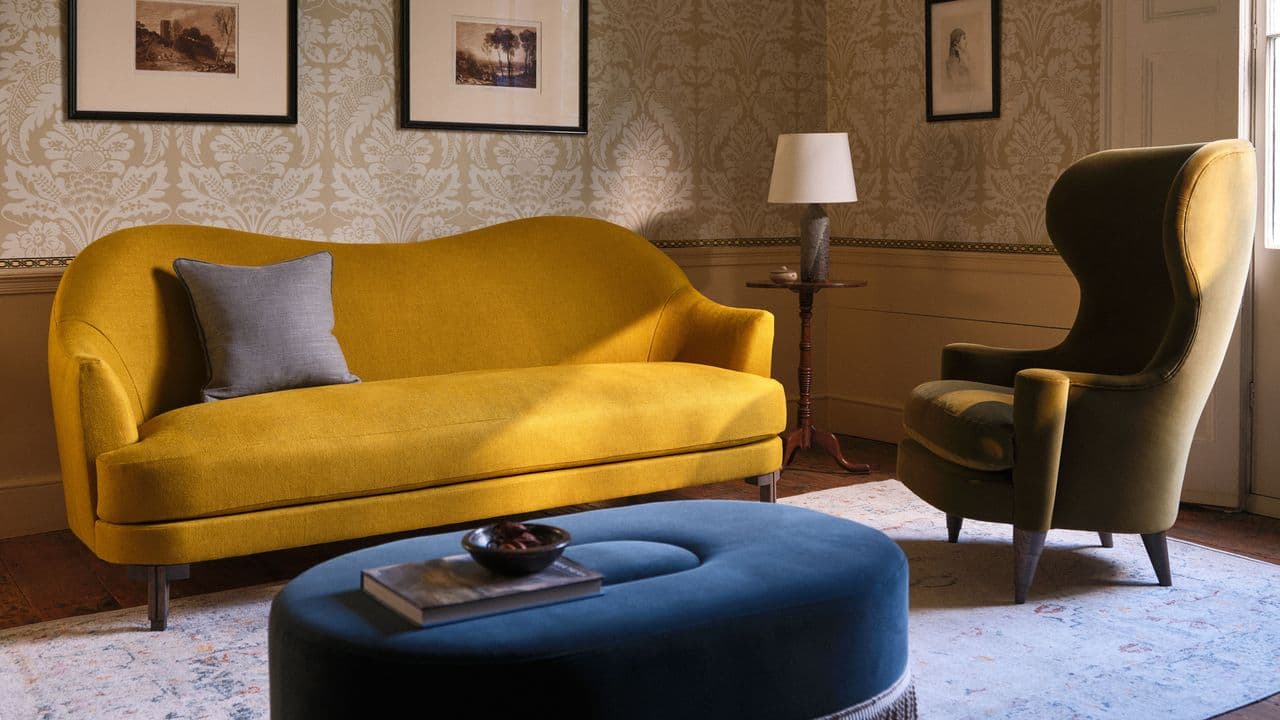
When a 200-Year-Old Painting Teaches Us How to Furnish a Room
In an era saturated with fast furniture, algorithm-driven aesthetics, and trend cycles that expire before the delivery truck pulls away, a new collection rooted in the paintings of J.M.W. Turner feels almost revolutionary. The British Romantic master, who lived from 1775 to 1851, spent his career obsessing over light, atmosphere, and the emotional weight of the natural world. Now, a Turner-inspired furniture collection is translating those very preoccupations into tactile, liveable form — and the result is a masterclass in why some design principles simply never age.
Turner never designed a chair. He never chose a fabric swatch or deliberated over joinery. Yet the visual language he developed across more than five decades of painting turns out to be remarkably well-suited to interior spaces. Hazy gradients of amber and slate. Forms that seem to dissolve at their edges. A persistent sense of warmth existing alongside melancholy vastness. These qualities, when translated into wood, upholstery, and metal, produce something that feels simultaneously ancient and startlingly fresh.
What Makes Turner's Vision So Transferable to Interior Design?
Turner was fundamentally a painter of transitions — between sea and sky, between light and shadow, between the industrial age muscling in and the pastoral world retreating. That sensibility, it turns out, maps elegantly onto the best furniture design, which has always been about negotiating transitions: between comfort and structure, between ornament and function, between the individual object and the room that contains it.
The collection leans heavily into what designers sometimes call "atmospheric materiality." Rather than sharp contrasts or aggressive geometry, the pieces favor surfaces that seem to hold light rather than simply reflect it. Warm oak finishes recall the golden hazes of Turner's late Thames paintings. Upholstery in muted ochre, storm blue, and chalk grey echoes his sky studies. Even the hardware — rounded, slightly softened — feels less like punctuation and more like a breath held mid-sentence.
The Role of Color in Turner-Inspired Interiors
Color is perhaps the most immediately legible point of connection between Turner's canvases and this collection. Turner was famously experimental with pigment, adopting new synthetic colors as soon as they became available and layering them in ways that created an almost luminous depth. The furniture collection channels this through carefully considered finishes rather than flat paint or standard stain.
The result is that a sideboard or a dining chair seems to shift slightly depending on the time of day and the quality of light entering the room — brighter at noon, warmer and more amber at dusk, cooler and more contemplative in the morning. This is not an accident. It is the product of a design philosophy that prioritizes how an object feels to live with over how it photographs in a showroom.
Form, Silhouette, and the Art of Deliberate Softness
Beyond color, the collection's silhouettes deserve attention. Contemporary furniture has largely bifurcated into two camps: the aggressively minimal and the aggressively maximalist. Turner-inspired design stakes out a third path. Edges are gently curved rather than sharply chamfered. Legs taper but not to a punishing fineness. Backs on seating pieces rise with a slight swell that suggests support rather than demanding it.
These choices echo the way Turner handled form in his paintings. His ships and trees and mountains are never fully dissolved into atmosphere — there is always enough structure to read the subject clearly — but they are softened, suffused with the surrounding air. The furniture achieves something similar: it is clearly legible as a sofa, a bookcase, a bed frame, but it does not insist on itself. It coexists with a room rather than dominating it.
The 200-Year-Old Design Lesson: Atmosphere Is Not a Luxury
The deeper design lesson embedded in this collection is one that Turner himself might have articulated if he had been a furniture maker rather than a painter: atmosphere is not a decorative afterthought, it is the whole point. We do not merely inhabit rooms functionally. We inhabit them emotionally. The quality of light, the texture of surfaces we graze with our hands, the way colors shift as an afternoon passes — these things constitute the actual experience of being home.
Modern design culture has become very good at solving practical problems and very poor at addressing this atmospheric dimension. We have ergonomic chairs and modular storage and flat-pack efficiency, but too often the rooms that result feel evacuated of mood. Turner's paintings were never interested in solving practical problems. They were interested in evoking states of feeling, and that ambition, transplanted into furniture design, produces spaces that genuinely nourish the people living in them.
How to Incorporate Turner-Inspired Pieces Into Your Home
Integrating pieces from this collection — or applying its principles more broadly — works best when you resist the impulse to match and instead aim to layer. Consider the following approaches:
- Pair warm oak or walnut finishes with walls in muted, slightly complex whites — colours that contain a ghost of yellow or grey — rather than stark bright white, which fights the warmth of the wood.
- Allow natural light to vary rather than evening it out with aggressive overhead lighting. A room that changes across the day is a more interesting room to be in.
- Choose upholstery textures that reward touch: brushed linens, slightly nubbled wools, velvets with a visible nap. Turner's surfaces were never inert, and neither should yours be.
- Resist the urge to fill every surface. Turner's most powerful canvases often contain enormous expanses of atmospheric near-nothing, and a room benefits from similar breathing space.
Why This Moment Calls for Romantic-Era Thinking
There is something fitting about a Romantic-era sensibility resurfacing now. The Romantic movement arose partly as a response to rapid industrialization — to the sense that efficiency and productivity were being prioritized at the expense of feeling, beauty, and connection to the natural world. The parallels to our current moment are not subtle.
A Turner-inspired furniture collection is not, at its heart, a product launch. It is an argument: that the spaces we build around ourselves matter, that beauty is not frivolous, that a 200-year-old painter who spent his life chasing light across canvas still has something urgent to teach us about how to live well. That argument, right now, feels more necessary than ever.