
When Veterans Came Home to No Home: America's Post-WWII Housing Crisis
When the guns finally fell silent in 1945, millions of American veterans boarded ships and planes headed home. They had fought, sacrificed, and survived one of history's most devastating conflicts. What they expected was a fresh start—a house, a yard, a life worth living. What they found instead was a country that simply could not shelter them.
By 1946, federal estimates put the shortage at more than 2.5 million housing units needed for veterans and their families alone. With a U.S. population of just 151 million at the time—less than half of today's 331 million—the scale of that deficit was staggering. Veterans who had slept in foxholes across Europe and the Pacific were now bunking in overcrowded apartments, dilapidated trailers, and even tents. A protest slogan of the era captured the bitter mood perfectly: "From foxholes to shacks!! We had more room in the foxholes."
It was a national embarrassment. And it demanded a national response.
How America Built Its Way Out: The Post-War Housing Boom
What followed was one of the most remarkable feats of domestic mobilization in American history. Builders, policymakers, and financial institutions came together to produce housing at a speed and scale the country had never seen before—and has not seen since.
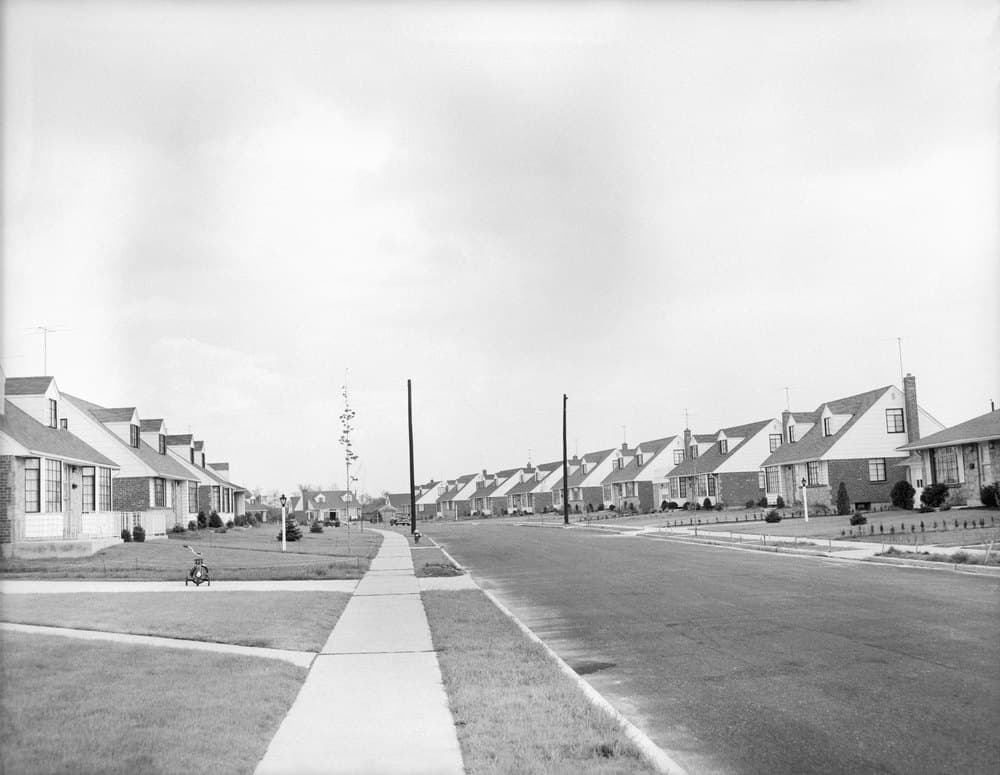
The construction industry, retooled after years of wartime production, shifted its full power toward residential building. Developers like William Levitt pioneered the concept of mass-produced suburban communities. Levittown in New York became the blueprint: affordable, standardized homes built quickly and efficiently using assembly-line techniques borrowed from the factory floor. By 1948, Levitt's crews were completing a new house every 16 minutes.
At the same time, the federal government modernized mortgage finance in ways that made homeownership accessible to ordinary Americans for the first time. The GI Bill, formally known as the Servicemen's Readjustment Act of 1944, provided veterans with low-interest, zero-down-payment mortgages backed by the federal government. The Federal Housing Administration (FHA) had already been expanding access to 30-year fixed-rate mortgages since the 1930s, and those programs accelerated dramatically in the post-war years.
The result was transformative. Homeownership rates climbed from roughly 44% in 1940 to nearly 62% by 1960. The American middle class expanded at an unprecedented rate. The starter home became the defining symbol of post-war prosperity—a tangible reward for hard work and sacrifice, and a cornerstone of the American dream.
Today's Housing Crisis: Familiar Pain, Different Landscape
Fast-forward to 2025, and the echoes of that post-war shortage are impossible to ignore. America is once again in the grip of a severe housing crisis, though the causes and contours are different from those of 1946.
The starter home—the very product that fueled the post-war boom—has effectively disappeared from reach for millions of Americans. In more than half the country, starter home prices have crossed the $1 million threshold. The typical first-time homebuyer is now 40 years old, a stark sign of how long it takes today's buyers to save enough to enter the market. Decades ago, that milestone often arrived in a buyer's mid-to-late twenties.
The shortage itself is enormous. Estimates from housing economists generally put the national deficit somewhere between 3.5 million and 7 million units, depending on the methodology. That gap is the product of years of underbuilding, particularly in the decade following the 2008 financial crisis, when construction activity collapsed and never fully recovered.
Meanwhile, costs have exploded. Land prices, labor shortages, supply chain disruptions, and rising material costs have all pushed the price of new construction sharply higher. Zoning laws and lengthy permitting processes in many cities and suburbs act as additional brakes on supply, often blocking new housing entirely in the places where demand is greatest.
Can We Replicate the Post-War Building Boom?
The question being asked by housing advocates, policymakers, and economists across the country is whether America can summon the same energy and ambition that solved the post-war housing crisis. The answer is complicated—but not entirely discouraging.
There are meaningful differences between then and now that make a simple replay unlikely. Post-war America had abundant cheap land on the suburban fringe, a booming industrial economy capable of producing building materials at scale, and a federal government riding the political momentum of wartime sacrifice. Today's challenges—urban infill development, NIMBYism, complex environmental regulations, and a fragmented construction industry—are substantially harder to overcome.
Yet there are also reasons for cautious optimism. Several states and cities have begun to take serious action on zoning reform, legalizing accessory dwelling units, multi-family housing in single-family zones, and streamlining permitting timelines. At the federal level, bipartisan support for housing production incentives has grown, though legislative progress remains slow.
Technology also offers possibilities that simply did not exist in 1946. Modular and prefabricated construction techniques, 3D-printed housing, and advanced building materials all hold the potential to dramatically reduce costs and accelerate production timelines—echoing, in some ways, the assembly-line methods that made Levittown possible.
What History Teaches Us
The lesson of the post-war housing boom is not that government alone can solve a housing crisis, nor that the private market can do it without support. What worked in 1946 was a combination: private builders empowered to build at scale, financial tools that made ownership accessible, and federal policy aligned with the goal of production over restriction.
That alignment is exactly what is missing today. Rebuilding it will require political will, policy creativity, and a willingness to prioritize the needs of future homeowners over the preferences of those who already have theirs.
America built its way out of a housing crisis once before—at a moment when the task seemed nearly impossible. Whether the country can find that ambition again may be the defining domestic challenge of this generation.
- The post-WWII U.S. housing shortage required more than 2.5 million new units for veterans alone.
- Government-backed mortgage programs and mass production techniques drove the post-war building boom.
- Today's housing deficit is estimated between 3.5 and 7 million units nationwide.
- Starter home prices have surpassed $1 million in over half the country.
- Zoning reform, construction technology, and aligned federal policy are key ingredients for a modern solution.