
Charlap Hyman & Herrero Reimagines the Modern Workplace With a Retrofuturistic LA Office
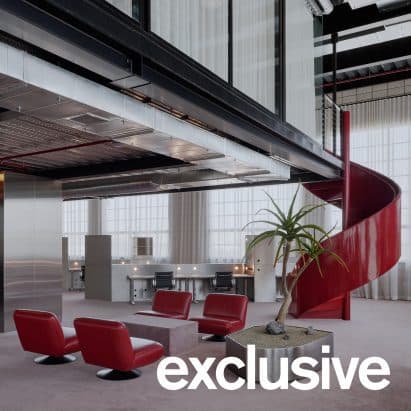
In a city already known for pushing architectural and cultural boundaries, New York-based design studio Charlap Hyman & Herrero has unveiled a remarkable office interior in Los Angeles that blurs the line between science fiction fantasy and functional workplace design. With a carefully curated aesthetic that looks simultaneously backward and forward in time, the project stands as one of the most visually arresting commercial interiors to emerge from the studio's portfolio — and arguably from the broader world of contemporary office design.
At the heart of the project are a series of bespoke custom workstations, purpose-built to complement the space's bold retrofuturistic vision. Rather than sourcing off-the-shelf furniture, the studio designed each piece to feel native to the environment — as though the office and its furnishings had been conceived as a single unified object. The result is an immersive workspace that challenges the sterile, open-plan orthodoxy that has dominated corporate interiors for decades.
What Is Retrofuturism in Interior Design?
Before diving deeper into the project itself, it's worth understanding the aesthetic language at play. Retrofuturism refers to a design philosophy that draws on how past generations imagined the future — think the sleek curves of 1960s space-age furniture, the bold color palettes of mid-century modernism, and the optimistic machine aesthetics of early science fiction. When applied to contemporary interiors, retrofuturism creates spaces that feel both nostalgic and visionary, familiar yet unlike anything else.
Charlap Hyman & Herrero has long been associated with theatrically rich interiors that resist easy categorization. Founded by Adam Charlap Hyman and Andre Herrero, the studio brings a deep knowledge of design history to every project, weaving together influences from across centuries and disciplines. Their LA office commission is a natural extension of this approach — a workspace that doesn't just function, but performs.
Custom Workstations as the Centerpiece of the Design
Perhaps the most striking decision in the project was the studio's commitment to fully custom workstations. In typical commercial interiors, workstations are often an afterthought — chosen for ergonomic compliance or budget efficiency rather than visual impact. Charlap Hyman & Herrero flipped that script entirely.
The custom workstations were designed to echo the overarching aesthetic of the space, incorporating curved forms, tactile materials, and a palette that reinforces the retrofuturistic mood. Each station functions as a self-contained world for its user, offering a sense of enclosure and identity that is rarely found in today's open-plan offices. This kind of bespoke furniture design signals a growing appetite among forward-thinking companies to invest meaningfully in the environments their employees inhabit every day.
The workstations also speak to a broader shift in workplace philosophy. As companies reckon with post-pandemic work culture and the ongoing challenge of attracting talent back to physical offices, the quality and character of the built environment has never mattered more. A space this considered and this visually compelling sends a clear message: this is somewhere worth showing up to.
Materials, Color, and Atmosphere
Charlap Hyman & Herrero's interiors are always material-rich, and this Los Angeles office is no exception. The studio is known for its sophisticated handling of texture and surface, layering materials in ways that reward close attention. In the LA office, this sensibility is expressed through a combination of warm tones, sculptural forms, and carefully chosen finishes that give the space a cinematic quality.
Color plays a central role in establishing the retrofuturistic mood. Rather than defaulting to the neutral grays and whites that define so many contemporary offices, the studio embraced a palette with depth and personality — one that references the optimistic chromatic experiments of mid-century designers while remaining entirely contemporary in its application.
Lighting, too, is used with intention. The interplay of ambient and task lighting reinforces the theatrical atmosphere, creating zones of focus and retreat within the larger space. It's the kind of lighting design that understands the emotional register of a room, not just its functional requirements.
Why This Project Matters for the Future of Office Design
The Charlap Hyman & Herrero LA office arrives at a pivotal moment for commercial interior design. The workspace as a category is undergoing its most significant transformation in generations. Remote and hybrid working models have permanently altered how companies think about office space — and those that are investing in physical environments are increasingly asking designers to do more than simply optimize square footage.
- Bespoke furniture and custom workstations are gaining ground as companies seek to differentiate their workplace culture and create environments employees genuinely want to inhabit.
- Retrofuturistic aesthetics tap into a cultural mood of nostalgic optimism — a desire to reimagine familiar ideas in fresh, exciting ways.
- Studios like Charlap Hyman & Herrero are demonstrating that commercial spaces can carry the same design ambition traditionally reserved for hospitality or residential projects.
- Investing in distinctive interior design is increasingly recognized as a tool for talent attraction and retention, especially in creative industries.
Charlap Hyman & Herrero: A Studio Defining Its Own Lane
This project reinforces what design enthusiasts and industry observers have been noticing for some time: Charlap Hyman & Herrero is operating at a level of creative ambition that places them among the most compelling interior design voices working today. Their refusal to default to safe, expected solutions — whether in residential, hospitality, or now commercial work — has earned them a reputation for interiors that are as intellectually rigorous as they are visually unforgettable.
The Los Angeles retrofuturistic office is not just a workplace. It is a statement about what design can accomplish when clients and creators are willing to commit fully to a vision. In a market saturated with competent but unremarkable commercial interiors, this project is a reminder that the office can be — and perhaps should be — genuinely extraordinary.
As workplace design continues to evolve in response to cultural, economic, and technological pressures, projects like this one offer a compelling blueprint: build spaces that inspire, that surprise, and that make the act of going to work feel like something worth looking forward to.