
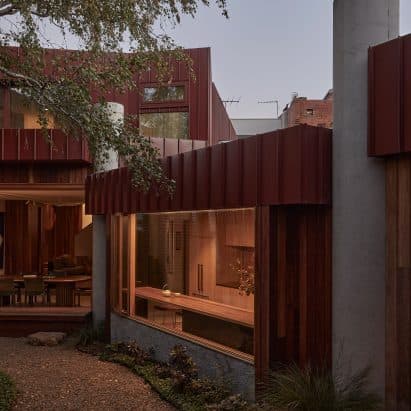
MRTN Architects Transforms a Melbourne Terrace with Bold Red-Brick Volumes
In the heart of Carlton, one of Melbourne's most architecturally layered inner-city suburbs, a modest Victorian terrace house has undergone a quietly spectacular transformation. Local practice MRTN Architects has extended the residence by introducing a cluster of red-brick volumes that grow organically from the rear of the existing structure, creating a dialogue between old and new that feels both considered and deeply contextual. Known as the Laneway House, this project is a compelling example of how thoughtful residential architecture can breathe new life into a heritage streetscape without erasing the character that makes it worth preserving in the first place.
The Challenge of Extending Heritage Homes in Melbourne
Carlton sits within a densely populated urban grid defined by bluestone laneways, Victorian-era terraces, and a rich history of working-class and migrant communities. Extending homes in such environments presents a layered set of challenges. Planners and heritage authorities often require that additions remain recessive from the street, respecting the primary facade's historic integrity. At the same time, homeowners increasingly demand contemporary spatial quality — open living areas, abundant natural light, and connections to outdoor space — that the original terrace typology simply cannot provide unaided.
MRTN Architects navigated these competing demands with a strategy rooted in material continuity. Rather than retreating to the ubiquitous glass-and-steel box that so often signals a modern addition, the practice chose red brick as its primary material — a choice that immediately anchors the extension within its surroundings while allowing a new architectural language to emerge.
A Cluster of Volumes That Reimagines the Rear Garden
The extension takes the form of several distinct brick volumes arranged in a loose cluster at the rear of the original terrace. Each volume is slightly different in height and orientation, generating a composition that feels more akin to a small settlement than a single monolithic addition. This fragmented approach has a number of practical and spatial benefits: it breaks down the perceived mass of the new construction, allows natural light to filter between volumes and into the interior, and creates a series of semi-enclosed outdoor spaces that feel intimate and sheltered rather than exposed.
The laneways that thread behind Carlton's terrace rows are central to the design concept. The architects treated the rear laneway not as a service edge to be hidden, but as a meaningful threshold — a secondary address of sorts — that the new volumes engage with through carefully placed openings and material expression. This decision elevates the project beyond a simple rear-of-house addition, positioning it instead as a piece of urban architecture that contributes to the texture of Melbourne's beloved laneway culture.
Material Honesty and Contextual Sensitivity
The choice of red brick is deceptively simple. Brick is, of course, the defining material of Carlton's residential fabric, found in everything from grand Italianate terraces to modest workers' cottages. By selecting a brick with a warm, hand-pressed quality, MRTN Architects ensured that the new volumes read as belonging to this tradition without mimicking it. The brickwork is laid in a contemporary bond pattern that differentiates the extension from the heritage building while maintaining a visual warmth and tactile richness that glass or render would struggle to achieve.
Inside, the material palette continues with similar restraint. Exposed brick walls, timber joinery, and concrete floors create a robust interior that ages gracefully and avoids the sterile blankness of over-finished contemporary interiors. The spatial organisation flows from the existing terrace through a transitional zone into the new living and dining areas, which open directly onto the courtyard spaces between the brick volumes. This sequence — from the compressed rooms of the original house to the generous, light-filled extension — is one of the project's most satisfying spatial achievements.
Light, Landscape, and Liveability
Natural light is treated as a primary design material throughout the Laneway House. Skylights are positioned at the junctions between the brick volumes, drawing daylight deep into the plan and creating pools of shifting illumination that animate the interior throughout the day. Clerestory windows allow light to enter from the north without compromising privacy, a particularly important consideration given the density of the surrounding neighbourhood.
The courtyards that emerge between the volumes are modest in scale but generous in quality. Planted with low-maintenance native species, they bring greenery and seasonal change into the heart of the house, softening the rawness of the brick and providing visual relief from the interior. These outdoor rooms function as extensions of the living areas, expanding the effective footprint of the house without requiring a larger building envelope.
Why the Laneway House Matters for Australian Residential Design
The Laneway House by MRTN Architects is significant not because it is radically experimental, but because it demonstrates an approach to urban residential architecture that is both responsible and inspiring. In an era when many Australian cities are grappling with housing density, heritage conservation, and climate resilience, projects like this offer a model worth studying closely.
- The use of durable, locally resonant materials reduces the project's environmental footprint while ensuring long-term relevance to its context.
- The fragmented volume strategy maximises natural light and ventilation, reducing reliance on artificial heating, cooling, and lighting.
- The engagement with the rear laneway activates underused urban infrastructure and contributes positively to the public realm.
- The spatial sequence from heritage terrace to contemporary extension demonstrates that old and new can coexist with intelligence and grace, without either element dominating or diminishing the other.
For homeowners, architects, and urban planners navigating the complex terrain of inner-city residential development in Melbourne and beyond, the Laneway House is a reminder that the most enduring architecture often comes not from dramatic gestures, but from a deep and patient engagement with place, material, and the everyday rhythms of domestic life. MRTN Architects has produced something quietly exceptional here — a home that fits its neighbourhood like a well-worn brick, and improves it in the process.