
A Startling New Study Says New Orleans Could Become an Island—Here's What That Means
Moving is widely considered one of life's most stressful experiences. Now imagine coordinating that process for nearly 400,000 people—an entire city—against the backdrop of rising seas, sinking land, and a shrinking window of time to act. That is precisely the scenario a landmark new study is asking Americans to confront. Published in the prestigious Nature Sustainability journal, the research paints a sobering picture of New Orleans' future and raises a question that was once unthinkable: Should one of America's most iconic cities simply be abandoned?
What the Science Actually Says
An interdisciplinary team of researchers from Tulane University, Yale University, Florida State University, and Coastal Carolina University examined the long-term impact of rising sea levels on one of the world's most vulnerable coastal zones. Their findings are as striking as they are unsettling.
Based on historical geological evidence, the scientists project that New Orleans will lose approximately 75% of its remaining wetlands by 2070. By the end of this century, the city could effectively become an island, completely surrounded by the Gulf of Mexico. To understand how that is possible, the researchers looked not just at future climate projections but at ancient history.
By studying an ancient shoreline, scientists discovered that roughly 125,000 years ago—during a period when global temperatures were only about 0.5 to 1.5 degrees Celsius warmer than pre-industrial levels—the waters of the Gulf of Mexico reached a point approximately 30 miles north of where modern-day New Orleans now stands. The implication is deeply alarming: global temperatures today are already approaching that same 1.5-degree threshold. The Gulf, in other words, has been here before.
Why New Orleans Is Uniquely Vulnerable
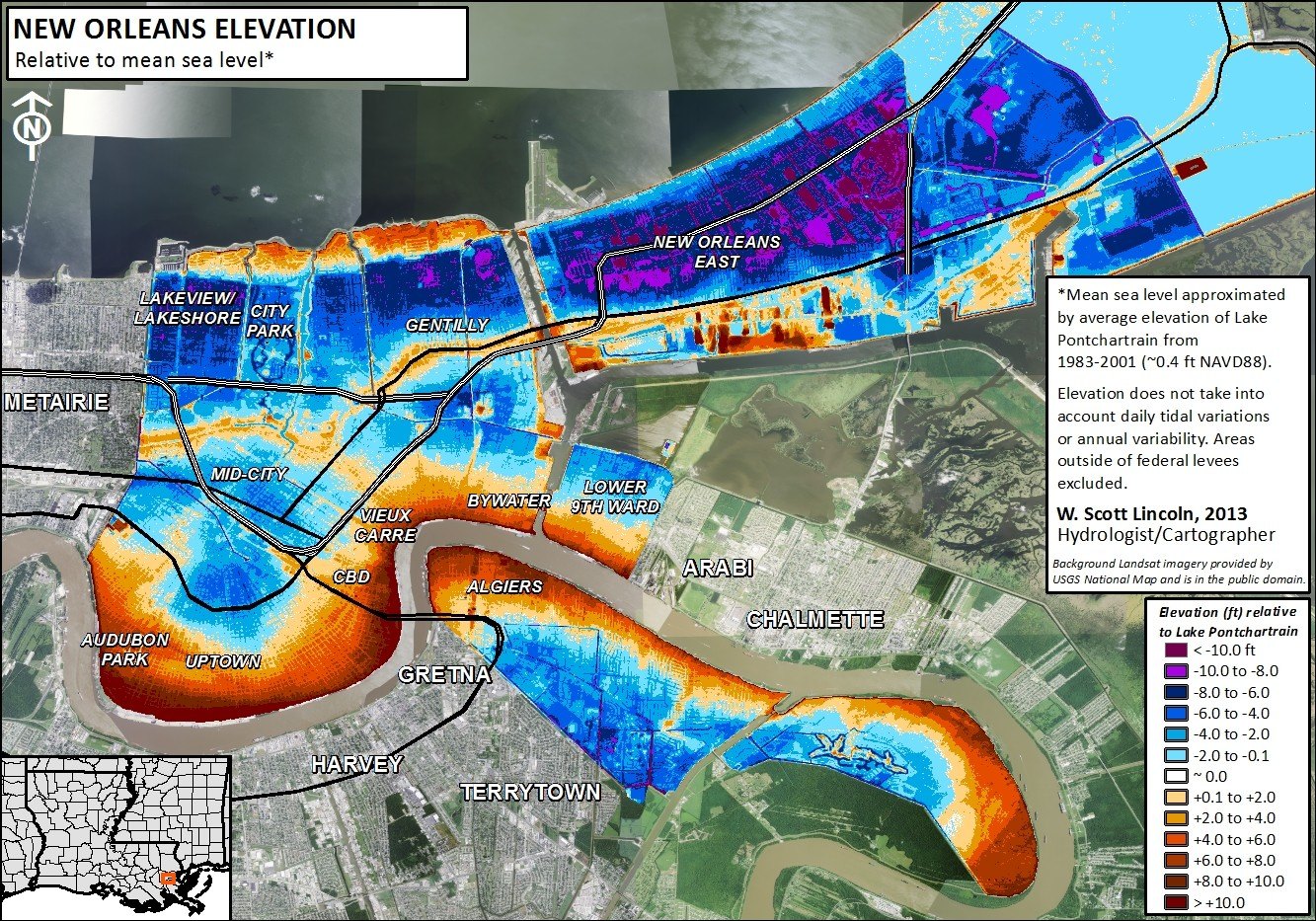
New Orleans has always existed in a precarious relationship with water. Situated below sea level and cradled between the Mississippi River and Lake Pontchartrain, the city relies on an elaborate system of levees, pumps, and floodwalls to stay dry. Hurricane Katrina in 2005 demonstrated in catastrophic detail what happens when that infrastructure fails. But the new research suggests that even the most ambitious engineering solutions may eventually be overwhelmed by forces operating on a geological timescale.
Several compounding factors make the city's situation especially dire:
- Land subsidence: Much of New Orleans sits on soft, compressible sediment that is actively sinking. Some neighborhoods are subsiding at rates of up to an inch per year, effectively amplifying the impact of rising sea levels.
- Wetland loss: Louisiana's coastal wetlands serve as a natural buffer against storm surge. Decades of oil and gas extraction, navigation canal construction, and altered river flow have already wiped out thousands of square miles of this protective marshland.
- Intensifying hurricanes: Warmer Gulf waters fuel stronger, slower-moving storms that dump more rain and push larger storm surges inland. Climate scientists broadly agree that the Atlantic hurricane season is becoming more destructive as the planet warms.
- Sea-level rise acceleration: Global mean sea level is rising at an accelerating pace. Locally, the combination of oceanic rise and land subsidence means New Orleans experiences some of the highest rates of relative sea-level rise anywhere on Earth.
The Concept of Managed Retreat
The study does not simply sound an alarm—it implicitly raises a policy concept that urban planners and climate scientists have debated for years: managed retreat. Rather than continuing to invest billions of dollars in flood defenses that may eventually prove inadequate, managed retreat proposes a deliberate, phased relocation of vulnerable populations to safer ground.
In theory, managed retreat is rational. In practice, it is enormously complicated. New Orleans is not merely a collection of buildings and infrastructure. It is a living repository of American history, culture, and identity—home to jazz, Mardi Gras, Creole cuisine, and some of the most architecturally significant neighborhoods in the country. The French Quarter, the Garden District, Tremé: these are not just zip codes. They are irreplaceable cultural landmarks.
Any serious relocation effort would need to grapple with profound questions of justice and equity. After Hurricane Katrina, lower-income residents and Black communities disproportionately struggled to return and rebuild. A managed retreat program that fails to center those communities risks repeating—and potentially magnifying—those historic injustices. Who decides who moves, when, and where? Who compensates homeowners for properties that may become uninsurable or unsellable? These are not abstract policy questions; they are deeply human ones.
Has Any City Ever Successfully Relocated?
While the scale of New Orleans would make it historically unprecedented, smaller communities have already begun grappling with climate-driven relocation. Isle de Jean Charles in Louisiana—a small, largely Native American community—became one of the first American communities to receive federal funding specifically for climate relocation, a process that has taken years and remained contentious. Newtok, Alaska, an indigenous village being swallowed by thawing permafrost and coastal erosion, has similarly been in the process of relocating for over a decade. If moving a community of a few hundred people takes this long and costs this much, the math for New Orleans grows staggering very quickly.
What Should New Orleans Residents Do Now?
For the nearly 400,000 people who call New Orleans home, the study does not necessarily mean packing bags tomorrow. But it does carry practical implications that residents, homeowners, and investors should take seriously today.
- Reassess flood insurance: Standard homeowner's insurance does not cover flooding. The National Flood Insurance Program (NFIP) is undergoing significant rate changes to better reflect actual risk, which may substantially increase premiums in high-risk zones.
- Monitor property values: Research increasingly shows that climate risk is being priced into real estate markets. Properties in flood-prone areas of coastal Louisiana may face long-term appreciation headwinds.
- Engage local government: Residents should be active participants in conversations about long-term infrastructure investment, zoning policy, and any future relocation planning programs.
- Consider elevation and construction standards: For those committed to staying, investing in elevated foundations and flood-resilient construction can meaningfully reduce risk in the near to medium term.
The Bigger Picture: A Warning for Coastal Cities Everywhere
New Orleans may be the most dramatic case study, but it is far from alone. Miami, Houston, Charleston, and dozens of other American coastal cities face variations of the same existential arithmetic. The Nature Sustainability study is, at its core, a warning not just to one city but to a nation that has long built its most valuable real estate at the water's edge.
The question of how to move an entire city may have no clean answer. But ignoring the question entirely—continuing to rebuild in the same places, on the same terms, after every successive storm—is itself a choice, and an increasingly costly one. Whether through adaptation, managed retreat, or some hybrid approach yet to be imagined, the conversation about New Orleans' future can no longer be deferred. The Gulf is patient, and it has a very long memory.