
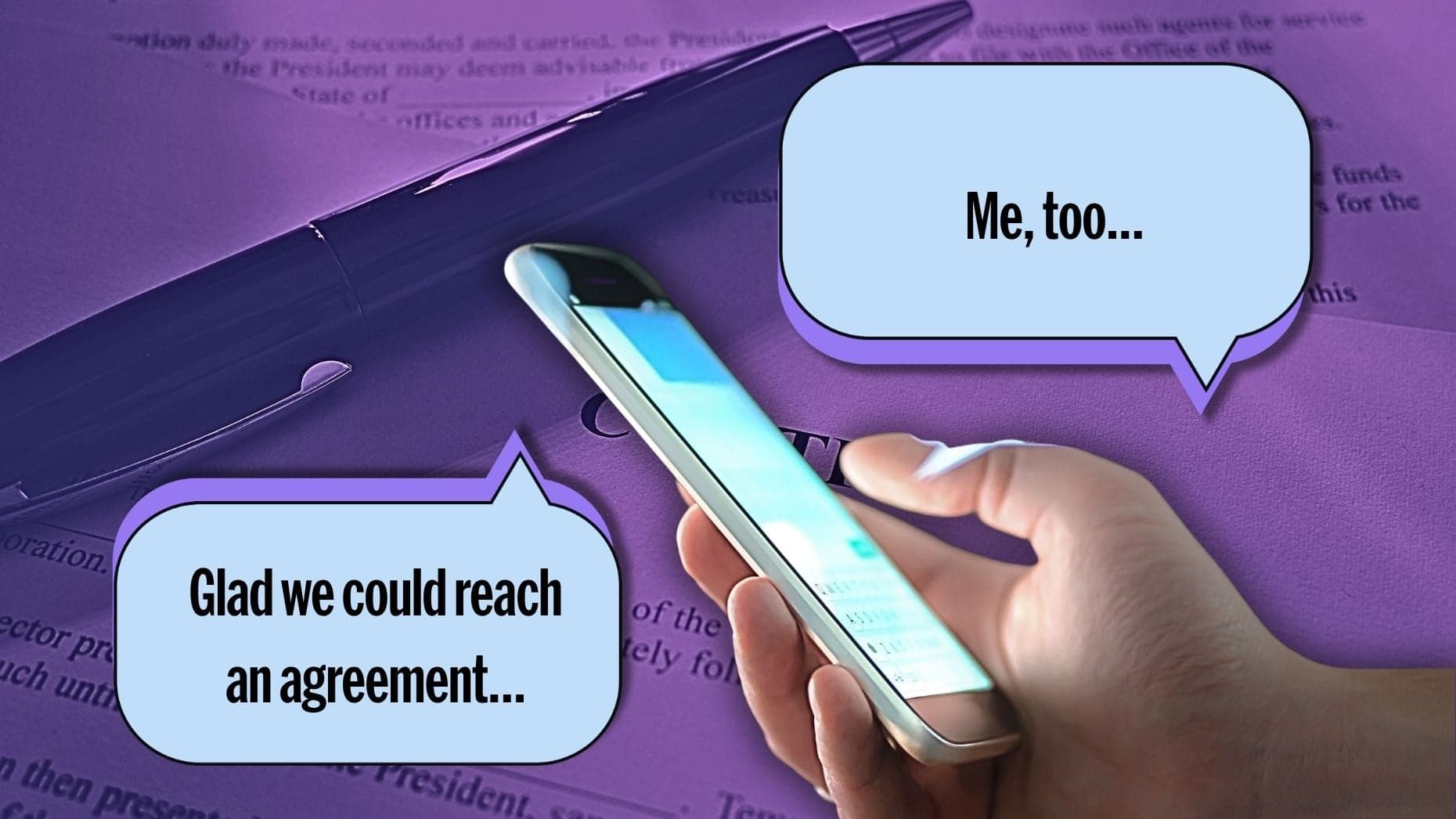
When "Sure, Deal" Becomes a $2.8 Million Mistake
Most people think contracts require formal documents, signatures, lawyers, and notaries. But in a landmark case that has sent shockwaves through boardrooms and legal departments alike, just two text messages — eight words in total — were enough to create a fully enforceable, binding contract worth $2.8 million. If you use email or text messages for business communication (and who doesn't?), this case should stop you in your tracks and make you rethink how you write every single message you send.
Attorney Kelly Lise Murray has been studying the intersection of digital communication and contract law, and her findings are both eye-opening and deeply practical. The core takeaway: your casual, off-the-cuff texts and emails may already be exposing you to significant legal liability — and you don't even know it.
How Contracts Are Formed: The Legal Basics You Can't Ignore
To understand why a text message can bind you legally, you need to understand the three fundamental elements that courts look for when determining whether a contract exists. These are offer, acceptance, and consideration. Courts do not care whether the agreement was written on a cocktail napkin, spoken over dinner, or tapped out in a 10-second text reply. What they care about is whether these three elements are present — and digital communications satisfy them with alarming ease.
An offer is a clear proposal to do something in exchange for something else. Acceptance is an unambiguous agreement to the terms of that offer. Consideration is the mutual exchange of value — money, services, a promise to act or not act. When you fire off a quick "Sounds good, I'm in" response to a business proposal via text, you may have just checked all three boxes. Courts across the United States and internationally have increasingly upheld text and email-based agreements, citing the Uniform Electronic Transactions Act (UETA) and the Electronic Signatures in Global and National Commerce Act (E-SIGN Act), both of which recognize electronic communications as legally valid.
The $2.8 Million Text: What Actually Happened
In the case that Murray highlights, a business negotiation was conducted largely through informal digital channels. One party sent a short text message outlining terms. The other replied affirmatively. Eight words. Two messages. The court later found that these messages constituted a complete and binding agreement, and the party who tried to back out was ordered to pay $2.8 million in damages. The defense that "it was just a text" did not hold up. The court focused on the content and the intent communicated — not the medium through which it was delivered.
This is not an isolated incident. Courts are increasingly comfortable enforcing agreements made via SMS, WhatsApp, email, and even social media direct messages. The message is clear: the casualness of the medium does not diminish the legal weight of the words.
Why Digital Communication Creates Unique Risks
Several factors make digital communication especially risky from a contract law perspective. First, the speed and informality of texting and email encourages people to respond quickly and without deliberation. Second, because these communications are automatically timestamped and stored, they create a perfect evidentiary record that courts find highly reliable. Third, autocorrect and shorthand responses ("k," "yes," "done," "agreed") can look like unambiguous acceptance even when you meant something more conditional or tentative.
There is also the issue of scope creep. A deal that starts in a formal contract can evolve through subsequent emails and texts, and those later messages can legally modify the original agreement — sometimes in ways that severely disadvantage one party. If you've ever sent an email saying "Actually, let's just do X instead," you may have amended a contract without realizing it.
Five Simple Fixes to Keep Your Messages Contract-Free
Murray's guidance is refreshingly actionable. Rather than telling business professionals to stop using digital communication — an impossible standard in 2024 — she recommends developing a written-communication protocol that signals professionalism while protecting you legally. Here are the five key fixes she recommends:
- Add a standard disclaimer to all informal communications. A line such as "This message is for discussion purposes only and does not constitute a binding agreement" can make your intent explicit. It takes five seconds and can save you millions. Include it in your email signature and train yourself to paste it into texts when discussing business terms.
- Never confirm price, scope, or timeline in a casual message. These three elements — price, scope, and timeline — are the heart of most business contracts. When a conversation turns to any of them, pause and move to a formal written agreement before responding. A quick text reply on any of these points can lock in terms you haven't fully thought through.
- Use conditional language deliberately and consistently. Phrases like "subject to a formal agreement," "pending review by counsel," or "this is not a commitment" signal that negotiations are ongoing. Train yourself to use this language habitually in any digital exchange involving business terms, so it becomes second nature rather than an afterthought.
- Confirm only process, never substance, in real-time messages. It is perfectly fine to use texts and quick emails to schedule meetings, confirm receipt of documents, or arrange logistics. What you want to avoid is using those same casual channels to confirm substantive terms. Keep the operational and the contractual in separate communication lanes.
- Establish a written-communication protocol for your team or organization. Individual discipline matters, but institutional practice matters more. Work with legal counsel to create a simple, one-page guide for how your team handles digital communications involving business negotiations. Train every person who negotiates on behalf of your organization to follow it consistently.
A Professionalism Signal That Also Protects You
Murray makes an astute observation that goes beyond pure legal protection: a clear, disciplined approach to written communication is itself a professional signal. Counterparties and clients notice when you communicate with care. It suggests that you are organized, deliberate, and serious — qualities that build trust and win business. The lawyer or executive who always follows up a verbal agreement with a clear, structured written summary is not just being cautious; they are demonstrating a level of competence that sets them apart.
In a world where everyone is communicating faster and more casually than ever before, the professional who communicates with precision and intentionality stands out immediately. Your written-communication protocol is not a burden; it is a competitive advantage.
The Bottom Line: Every Word You Type Is Evidence
The $2.8 million text message case is a jarring reminder that the law has fully caught up with digital communication — even if our habits have not. Courts will not excuse you because you thought you were just chatting. They will look at your words, evaluate them against established contract law principles, and hold you accountable for what you wrote. The good news is that with five straightforward adjustments to how you communicate, you can dramatically reduce your legal exposure while simultaneously elevating your professional reputation. Start today, before the next message you send becomes the most expensive eight words you've ever typed.