
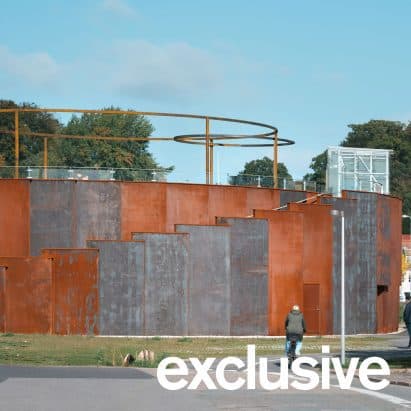
When Infrastructure Becomes Architecture: GinnerupArkitekter's Weathered Steel Pumping Station
Utility buildings rarely earn a second glance. They are, by their very nature, designed to work rather than to impress — tucked behind fences, camouflaged by landscaping, or simply left to blend into their surroundings with minimal architectural ambition. That is precisely what makes GinnerupArkitekter's latest project in Denmark so refreshing. The Danish architecture firm has completed a pumping station that refuses to be ignored, wrapping its functional form in a skin of weathered Corten steel and topping it with a dramatic sawtooth roofline that elevates municipal infrastructure to something genuinely worth looking at.
This project is a compelling reminder that even the most utilitarian structures can benefit from thoughtful design. More importantly, it demonstrates how the choice of materials — and a willingness to let nature participate in the aging process — can transform a building's relationship with its environment over time.
The Power of Weathered Steel in Contemporary Architecture
Corten steel, technically known as weathering steel, has been a favourite among architects and landscape designers for decades. Its defining characteristic is its ability to form a stable, rust-like patina when exposed to the elements — a surface layer that actually protects the underlying steel from further corrosion rather than contributing to structural decay. This means the material demands minimal maintenance while continually evolving in appearance, shifting through warm ochres, burnt oranges, and deep umber browns as the years pass.
For a pumping station — a building type that must endure constant exposure to moisture, ground conditions, and the general wear of an operational environment — weathered steel is not just an aesthetic choice. It is an eminently practical one. GinnerupArkitekter understood this synergy and exploited it fully, allowing the material to speak to both the building's purpose and its long-term life in the landscape.
The use of Corten steel also positions the pumping station within a broader architectural conversation happening across Scandinavia and Northern Europe, where designers are increasingly drawn to materials that acknowledge the passage of time rather than resist it. Buildings clad in weathering steel carry a kind of honest durability — they look as though they belong to the earth, stained by it, shaped by climate and season in ways that glass and polished concrete never can be.
The Sawtooth Roofline: Form Follows Function, Beautifully
Beyond the material cladding, the most visually striking element of GinnerupArkitekter's pumping station is its sawtooth roof profile. Historically associated with factory and industrial buildings from the nineteenth and early twentieth centuries, the sawtooth silhouette was originally engineered to maximise natural light inside large working spaces by incorporating north-facing glazed panels along each ridge. It is a form born entirely from practical necessity — and yet it is one of the most architecturally compelling profiles in the industrial canon.
By applying this roofline to a contemporary pumping station, GinnerupArkitekter makes a deliberate reference to the heritage of industrial architecture while firmly situating the building in the present. The repeated angular peaks create a rhythmic, almost musical skyline that reads boldly against the flat Danish landscape. Combined with the textured warmth of the Corten cladding, the silhouette gives the building a sculptural quality that far exceeds what might be expected of a structure whose primary job is to manage water.
The sawtooth form also performs a practical role in breaking down what could otherwise be an oppressively monolithic volume. By fragmenting the roofline into a series of ascending and descending planes, the architects give the building visual complexity and scale, making it feel considered rather than simply constructed.
Architecture in Context: Responding to the Danish Landscape
Denmark's landscape is characterised by open skies, agricultural flatness, and a coastal light that shifts dramatically with the seasons. Designing a building to sit meaningfully within this context requires sensitivity to scale, material, and tone. A pumping station clad in reflective metal or pale masonry might disappear into an overcast sky or jar against the earthy greens and browns of the surrounding terrain. Weathered steel, by contrast, echoes the colours of ploughed fields, autumn reeds, and rusted farm equipment — it belongs.
GinnerupArkitekter's approach reflects a wider tendency in Danish architecture to pursue what might be called a quiet confidence: buildings that do not shout for attention but reward those who look closely. The pumping station is visible and distinctive, but it does not impose. It occupies its site with a kind of grounded self-assurance, as though it has always been there — or always was meant to be.
GinnerupArkitekter: A Firm with an Eye for the Overlooked
Based in Denmark, GinnerupArkitekter has built a reputation for bringing genuine architectural care to building types that are too often treated as afterthoughts. Their portfolio demonstrates a consistent interest in the intersection of function and beauty, particularly within civic, public, and infrastructure contexts where budgets are constrained and ambitions are often modest by default.
With this pumping station, the firm adds another example to a growing body of work that argues persuasively for the value of design investment in infrastructure. When a water management facility becomes a local landmark — something that residents orient themselves by, that photographers seek out, that other architects reference — the return on that investment extends far beyond the purely practical.
Why Architectural Infrastructure Design Matters
Projects like this pumping station raise a question worth sitting with: how many of the functional buildings that shape our daily environments could be significantly better with relatively modest shifts in design ambition? Substations, treatment facilities, water towers, storage depots — these structures are woven into every landscape, urban and rural alike. Most are invisible by design, built to disappear. A small number, conceived by architects who believe that function and beauty need not be mutually exclusive, become something more.
- Weathered steel provides a low-maintenance, visually dynamic cladding solution that improves over time rather than degrading.
- The sawtooth roof references industrial heritage while providing an immediately recognisable and architecturally distinctive silhouette.
- Thoughtful material and form choices allow even utilitarian buildings to contribute positively to the character of their surrounding landscape.
- Danish architecture continues to demonstrate that restraint and ambition are not opposites — a building can be quiet and still be extraordinary.
GinnerupArkitekter's weathered steel pumping station in Denmark is, at its core, a water infrastructure building. But it is also proof that the decision to design something well — to bring genuine thought to material, silhouette, and context — transforms a structure from mere function into an enduring piece of the built environment. In a world where infrastructure spending is often enormous and architectural quality within that spending is often minimal, this project stands as a small but significant argument for doing things differently.
Conclusion: A New Benchmark for Infrastructure Architecture
The sawtooth pumping station by GinnerupArkitekter deserves attention not simply because it looks striking — though it undeniably does — but because of what it represents. It is evidence that even the most prosaic briefs can yield remarkable outcomes when approached with care, material intelligence, and a genuine belief that every building, however functional its purpose, has the potential to enrich the landscape it inhabits. As cities and municipalities around the world grapple with aging infrastructure and the need for significant new investment in water, energy, and utility systems, this Danish project offers a quietly radical proposition: that infrastructure can be beautiful, and that making it so is worth the effort.